Goodbye Uncle Harry

Growing up, my maternal grandfather was seldom seen in the congregation of the church, he was always at the back “helping out” Uncle Harry.  I grew up knowing Uncle Harry as Uncle Joe, then others called him Harry, when I asked my grandfather about it he said that he is Harry Joe!  You never question wisdom like that!

Uncle Harry would be there to open the church, he’d be there to close the church, he was the man to go to to get your weekly Catholic Standard, or the tickets for the next Festival of Carols.  He would hand out the collection baskets to the people who would be needing them for each mass, and he’d have Bibles, Hymnals and other little books on sale too.

He was as grumpy as he was jovial.  He was a New Year baby, born on the 1st of January, worked for many years at Banks DIH, from all the way back when it was known as D’Aguiar’s, and he worked at the Cathedral of the Immaculate Conception for as long as my memory serves, up until he was retired a few years ago.

After retirement from his duties in the church he’d try to attend either the early morning 6:00 am mass, or the next one at 7:30 am on Sundays, rain or shine, in his long pants, dress shoes, shirt-jac, umbrella, hat and his spectacle case and pen in his top pocket.

He died on Sunday 17th March 2013, St Patrick’s Day, at around 2am; it was his time.  May his Soul Rest in Peace.

I had taken that photograph of him (candidly) two days before my own birthday in 2011, and he was sitting there staring towards this altar below:


2013 Deck – Week 03

Although I like to think of myself as a photographer who likes to take Landscape photos, there is not a lot of scope for that living in the city, but I’ve always had an interest in capturing images of buildings, especially old ones that may not survive due to neglect or just continued development (or any number of other reasons)

During the third week of the year, I had an inexplicable desire to take some photos of St Rose’s High School, just before attending a presentation by Hew Locke (an artist with some amazing work), Nikhil and I took a walk around the block, and I got my chance to take a few images.

To emphasize the building more, I used an “orange filter” setting whilst processing, this darkened the sky and made the building more pronounced.  Although I did not intend to combine “street photography” into it these two boys strolled past just as we were there.

As always, click on the image to see it in the Gallery


Working With Wides

Well, I wanted to say “Playing with a Wide-angle Lens”, but I couldn’t resist the alliteration. 🙂

The word wide is relative, so I’ll describe how I use the terms, these are probably not industry accepted descriptions, so don’t quote me 🙂   Your basic entry-level DSLR usually comes with a kit lens that has a range of focal lengths from 18mm to 55mm, this I consider to be a wide telephoto lens, at the widest end (18mm) you get a nice wide view and at 55mm you get closer to close up of the subject, I consider somewhere around 33mm (on the crop-sensors) to be somewhere around “normal” (mind you, I’ll be talking from the stand-point of an APS-C sensor or crop sensor, a full frame or micro-four-thirds is an entirely different scenario)

Since this is the standard kit lens that most people get, we don’t often see it as wide, so that’s when we go Ultra-wide.

My favourite wide-angle lens (OK, the only one I have in the Ultra-wide category) is the Sigma 10-20mm, this produces pleasing images for me, and I love working with it.  You get some amount of distortion at the wider end (understandable) but this tends to be good in certain circumstances.

Often, in architectural photography, you can use wides and ultra-wides to capture more of the interior, and convey more of the sense of space and more of what encompasses the room.

At other times, you can use them closer to the subject to give an increased sense of distance, even accentuate the distortion by being close (do this with people’s faces, and you’ll get some weird effects)

I used the ultra-wide to capture the corner of this building (New Building Society), along with parts of the sidewalk and sky (and a pedestrian) 🙂

There are many things you can do with a wide, many of which I don’t do, I don’t normally put it right up to people’s faces and click, but I’ve seen those photos, and it’s a neat effect  🙂

What I did in this next image was to use the ultra-wide to adjust the sense of scale, I used a fire-hydrant in the foreground to dwarf a three-story building in the background.  One thing that I liked about this shot was that I didn’t have to worry about electricity wires!

The best way to see what your wide-angle lens or your ultra-wide angle lens can do is to put it on the camera and go have fun.  Sometimes it makes compositions tricky as it tends to include everything, even things you may not want, but like working with any focal-length, it’s up to the photographer to adjust framing and composition for these things.

I mentioned using wide-angle lenses for interior architecture, well I doubt if a tent falls under the category of architecture, but I suspect the engineers who came up with the idea for this tent would appreciate the use of the wide-angle for impact  🙂  And would you look at the view!  🙂


All images above were shot with the Sigma 10-20mm on a Canon body, Click on the images to see them in the Collection along with others in their respective Galleries.


Variety and Diversity

I processed this photo yesterday after having the pixels just sit there for a year, and I wondered at the diversity of materials used in the construction and the “architecture”.  This morning I caught a snippet of Jon Stewart on the Daily Show speaking about the Diversity in the Democratic Party (funny stuff!), and I wondered at the coincidence of my thoughts on a building and his thoughts on a political party.

Growing up in Guyana, I never felt “race” play a part in my life until in my teens, before that it was always that we were different people, individually, not as a “class” or a “race”.  What happened when I was a teenager?  I learnt about politics and the struggles of the main political parties vying for power and each using the “race” card for their own ends regardless of what it did to the youth and the future of the country.

You can build a house entirely out of wood, you can build it entirely out of concrete, you can build it out of any one substance you feel like, it may or may not stand up to the elements (just imagine a real Gingerbread house in the rainforest! And no offence to the Igloos of the arctic and antarctic), but I’ve found that a good architect/contractor can take a variety of materials and produce not just a shelter from the rain, but a thing of beauty to “live” in, just as a good leader can make the best of the talents, varying and diverse, of the people who place their trust in him.

Click on the Image above for a better view in the Gallery, along with other images in the “Out and About” collection.

A Windowed View

When the new owners of the Central Garage building began their renovation works, I asked permission to take a few photographs inside the building and also from the roof.  Although I took quite a few, this one always nagged at the back of my mind (I’ve yet to process that set completely).

The front of the building was windowed in sections, and at the time of my visit the windows and their frames had been removed from the eastern wall, this wall has now been remodelled and houses large glass panels, so the view may be similar  🙂

I had originally thought that the new owners would remove the old building and replace it, but they chose to retain the existing steel structure, remove and replace the old wooden and asbestos outer walls.  Although they changed more of the facade than I’d have wished, they retained more of the original building than was expected  🙂

This view shows mainly City Hall, which itself is in danger of crumbling, you can also see part of the ACME building, and part of the Victoria Law Courts.  I liked the contrast between the darker interior of the building and the brightly lit City, framed by windowless orifices.

Please click on the image for a better view in the Gallery, this Gallery also holds other photos from around Georgetown, Guyana.

2012 Deck – Week 21

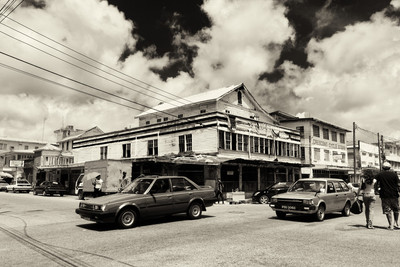
Georgetown is changing, every day; some may say it is for the better, newer buildings, more businesses, a boost to the economy, others look at it as a neglect of the traditional, our history, our heritage and, ultimately, our past.

While others countries, even other Caribbean nations, strive to preserve and maintain the “Heritage” buildings, our politicians can’t seem to grasp the idea of Tourism generated by the longing to see just such buildings, they apparently think that tourists come here just to see the Kaieteur Falls.

Although my photograph for this week is not one of the exalted buildings, I think the point can be made that there are many buildings worthy of being preserved, saved and cherished.

There is a Heritage Building Corridor that runs through the heart of historic Georgetown, it stretches from the head of High Street where the building that houses the Canadian High Commission marks the first notable Historic building, and stretches down through Main street and into Avenue of the Republic where the Parliament buildings and Saint Stanislaus’ College mark the end of the designated corridor.

Among the numerous buildings in the corridor are the Prime Minister’s Ressidence, Red House, City Hall, the Demerara Mutual building, City Hall, Cameron and Shepherd, The Victorian Law (High) Court and St Andrew’s Kirk.  The National Trust of Guyana has earmarked twenty-four sites along the corridor as Heritage sites.  Some are kept in good condition, whilst others are falling steadily into disrepair.

This photograph is of a junction off the corridor, and while it may not be a historically important building, or of architectural value, it shows that many buildings are ageing, and unlike rum, some of which are said to be “aged to perfection”, this one has passed its prime, and is definitely somewhere the other side of perfection 🙂

Old(er)

Age is a relative thing, something (or someone) is either younger (or newer) or older than another by a certain amount of time, whether it is by minutes, days, years, decades, centuries, etc.

I’ve grown up knowing the Hand-in-Hand Insurance Building (and others of its time) and they’ve become landmarks to me, that makes them old, or older than the stuff that went up in the last decade anyway.

They may not be of the Victorian era, so their architectural aesthetics may be less appealing, but they are certainly a lot more appealing than many of the concrete boxes that are being erected these days.

The Hand-in-Hand building always reminded me of a concrete and stone attempt to look Victorian, or maybe semi-Greco-Roman, but I’m not an architect and my terms may be far off the mark.

I had always admired its arches, the wrought-iron fence, the wrought-iron “fret-work” that created the arches between the columns, the low-sprawling style of the building.

When I took this photo I never intended to process it in Sepia tone, yet that is what appealed to me when I began processing, and to help the age along a bit, I added a light vignette (hopefully not too noticeable)

So this building is Newer than Victorian, but probably older than I am 🙂

Hand-in-Hand – 7216

2012 Deck – Week 11

I try not to do single image HDRs, that is, using a single exposure and tone-mapping it for greater detail throughout the scene, but sometimes I can never quite seem to get the processing on an image quite right in colour, and sometimes its an image that I would prefer not to use as a monochrome, so then I tone-map it in an HDR software to bring out that detail that I know is there.

This photo is of the Moravian Church in Queenstown, Guyana.  It is more than a hundred years old.

It stands at the junction of Anira Street and New Garden Street, and there are utility posts and wires on two sides of it, I composed this to minimise the effect of those wires.

Queenstown Moravian Church

2012 Deck – Week 8

Although Mashramani fell in the eight week of the year, I did not necessarily want to use a photograph from that event, fortunately I had gone on a walk with Nikhil around St George’s Cathedral and I had tried out an HDR, although it has some issues, I rather liked the outcome.

I was a mere four feet from the door, but other than standing in mid-air to get the shot, this was my only option.  Although I did some correcting to the distortion caused by the Sigma 10-20mm lens (and the close proximity to the subject), I still got some distortion that I couldn’t get rid of.

My aim with this HDR, was to get the doorway, but also to get as much detail on the inside that I could.  Nikhil wanted to go and adjust the mat, but I thought that the angle that it was at worked fine for me.

Oh, and as usual, I neglected to lug the tripod with me, so this was handheld.

Looking In

2011 Deck – Week 32

Another symmetry inspired image, or a Nikhil inspired image 🙂  I’ve seen Nikhil shoot this particular spot a few times already, but I never tried it, mainly because I wasn’t “seeing” anything that captured me, this week was a slow week, I only got out one day to take anything, and this day I forced myself to shoot something, if not I’d have had to post an image from a recent wedding I attended, and I didn’t want to have to rely on that 🙂

This is the side of the Ocean View Hotel facing the seawall, the salt air can be seen taking it’s toll on the iron-work, and the rust staining the face of the wall.  This particular afternoon I was going for something simple, I tried a boat, some silhouettes, just the plain old sea and sky, but I kept going back to this image for a second look.  Although I was tempted to go for a monochromatic image I liked the red iron structure and the rust-stains, so I kept it in colour. also the discolouration on the walls added to the warm afternoon sunlight 🙂

As usual, click on the image for a better view in the Gallery.

Escape
Escape