Photography; I shoot what I like, and sometimes people like what I shoot. All photos are copyright to Michael C. Lam unless explicitly stated otherwise.
I had just decided to upload this, and then I gave it a title… Giving it a title brought forth a torrent of emotion. Yesterday I said farewell to my sister-in-law and niece, Areza and Ariel, and in a few months I will be saying the same to my brother André. They have lived at Ogle for all of Ariel’s life and as soon as I titled that image “Sunset at Ogle” I realized that their family is having their sunset at ogle all too soon.
Ariel is my first niece, Areza is my first sister-in-law, André is my first brother, it is strange how those things happen. My parental family may not be the perfect family, but we grew up together, had and have our differences, but at day’s end we are family. I count myself fortunate, in that my brothers and sisters are not just my siblings, they have grown to be my friends, André and Nicholas are the closest of these, but that’s because we grew up like the Three Musketeers, inseparable, always fighting, always in mischief.
If you click on the image and see it at the site slightly larger, you’ll see three figures walking towards the sunset, two adults and a child. Serendipity. This photograph is not of them, but I dedicate it to them, as the sun sets on Ogle.
This week was a poor week for photography for me, didn’t take too many photographs 🙂
The deck photo is not the best photo that I’ve taken all week, but it is unusual for me, so that’s the reason for its choice. Aesthetically, it may not be pleasing to everyone, or as we say, not everyone’s “cup of tea”. I went to accompany Nikhil again, and not having too much time, we took a short visit to the Promenade Gardens again. I wasn’t in the mood for photography, but Nikhil said I couldn’t go and not take something, so after shooting a few things; a flower here a leaf there, I followed him to a spot where he would eventually get his photo of the day for his 365 Project, and the sun coming through the fabric of some leaves caught my eye.
When I put the camera to my eye, there was a spectrum of colours in the light rays that showed in the viewfinder and I was just hopeful that it would also appear that way when I snapped the photograph, to be sure I tried a few different exposures. When peering through th eyepiece of the camera directly into the light it does appear more vibrant, but I think I caught the nice effect that grabbed my attention in the first place.
Padma or Lotus, a flower native to India has spread throughout the waterways of the world. This is the Lotus Flower, scientific name Nelumbo nucifera, a flower that I grew up thinking was a water-lily, until I was recently corrected. Water lilies come in a variety of colours, but the Lotus is only found in tones of pink and white, the petals that is, the central seed pod is yellow when the flower is in bloom.
The flower is supported by a very thick stem that elevates it above the water and the leaves, the leaves are very large and though are sometimes seen above the waterline, they generally float on the water. It is hard to walk the length of Guyana’s coastline without seeing ponds or other waterways (yes, the trenches and canals) filled with these flowers. With a strong Hindu culture, these flowers / plants are a part and parcel of the Guyanese heritage.
These are often used decoratively, as live plants for their colour and size and even as dried arrangements, especially in the case of the central seed pod (which resembles a watering can) which is the part most often used in dry arrangements, I seem to remember seeing it painted gold in a dry arrangement once when I was a child. In Guyana (and parts of Suriname and Trinidad) the tradition of using the leaf at functions is very common, this too is a tradition handed down through the Hindu religion brought from the far east.
Across the coastal regions of Guyana there is not a weekend that goes by without a Hindu Wedding or Jhandi, at both functions there is the traditional Hindu ceremonies conducted by a Pandit and when the time comes for the sharing of the meal, it is served in a leaf from the Lotus plant.
Jhandi actually means flag, but has come to refer to the ceremony that culminates in the planting of that flag, the ceremony is an offering of thanksgiving to Hanuman (a Hindu deity). Over the years both Nikhil and I have taken photographs that either include or centre on the Jhandi flag.
This highpoint for us non-Hindus at the Weddings and Jhandi ceremonies is usually the meal eaten in the Lotus leaf, notably the “Seven Curry” , where rice is served with seven forms of “curry” dishes (and achar, don’t forget the achar!). Before some of you get excited, its vegetarian, no meat. Usually there’s Aloo (potato) curry, Dhaal, Mango curry, Channa (Garbonzo or Chickpea) curry, Catahar (breadnut) curry, Bajee (Calaloo or spinach) curry and Pumpkin curry. When catahar is not available the breadfruit curry is usually a good substitute and sometimes the Potato and Channa are a combined curry. This is usually washed down with a cool drink, like Kool-aid or swank (lemonade or lime-aid :-). Of course, most of us don’t like to hear “Kool-aid” since it brings to mind images of Jonestown, so we can now use Mak-C 🙂
A fascinating plant, and there probably isn’t a Guyanese who owns a camera who hasn’t taken at least one photograph of it.
I never thought that so many people would like my monochrome photographs, but it turns out that many family members and friends like them. Over the last few years of taking photographs, I have come to realize that some photographs just render better in one monochromatic form or another than in colour. Most of the time when I post a monochrome photograph it was intended that way from when I pressed the shutter button, but sometimes the coloured version just does not do the scene justice and rendering it in black and white or another form of monochrome like sepia, usually brings out more tonal differentiation and character from the image.
When I used the Canon PowerShot S5, there was a dedicated mode for these types of photographs, and I used it rather than converting after, mainly because, as I have mentioned, I take certain scenes with the full intention of them being black and white or sepia. When I moved on to an SLR, the Canon Digital Rebel T1i does not have that feature, which is probably a good thing 🙂 Using RAW mode shooting I have found that I get a lot more processing ability, some people call this editing, but I look at it as getting more out of the photograph, the information is there, I’m not adding or removing, just revealing.
Of the four monochromes below, only two were intended as monochromes, the other two just rendered better that way 🙂 Click on them to see them at the site.
Although not a true sepia, I put this one in that category because, well, I had nowhere else to put it I suppose. I used one of those Lightroom presets and did some exposure and fill light adjustments.
Alexander Street, Bourda
This building I will have to revisit another day, there were just way too many vehicles around for a nice wider shot, but the building intrigued me enough that I think this worth posting up.
Camp and Charlotte Streets, Georgetown, Guyana.
Some things attract your attention and trying to convey that in a photograph can be… difficult, at least for me. This bird was “riding the waves”, standing on that branch and just bobbing and weaving with the rise and fall of the incoming waves.
Riding the Waves
And finally, this scene I had done in a previous post on Georgetown, Guyana. It is a familiar scene to anyone who has driven along the Clive Lloyd Drive, its been there since I was a little boy, a quaint little cottage amidst some palm trees, while the previous photograph was in colour, this one was taken with the monochrome idea and the result was quite nice.
Have I been taking numerous photos of buildings recently? Yes I have, and it’s all Nikhil’s fault! As usually happens, when we take a walk, it’s usually centred around a small area in Georgetown, and what else is there to photograph in Georgetown except buildings? Maybe some trash on the road-corner, but that’s not my style of photography (well, not yet anyway).
Georgetown has a very wide array of “architectural styles”, so you can often go around one city block and come back with a nice diverse set of photographs, while I may photograph the entire structure most times, it is usually a combination of the smaller features that really draw my attention.
Combinations of both wooden and concrete portions are somewhat common to see these days, usually because of “additions” to the original structure, but sometimes it is a deliberate architectural decision.
Even buildings constructed with one type of base material have very appealing little characteristics sometimes. Something I don’t see too often these days is the use of shingles, especially on the walls of a building, quite interesting to see that, especially when you’ve grown up in either wooden houses (with tongue and groove wood walls) or in concrete boxes with louvre windows like I did.
This blog-post is going to be particularly shot on words, but heavy on the photographs. I have six photographs of buildings that I wanted to include in this post, all taken in Georgetown, some from the wards of Bourda and Queenstown and one from the Kitty area, on Clive Lloyd Drive.
I am not sure how many residents of Georgetown (much less Guyanese) know where Clive Lloyd Drive is. It’s that little stretch of road from Vlissengen Road to Sheriff Street running along the Seawall, I think that it becomes the Rupert Craig Highway at Sheriff Street.
Now that I have filled up the space between these two photographs with words, I can now go on to show you the other photographs 🙂 Two are of the “Open Bible Church”, whose “building” is for sale, so it’s not likely to be there for much longer. One of my goals is to try to photograph some of the more interesting buildings around town before they disappear, and are forgotten. I have an open list, so feel free to send suggestions, and no, the concrete box with the louvre windows is not that photogenic, seriously!
Open Bible Church, Oronoque and Lamaha StreetsQueenstown, GeorgetownOpen Bible Church, Frontal viewThe Cottage - Clive Lloyd Drive
This particular HDR image needs an explanation, so here it is (well, maybe it doesn’t need one, but you’re going to get it anyway. I went up to Good Hope on the East Coast of Demerara to pick up my family who were visiting with my in-laws for the day, after saying my hellos and pleasantries, I wandered back to the front of the yard and saw this amazing sky, I wanted to capture it as soon as I could.
A few things contributed to this being almost impossible, it was already getting dark and I did not have my tripod with me, and I wanted to get this in HDR, a standard shot just wouldn’t convey the sky that I was seeing, from ground level it was great, but the view of the sky with just the houses in front of me wasn’t appealing, so I ran upstairs with my camera. I quickly set the camera for my multiple exposures and proceeded to snap the shots, but the first thing I noticed was that the place was so dark I ended up with longer exposures than I intended. MY “normal shot was a half second, the underexposed one was one-eight of a second and the over-exposed shot was two seconds, all hand-held. and then when I reviewed the images I notices a “fogginess” in the image, when I checked the lens there was a lot of condensation on it, I figured this was disastrous, the images would be totally spoiled under that combination of conditions.
When I downloaded the images I thought that I couldn’t get anything useful out of them, they were all blue, exposure was “iffy” and I wasn’t even sure that it was worth trying. But I thought, I went to all that trouble (and exercise, running up those stairs was serious cardiovascular for a desk-jockey) I should see what the HDR software could make of it. My first combination wasn’t too promising, but after adjusting some settings, I liked the resulting image, the colour was terrible though, so I though that even though it was not what I intended, this could very well work out to be my second Black and White HDR, I had done one before that actually made it into The Editor’s Collection – Best of HDRs at Webshots.com, if you can’t spot my image its Orinduik Falls Black and White, I am rather proud of that achievement, small though it may be.
All that being said, after I used Nik Silver Effects to do my Black and White conversion using some high structure, I liked the outcome and decided that I liked it enough to share it. 🙂
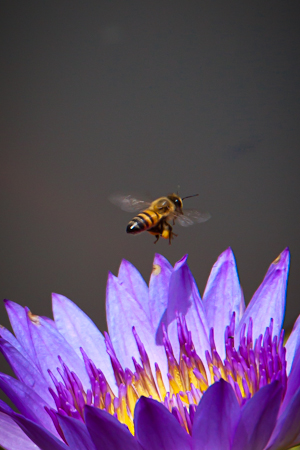
On one of those midday walks with Nikhil, while he was experimenting with his IR filter and generally trying to get his photo for the 365 Project that he is undertaking, I spent some time trying to get this photograph…
The problem? That darn bee 🙂 although I took lots more photographs of houses or parts of houses this last week, I liked this shot for the Deck, maybe because I spent so much time trying to get it, maybe because I already have too many photos of buildings, maybe because, of the candidates for this week’s choice of photograph, this was one of the few that were still processed as colour and not monochrome 🙂
This was taken at The Seven Ponds, a monument in the Botanical Gardens, so many things around to photograph and I spent loads of minutes on this 🙂
As a small photograph and, worst yet, as a thumbnail, it’s a photograph of a flower, water-lily, some large leaves… my particular interest in the photograph was the insect, the busy bee… so just to show you what it was that REALLY interested me… I’ve included the following enlargement 🙂
If only I had a longer lens, or that flower was closer to the edge of the pond 🙂
Everyone leaves a mark in this world, everyone, without exception. They may be remembered by one or my many, for good or for bad, but they are remembered. At least, that is what I like to believe, in time we will be eventually forgotten, but just for a moment, we leave a mark upon the lives of others, these are the moments that matter.
Aunt Yvette always referred to me as Comrade Hinds, no doubt referring to someone else she remembered working in this building. Many may have called her a beggar, but she always asked very nicely if we could “support local”. And there were many a time when after giving her what we had, she would return at a later time with gifts for us; a comb, perfume, hand-sanitizer, a myriad of things. While I may not be able to cherish any of her gifts, I cherish the memories.
She sat on the pavements or on our door-stoop, when she walked it was in an almost completely doubled-over posture, apparently a combination of age and health issues, although I had heard rumour of an accident that left her so. She is reputed to have been a school teacher in her younger days, she certainly had an artistic flair, evidenced in her drawing, she sewed her own clothes and even did some crochet. She was an avid reader, many times collecting old magazines from us, and she loved to do Word-Find puzzles. She also carried on lengthy and complicated conversations with person (or persons) whom only she could see, always an entertaining event.
This was the only photograph I remember taking of her, I am sorry I never took more.
She was apparently in the compound of the Sol Service Station on Regent Street yesterday when she was struck by a vehicle and died, another victim of reckless driving. Maybe the driver did not see her in her bent over position, but then it could have been a child he hit if that is his excuse. I don’t know how many people’s lives she has touched through the years, but she touched mine and she will be remembered.
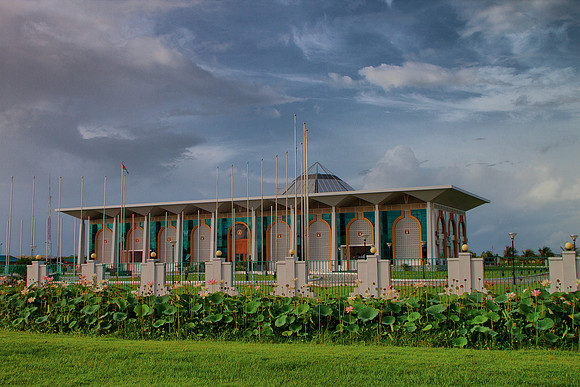
On Saturday, I had to take the vehicle to the mechanic for a strange “shuddering” that was making driving a bit nauseating, I get motion-sick it seems. Synchronizing for someone to collect me from the mechanic was not too easy, especially as I seem to make an earlier start than most folks I know. So, instead of waiting around outside the mechanic shop, I decided to start walking towards town, and get picked up on the way. It was one of those times that opportunity knocks, the sky over the Conference Centre at Liliendaal was very nice and I looked at the whole scene for a minute and finally decided to try a HDR of it.
After taking two sets of three exposures I continued my walk, I have other photos from the walk, but this post is abut the HDR, so that is the only one I will link to for now.
As most photographers, whether hobbyists or professional, have discovered (sometimes the hard way), it is important to always have your camera with you, you just never know when opportunity will knock.
International Conference Centre, Liliendaal, Guyana.



 The Michael Lam Collection's Blog