Photography; I shoot what I like, and sometimes people like what I shoot. All photos are copyright to Michael C. Lam unless explicitly stated otherwise.
OK, most trees branch, I know. But I had a difficult time coming up with a title for the photo, and this one seemed appropriate somehow.
This is a tree on the northern side of The National Park, towards the Carifesta Avenue side. It possibly fell and continued to grow, growing across the waterway and then branching upwards and out. It creates a nice shady area, on this overcast day, there was very little light under the tree’s canopy, and I thought that an HDR would be a nice idea, I didn’t have my tripod with me, so I had to hand-hold the camera for the exposures. The re-alignment didn’t come out spot-on, but it has a softness to the image that I liked.
I’ve had this one since last September to process and finally got around to it, I did no pre-processing in Lightroom, simply carried it into HDR Efex Pro and did the merging there, then a slight crop and rotate in Lightroom, then some saturation shifts and clarity adjustments to finish it off.
It is not a spectacular HDR, but it was geared towards revealing more detail in a very gloomy area 🙂
This week sees a continuation of the monochromatic trend of late, but instead of just a straight BW, I went for a sepia with a vignette. It was on one of those walks with Nikhil, while looking for his Photo for his 365, and even though these waterways have been done, and over-done, I thought I’d give it a try, with the over-cast sky and perpetuating gloom of the afternoon this was pre-destined to be a monochromatic photograph.
After minimal processing in Lightroom, I did the monochromatic rendition in Nik Silver Efex, it came out rather nicely.
I am pretty much disappointed with this week’s photographs, I have one of my wife that I thought was a great shot and was very tempted to put as the photo for this week’s Deck entry, but she would never forgive me if I did, so I had to settle for this one.
I intentionally took multiple exposures most of this week because I intended to do some more HDR attempts, but this one didn’t come out as expected. For some reason my alignment was all wrong and there’s quite a bit of haloing as a result. I did intend a BW HDR, so this I used as much to my advantage as possible.
I did the HDR merging in Nik HDR Efex Pro, and also added a vignette to it there. The final touches were added in Lightroom using a BW POP preset I got from Eric Kim, who does really great Street Photography, I hope he doesn’t mind that I used it for something other that Street Photography 🙂
I rather liked the lone tree and it’s reflection, so that’s why this was my choice this week.
There’s an old Koker (or sluice) on Camp Road outside of the Guyana Technical Institute that I have been keeping an eye on for months, I always want to stop and photograph it, but most times there are some homeless men or just loafers around it, then at other times, the scene just wasn’t appealing to me. I was accompanying Nikhil as he headed up to David Street to photograph a scene his wife had pointed out to him when I noticed the lighting and the overall scene and asked him to stop so that I could get it at least this once.
I was a bit pressed for time this week, I haven’t processed any of my other images for the week, I took the easy route and did some minor “light” editing in Oloneo for this week’s image.
Oloneo just extended their current Beta version of their software to December, and I remembered that I had wanted to experiment with a single image in their software and see what lighting possibilities there were, so this week I chose a photograph that I had wanted to do some minor lighting adjustments and colour saturations to. As Oloneo can work directly with the RAW file I actually got quite a lot of noise in the process, and I then used some noise reduction before uploading.
As a stand-alone RAW processor it is not bad at all, nowhere close to Lightroom, but then nothing is. I like the slider controls and I would recommend it for HDR work, and if you like experimenting, it has a unique “Relighting” HDR feature, for controlled shooting conditions, check out their site if you get the chance.
I only took 86 photos this week, but for the small number I had a slightly hard time choosing one, I think it is just because of my experimenting in Oloneo that I chose this one 🙂
This was taken at Diamond (village) on the East Bank of Demerara, the cane fields are in bloom, the sun was about to go into its daily descent for sunset and some of the clouds were reflecting the sun’s glow nicely. Oloneo stripped out the EXIF information from the file, I hope they fix that in the final version.
So, I’m figuring that if it’s not a photograph for The Deck, or something thematic like Monochromes, what do I do with the photographs? Nikhil came up with a brilliant idea for his blog, he started a weekly review of his photos for his 365 Project. That gave me an idea for these photographs that don’t fit into my regular type of blog post, here’s the ones that did not make it onto The Deck 🙂
First up is this image taken in the Gardens, I was off to get the photograph of the Kissing Bridge when I found this corner of the bridge interesting, so I shot it, I still can’t quite put my finger on the reason it interests me, it just does, so I tried my best to frame it right and get a decent photograph of it.
Corner column, Kissing Bridge, Botanical Gardens
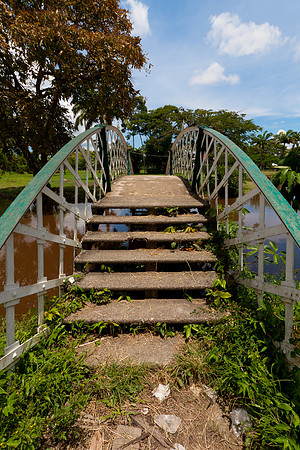
Then, of course, there is the bridge itself! Although I preferred the one I used that week for the deck which was in Black and White, I did take one in portrait orientation that I quite liked as well, so I dropped that one into my “Georgetown,Guyana” album, and here it is 🙂
The Kissing Bridge, Botanical Gardens
I used to take a lot of photographs of flowers, that was when I shot with a Canon PowerShot S3 and S5, it seems that since I moved onto an SLR my focus has changed (excuse the pun), but every once in a while I still catch one in my viewfinder and get a fairly decent shot of it, like this one I saw on Brickdam.
Yellow on Green
And then, of course, there’s one of my favourite areas to photograph things, the Seawall. I often just thought of the seawall as just the Georgetown Seawall, but it extends along most of our coastline, these two were taken up near the village of Montrose, which is known most for the Starlite Drive-in, although I am not certain when it was exactly the they last showed a movie there.
Greens and BluesKoker Montrose
Well, now that I have gotten that off my chest, I can rest knowing that these have not been ignored 🙂 I hope you enjoy one or more.
I really really thought long and hard for a title for this post, and couldn’t come up with a single thing worth using, so here’s three for the weekend…. Three photos, that is; this is a blog about my photographs after all.
The first is a building that I have had my eye on for some time, I seldom ever see it without a few to several vehicles in front of it, and I didn’t want the vehicles in the photograph, at least not this photograph, I wanted the building. Of course getting a nice composition is challenging, especially with the many wires crisscrossing the street in front of the building. Whenever I saw it nice and clear, the lighting would not be optimal, and whenever the lighting was right, the place was very very busy, well I finally saw it clear and with a nice morning light.
On Waterloo Street, Georgetown, Guyana
It only takes a small rain shower to ensure that pedestrians walk on the roads instead of the pavement, especially on Avenue of the Republic, it probably only rained for about ten minutes the morning I took this, normally I wouldn’t be tempted to take a photograph, but the sun had come out and the colours were popping and it was even evident in the reflections in the water 🙂
Pavement, Avenue of the Republic
Two days ago, Nikhil did a very nice close up shot for his 365 Project, and while I was also captured by the colours of the structures, I decided to wait and see what else about the scene would capture my attention, as it turns out I liked the house and tree more than the structures 🙂 This is also a move away from the norm for me, I usually do proportionate cropping if I crop the image, but in this case I found a square crop to be optimal for the image (that and I really needed to crop out the other buildings on the left without losing some of the elements in the shot)
Hadfield Street and Brumell Place (taken while standing in Louisa Row)
It seems I forgot to mention that all three are in Georgetown, Guyana. Three different days and three very different images of Georgetown 🙂
Padma or Lotus, a flower native to India has spread throughout the waterways of the world. This is the Lotus Flower, scientific name Nelumbo nucifera, a flower that I grew up thinking was a water-lily, until I was recently corrected. Water lilies come in a variety of colours, but the Lotus is only found in tones of pink and white, the petals that is, the central seed pod is yellow when the flower is in bloom.
The flower is supported by a very thick stem that elevates it above the water and the leaves, the leaves are very large and though are sometimes seen above the waterline, they generally float on the water. It is hard to walk the length of Guyana’s coastline without seeing ponds or other waterways (yes, the trenches and canals) filled with these flowers. With a strong Hindu culture, these flowers / plants are a part and parcel of the Guyanese heritage.
These are often used decoratively, as live plants for their colour and size and even as dried arrangements, especially in the case of the central seed pod (which resembles a watering can) which is the part most often used in dry arrangements, I seem to remember seeing it painted gold in a dry arrangement once when I was a child. In Guyana (and parts of Suriname and Trinidad) the tradition of using the leaf at functions is very common, this too is a tradition handed down through the Hindu religion brought from the far east.
Across the coastal regions of Guyana there is not a weekend that goes by without a Hindu Wedding or Jhandi, at both functions there is the traditional Hindu ceremonies conducted by a Pandit and when the time comes for the sharing of the meal, it is served in a leaf from the Lotus plant.
Jhandi actually means flag, but has come to refer to the ceremony that culminates in the planting of that flag, the ceremony is an offering of thanksgiving to Hanuman (a Hindu deity). Over the years both Nikhil and I have taken photographs that either include or centre on the Jhandi flag.
This highpoint for us non-Hindus at the Weddings and Jhandi ceremonies is usually the meal eaten in the Lotus leaf, notably the “Seven Curry” , where rice is served with seven forms of “curry” dishes (and achar, don’t forget the achar!). Before some of you get excited, its vegetarian, no meat. Usually there’s Aloo (potato) curry, Dhaal, Mango curry, Channa (Garbonzo or Chickpea) curry, Catahar (breadnut) curry, Bajee (Calaloo or spinach) curry and Pumpkin curry. When catahar is not available the breadfruit curry is usually a good substitute and sometimes the Potato and Channa are a combined curry. This is usually washed down with a cool drink, like Kool-aid or swank (lemonade or lime-aid :-). Of course, most of us don’t like to hear “Kool-aid” since it brings to mind images of Jonestown, so we can now use Mak-C 🙂
A fascinating plant, and there probably isn’t a Guyanese who owns a camera who hasn’t taken at least one photograph of it.
On Wednesday last (June 2nd), my friend launched his Blog “Bad Light, Good Light” (http://badlightgoodlight.wordpress.com/2010/06/02/origin-of-a-name/) with a post regarding the origin of the name of his blog. It just happens that the image he used to illustrate the point he was making in the post was one from a walk we went on the day before, and on that walk I took what would become my photo for the 2010 Deck for this week, and it is of the same location as his, although I’ll admit his image had a lot more artistic merit. 🙂
.
I’ve always been told “don’t shoot towards the sun”, and, by and large, this is usually good advice, but there are times when doing just that results in some nicely silhouetted images that have their own appeal. What I particularly liked about this scene was the portion of land to the right with the vegetation and the two boats anchored to the left, these made excellent silhouetted areas that contrasted nicely with the mostly clear sky, the low clouds were nicely “haloed” by the afternoon sun and that pretty much competed the scene for me.
.
I have always been an admirer of paintings by a local artist named V. C. Budhram, his renditions of water ans skies were always impressive, for that reason alone the ripples in the water reminds my of his work. His compositions, of course, were never like this, always more vibrant, full of life, and far more colourful.




 The Michael Lam Collection's Blog