Photography; I shoot what I like, and sometimes people like what I shoot. All photos are copyright to Michael C. Lam unless explicitly stated otherwise.
I still think that some of my favourite photos are from my pre-DSLR days, but that is probably because those were the days of learning about photography… I’m still learning, but at a slower pace 🙂
Since switching to a DSLR, I found that I take less of the images that excited me back then… I take less Macro photos and I take less long exposures in the evening…
I’m sharing one of the those evening ones today,
Rupert Craig Highway, the Green Light you see there is the traffic light at the Conversation Tree junction.
October 22, 2008, 6:02pm | 6s, f/8, ISO 80 | Canon PowerShot S5 IS
Click on the image to see it in the Gallery, along with some other Sunset / Sunrise photos
I recently saw (again) a panorama of Kaieteur that James Broscombe had done, and I remember the one I had done with a Canon PowerShot S5 IS, point and shoot, so I went to look for it and upload it to my page. It’s the one seen here:
Seeing James’ panorama also reminded me that I was meaning to write this post and share with whoever might stumble across it.
I had the distinct pleasure of meeting Sarah and James Broscombe a few years ago, Sarah was working in remote areas of our country with some of the Amerindian communities and James seemed to tag along camera in hand 🙂
These two talented people made quite an impression on me, and on most (if not all) people who they’ve met and interacted with.
Whatever their initial intent on coming to Guyana, the mark they’ve left on me was most likely not in the original plans… and I daresay there are others who may feel the way I do.
I was introduced to Sarah through her blog, one that she kept as a record of her “adventures” here, what struck me about her writing was the clarity of expression, and the vividness with which I could visualise everything she described. Her grasp of the English language and her ability to use it to reach across miles of terrain and to describe the nuances of a culture that engulfed her made her writing a compelling read for me.
But this post is more about the work of her husband, James. James dealt not with the expression of the written word, but with the capturing of scenes from their stay in photographs. From the streets of the capital to the trails of the Rupununi, he captured an amazing array of cityscapes, landscapes, portraits and other scenes. His amazing panoramas are breath-taking in the book, so I can only image what they’d look like printed large. His, now iconic, photograph of lighting over Kaieteur is featured alongside many photographs that showcase the life of the Amerindian communities they spent time in.
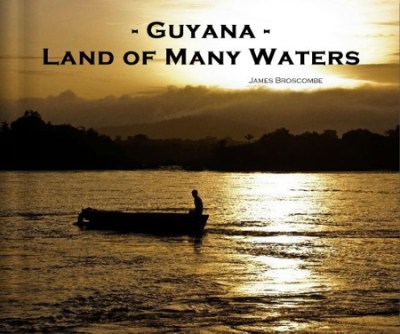
The book is titled “Guyana: Land of many waters”, and although t can’t cover everything, it covers more than any other book of its kind. As a book of photographic work it is packed, no, it is crammed full of beautiful imagery. The only thing that could have made this book better would have been short stories written by Sarah. Although I’ve seen most or all of the images online in his blog, it was so much more satisfying to turn leaf by leaf through the book!
If you are Guyanese, or love Guyana, or even just love photography, this is a boo to own, and at that price, it is a steal considering the sheer magnitude of its content. The book is available here, and below I’m putting some samples I think may peak your interest even more.
The cover alone, should make you want to delve into it 🙂
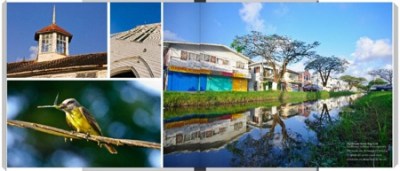
Pages 24 and 25
Pages 58 and 59
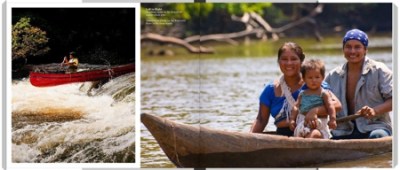
Pages 124 and 125
and the Back Cover, the amazing image of Lightening over Kaieteur
At the list price, James isn’t making any kind of profit, so I suggest you get one before he changes his mind about that price 🙂 Get your copy of “Guyana – Land of Many Waters”, you won’t regret it.
This year, as the teams are already on their first day into the 2013 Mountain Safari, I’ve decided to share some images from last year’s trip.
It begins at night, so there’s not much to see 🙂 Our fist stop is at Peter and Ruth, 58 Mile, Lethem Trail; that’s 58 miles from Linden. There’s a GuyOil Service Station there now, as well as cellular service from Digicel.
Nikhil was our primary driver (but seeing as he didn’t trust any of us behind the wheel, he ended up being the sole driver; I don’t blame him, I wouldn’t trust me behind the wheel on a Safari either)
A view from the back seat, note the can to the right 🙂
The trail crosses the might Essequibo at Kurupukari, where the Mekdeci Mining Company operates the pontoon crossing.
After the crossing, we pass through the Iwokrama Rainforest Preserve, and as soon as you leave the forest, we are hit by the vastness of the Rupununi Savannas, and the lovely undulations of the foothills of the Pakaraima Mountains. Our next stop is The Oasis, at Annai, run by Mr Colin Edwards and the native Amerindians from the village. Colin has carved out a piece of paradise at The Oasis and the Rock View Lodge just behind it.
After leaving Annai, we continue on the trail until the turnoff to the first village on the main Safari, Karasabai, where we spend our first night. Along the trail, the view of both the Pakaraima Mountain range and the Kanuku Mountain range is breath-taking
At Karasabia, we arrive with just enough light left in the day to set up camp… and enjoy the sunset 🙂
I think the first day was probably the most diverse for the photography 🙂 I may not post tomorrow (it being Palm Sunday, but look out for my next post from the Safari. Best wishes to those on this year’s Safari, come back safely.
Click on the images to see them larger in the Safari 2012 Gallery in the collection.
I was taking some photos out by the seawall at Lusignan, and although I think I came away with some nice ones, there was one that I really wished I had taken a different approach to. I saw a dramatic sky behind a stand of Jhandi flags, and I took a few photos, then moved on, then the thought struck me that I should have tried multiple exposures for an HDR. By that time it was a little late since the clouds had changed significantly.
When I downloaded my images I was still struck by that scene so I decided to try an Pseudo HDR Technique on it, and this was the result.
Click on the image for a better view in the Gallery
For my Deck Photo last week I used a black and white image of a bird walking across a wet expanse, one of my friends and fellow photographers told me that she didn’t like the photo, because it made her feel sad and lonely
When she told me that she didn’t like the photo, I was a little disappointed to tell the truth, but when she told me that it was because it made her feel sad and lonely, I was elated.
One of the things that makes a good photograph is the conveyance of some sort of emotion to the viewer. For most photos, we look at them and move on, it was a photo of a sunset, or a flower, or an insect, or a door, or a building, or a bird, or any other subject you can think of, but when someone can say that a photo of mine made them reminisce or feel happy or sad, of any other emotion, then I feel that the photo was not only good, but better than I’d hoped for.
Each photo has the potential to reach past the optics of the viewer and into their emotions, when it does, then the photo was worth taking, it was worth the pixels that were spent on it, and the time it took to take and process.
None of these photos are new, but each one has had an emotive response from a viewer, it may not do it to everyone, but to me, that is what makes photography a challenge, to reach into as many of the viewer’s hearts as possible, but to even reach one, is usually enough for me.
As usual, click on the images to see them in their respective Galleries in the Collection.
Sometimes, in any art form, you have to break away from the norm, step away from the straight and narrow line that you’ve followed all along, and try something different.
I’ve broken the rule about shooting into the sun before, so this is not new…. but trying to get the palm tree and horse as the focus while doing so was different for me, and even then I was not ecstatic about it, when processing, I went for a duotone processing that I don’t do, and I though that the result was pleasing.
Although the original duotone processing had much more colour to it, I toned it down a bit to bring the focus back to the photo rather than the duotone, and the result; “sunset Liliendaal” 🙂
Click on the image for a better view in the Gallery!
I have a few rules or guidelines that I try to abide by in my photography, and I’m not referring to the Rule of thirds or Rules of composition, I’m referring to ones that will guide me as a photographer and help me to get those photos that I want.
Rule #2: STOP and take the shot
Many times we regret not stopping, for one reason or another, to take the “shot” that we could see in our mind; we saw it, we thought of how to compose it, maybe even how to process it afterwards, but unless we actually stopped and took the shot, everything else is supposition and a wasted opportunity.
I was driving down the Railway Embankment heading home and saw the colours in the sky developing into what could be a lovely sunset, I saw the clouds low on the horizon and the sun dipping towards them and I knew I had to take a photo of it.
A photo of a sunset, is a photo of a sunset, unless you have something else in the photo that adds interest, then its just a photo of a sunset, and there’s a million of those. As I was driving down, looking for something to use in the foreground, I remembered the Chimney at Chateau Margot, and quickly diverted towards the main Public Road. As chance would have it, I ended up behind some slow moving traffic and could not get to the spot as quickly as I’d have liked, but I got there, didn’t try to change lenses, but grabbed what was there and just shot a few exposures to get it.
Although I could have gotten the sky as I saw it earlier, from the road with houses around and utility wires all over the frame, I spent a few precious minutes to get to a spot I felt better about, and I think I can live with that 🙂
Click on the image above for a better view in the Gallery.
As coastal dwellers we are always mindful of the flooding of our properties, growing up it never seemed that much of a problem, but now it seems more frequent.
Six feet Under – A phrased usually reserved for the dead and buried, is also the correct description of Georgetown, the capital of Guyana. The city is six feet below sea level, and all that protects us from the might of Neptune’s oceans is the famous Seawall, which was built by the Dutch when they colonized the area, back in the nineteenth century. It’s a good thing the Dutch know how to build these things!
When rain falls heavily (sometimes it just has to drizzle) and the tides are high, areas within the city, and even along the coast, become flooded to various degrees, most times it may just be an over-topping of the drainage canals and trenches. One good side effect of this is the lovely reflections of scenic places in the calm, still waters.
I’d shot multiple exposures for an intended HDR image, as these things turn out, I never got around to it until now. I’ve gone into detail on what an HDR is and even twice detailed how I approach the processing, but since it has been a little while since those posts, I’ll just give a brief description on HDRs here.
HDR stands for High Dynamic Range, it is a technique used in imaging and photography to produce in the resulting image a wide (or high) range in the luminance of an image. Simply put, it attempts to retain as much detail as possible in the lighter (brighter) areas as well as in the darker (shadow) areas.
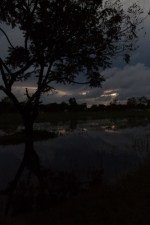
These two images show (a) the underexposed image that is used to capture the detail in the lighter areas, notice that the rest of the image is very dark, and (b) the overexposed image that is used to capture the detail in the darker areas, notice that the sky and water in this are very bright and show little detail.
When these are combined with the neutral or “normal” exposure image, the dynamic range of the final image is increased.
After combining or layering the images in an HDR software, the process by which the photographer renders the final image is called tone-mapping. In this process, various sliders are employed to adjust things like brightness, contrast, light, shadows, and, depending on the HDR software being used, a variety of “specialty” sliders. The resulting image is usually to the photographer’s taste, some with a desire to approach realistic images with a higher dynamic range than a standard exposure, others go for a more surreal result, some can carry this as far as having a very high contrast, high saturated look that is more illustration than photography, but that’s a debate for others. To the left is a small image processed for effect, very vibrant very “artsy”. It is also possible to tone-map a single exposure to achieve some of the same HDR effect, although I do not personally call this an HDR, I refer to them as Tone-Mapped Images, another possibility is to use a single exposure to create the various over and under exposures in software, then combine them, this I refer to as a Pseudo-HDR, but these are only my terms and distinctions.
My preference lies in trying to produce an image that resembles the scene that I saw, but could not reproduce in a single exposure, for some scene this will result in a photo that may have people wondering whether or not it is an HDR, and in other cases it will leave no question that it’s not a standard exposure, but definitely and HDR, especially when I try to reproduce the great detail that is there in a cloudy sky (such as my “Doomed” from the Coastal Wanderings exhibition at the National Art Gallery). The results of this particular HDR processing? I’ll let you decide.
This was one of those weeks where I had not taken a photo at all until I was forced to take something on the last day or abandon the Deck Project. To be on the safe side, I stopped on the seawall to take a few photos for another “Seascape”, this would have been around the Bel Air / Sophia area.
As things turned out, I took the family out to the seawall near Lusignan, as it was nearing sunset, I took some photos in general, then settled down amidst some rocks and waited for the sun to drop to just the right height. This was one of the few times that I had “planned” a shot (or rather the general concept of what I was looking for). I took several at different times in different orientations, but this one was the one that appealed to me the most.
As always, click on the image for a better view in the Gallery.
Third day of the full reunion, we visited the famous Dunn’s River Falls, and the tour guides split us up into two groups (we were apparently too large a number to keep together, especially with other tourists there too 🙂 ) In their introduction the guides said that there were two famous waterfalls in the world, Niagara Falls and Dunn’s River Falls, ALL the Guyanese in the group said without hesitation “KAIETEUR FALLS”, after giving us a look that could curdle milk in the goat, he ignored us and carried on with his “talk” 🙂
I didn’t mind a talk about safety on the falls, but when I have to start chanting “hot hot hot” and “wet wet wet”, and have to answer tour guides questions on camera, when all I want to do is enjoy the climb, I can get testy, I didn’t go for the Kumbaya and to make the guides look good on camera, especially when all the notices going down had a number of warnings for climbers and at the very top was “Anyone climbing the Falls to so at their own risk”, so kept thinking to myself “back off Rasta, and let me climb”
The guides were only interested in getting photos and video of their groups to “sell” to you after the climb, safety was the last thing on their mind. Our group got separated numerous times, members fell, and even had slight injuries.
At the beginning of the climb, from the bottom of the falls, there were at least five groups of people trying to climb the same section, simultaneously… The first stop they made was at a “pool” in the falls where they got small groups (families etc) to get in (it was fun!) and smile and wave for the camera 🙂 It was all for their camera, this was the photo they’d try to sell you when you reached the top! Yes I’m complaining, and I’m a photographer! Here’s one Andre took at that point 🙂
An Andre Lam photo
I prefer his photo, not because it is better (which it is), but because he didn’t twist my arm to take it, and he didn’t twist my other arm to buy it 🙂
Remember I mentioned the groups of people trying to climb simultaneously? Here’s a photo of a (relatively) calm spot, now go pick out the groups, remember that each group has two “guides”, one has on a blue shirt (he’s the official guide) and the other has on a yellow shirt (he’s the one with the video camera, who will disappear halfway up to go make the DVD) 🙂
Somewhere before this point (after my daughter had fallen and was saved by my cousin Nyuk-Lan in true action hero fashion, and my father had fallen twice, a few of us departed the falls, and I took over Andre’s camera to get some shots in, I really have to get more experience on strange cameras, I got fewer good ones than I’d hoped 🙂
Being totally fed-up with the guides, Nyuk-Lan led a team of rebels on their own merry way up the falls, including a section that was obviously being avoided by the guides and their groups, and it made for a few lovely photos 🙂
After all that, getting back to the hotel and it’s pools was relaxing 🙂 Joan had made reservations at La Diva Italian Restaurant, while waiting for dinner we noticed what was going to be a lovely sunset, both Andre and I headed out (while the servers were serving the appetizers) to take a few photos. The sight of the two of us taking photos seemed to have spurred numerous diners in other restaurants to do the same, and heading back to the restaurant, Andre noticed numerous people on their room balconies with their cameras too 🙂
From my seat in the restaurant, I noticed the colour of the sky contrasting nicely with the lighting in the restaurant area 🙂





 I’d shot multiple exposures for an intended HDR image, as these things turn out, I never got around to it until now. I’ve gone into detail on what an HDR is and even twice detailed how I approach the processing, but since it has been a little while since those posts, I’ll just give a brief description on HDRs here.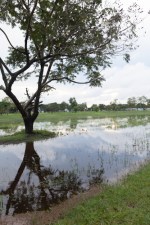
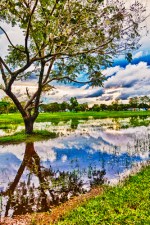 brightness, contrast, light, shadows, and, depending on the HDR software being used, a variety of “specialty” sliders. The resulting image is usually to the photographer’s taste, some with a desire to approach realistic images with a higher dynamic range than a standard exposure, others go for a more surreal result, some can carry this as far as having a very high contrast, high saturated look that is more illustration than photography, but that’s a debate for others. To the left is a small image processed for effect, very vibrant very “artsy”. It is also possible to tone-map a single exposure to achieve some of the same HDR effect, although I do not personally call this an HDR, I refer to them as Tone-Mapped Images, another possibility is to use a single exposure to create the various over and under exposures in software, then combine them, this I refer to as a Pseudo-HDR, but these are only my terms and distinctions.


 The Michael Lam Collection's Blog