Photography; I shoot what I like, and sometimes people like what I shoot. All photos are copyright to Michael C. Lam unless explicitly stated otherwise.
I’ve uploaded my image for the 2010 Deck collection on the site. It seems I’ve been in a monochrome rut for the last few weeks. It’s actually interesting this time, since I usually only make monochromatic shots for a few reasons;
I initially look at the scene and believe from the start that it will look good as either black and white or sepia
The sky was blanket grey and made an otherwise lovely scene look drab – I’m a sucker for a blue sky.
The post process intention was to give the image an older look
In this image, I actually got a lovely blue sky with those white clouds encroaching, something about the decaying building bothered me and I decided after some contemplation to render this in monochrome. I am mostly a fan of “whole buildings” but occasionally I like the partials 🙂
For the post-processing details, I did a bit of distortion correction and then did the monochrome editing in Nik Silver Effects.
This post is also going to be the first post where I do a bit of social commentary, in this case, specifically brought about by my photos of City Hall yesterday.
It is shameful that such a beautiful building, with so much history can be allowed to deteriorate like this, pieces are literally falling off. I don’t know about anyone else, but I pay my taxes, and I would expect certain things in return. I expect them to clean the drains REGULARLY, I’ve only seen them in our area once since I moved in more than two years ago, I even expect them to maintain the parapets, you know, weeding etc., again, never saw them, and I expect them to maintain City Hall! even if it was a crappy building, they should do it, but because it is such beautiful architecture, it is not only a good idea to keep the building that houses the governing body of the city in good repair, it is also their social responsibility to ensure that this piece of history is maintained and not become a part of history, relegated to photographs and memories.
Sadly, it may come to the point that restoration may not be an option and the building will probably be replaced by some concrete box with little or no character. From a photography standpoint, that would be disastrous 🙂
As I never intended to pursue the art of photography as a profession, I never thought that I should really delve into certain aspects of it, such as the technical work involved or the jargon, or understanding what all the dials and buttons on cameras really do, I just wanted to point the little gadget in the direction of what caught my interest and after I put into the frame what I figure was a good image, press the shutter button and… Voila! I have the photograph I want. But as with most things in life, it never quite works out that way.
As I got more and more into “taking pictures” I began to concentrate on focusing. and once I did that I noticed that certain things were “sharper” or more in focus than others, and that the general area of “sharpness” varied throughout my photographs, so my landscapes would have a lot of objects sharp, and my portraits would have less objects being sharp, since I was shooting in Auto, the camera was doing these things automatically, depending on light, and the distance the objects were from the camera., so if the camera was doing it, why should I bother with how its done? Exactly! let the camera do all the work, I say. Again, it never quite works out that way.
As I paid more and more attention to the photographs that I took, I began to wish that I had gotten more things in focus or less things in focus, and then I had to go and ask how that was done, and I was told about Depth of Field. Now there are lots of articles on this subject, and if you are interested in really learning all the nitty gritty of DoF, then you should read those, I understand enough to get by but not the whole story.
This is as far as I got and I think it serves me well enough for now, until, of, course, I get the need to do more and need to learn more 🙂
I’ve been taught that there are two types, shallow and wide, those words don’t exactly scream “opposites” to me but, instead of arguing the point, I’ll just accept it. If they say its a shallow depth of field, they’re referring to the fact that I have fewer things in focus or sharper, and if the say it’s a wide depth of field, they’re referring to the photo having more objects (at varied distances from the camera) in focus. Sounds straightforward to me, so how do I manipulate it myself? I apparently need to adjust the “aperture”, oh boy, more things to learn about 🙂
The aperture simply refers to the opening of the lens, how large or how small the opening is, obviously if its larger more light enters and if its smaller less light enters, if you want to know what this has to do with the depth of field, you should read the more technical articles available all over the internet, I won’t even try to explain this one, suffice to say that they’ve come up with a numbering system for describing the aperture size. Now this is where they first confused me, the smaller aperture is assigned the larger number, and the larger apertures are assigned the smaller number. Why? Think of it as fractions. If you were not very good at math then you’ll be as confused as I was. The Aperture settings are described as f/15 and f/2.8, so if you think of the f as 1, then its 1/15th and 1/2.8, and according to my math teachers if the number at the top is the same, then the fraction with the bigger number at the bottom is actually the smaller of the two.
I call this Shallow Depth of Field, right? maybe?
I actually understand what I’m saying and I’m still confusing myself. Here’s the gist then, if I ignore the whole fraction thing and just think of the apertures as numbers, then if I want a shallow depth of field I use the smaller numbers, like 2.8, and if I want a wider depth of field I use the larger numbers, like 15. I like this logic better, narrow = smaller, wide = larger. I can work with this. And then they tell me the next thing that happens when I mess with apertures is that, because I’m playing with the size of the aperture, remember this is the opening of the lens, and this will affect not only the depth of field but the “brightness” of the image (OK, fine, exposure), so if I’m shooting in manual mode I need to adjust the Shutter Speed accordingly. Let’s just say I haven’t gotten to the stage in my learning where I shoot a lot in Manual. So I set the camera in Aperture Priority (usually a big A on the dial) and let the camera figure out the best shutter speed 🙂
So, if you’ve read this far, you KNOW that I’m not a professional, and you should probably doublecheck EVERYTHING I just said 🙂
What sparked this long explanation of mostly confusion, I was staring at the image in this article, which I had taken back in April. Speaking of confusion, if someone mentions to you the “Circles of confusion” with regards to Depth of Field, if you don’t understand what I’ve described here, don’t bother, it will only add to the confusion 🙂 If however, you do grasp the gist of things, then, by all means, look up the “Circle of Confusion” and have some fun reading it.
I seem to live in a location where the “city” meets the “country“, do they call that the suburbs?
One benefit of living here is that I get to see a little bit of both, I have family living in both sections, as it were. On occasion, when I am leaving home for work, I would see some birds, usually too far off for me to photograph, but sometimes, they’ll be perched on a nearby fence, or post, or wire (you get the drift) and if I carefully lift my camera I may even get to photograph them without scaring them away first.
On Graham Hall Road, Cummingslodge, Georgetown.
My favourites are the various hawks that prey on snails from the gutters and trenches in the area, anyone who has seen my photographs would have seen these quite a few times over the years 🙂 I probably need to try and capture those in new ways, even I am getting tired of just seeing them staring at me 🙂 Quite common, in our area are some types of white birds… OK, I just noticed that I know nothing of bird nomenclature, if anyone knows where Waldyke Prince is, tell him I need help in this area. Anyway, back to what I was saying… there are these white birds, and once in a while they’ll pose just like the hawks.
I have also found that I don’t take enough photos in the rain, this may have to do with the fact that my camera is now weather-sealed, but still, I don’t do it enough. My favourite rain shot is still my Fleur de Lis Gate Toppers, which I did twice, once when I used a Canon Powershot S5 and then recently with the Canon Rebel T1i, anyway, enough advertising for Canon, here is that white bird sitting in the rain 🙂
Of course, if anyone knows the name, common and scientific, I would be grateful for the knowledge.
Back in March of this year, we were fortunate enough to get an invitation to go along with my brother to visit a forestry concession in the Berbice area, the main location was at Bamboo Landing, where we visited the first day, then we traveled onto the base camp at Charabaru where we spent the night.
One of the main reasons for going was to see a Harpy Eagle in its natural habitat, Rommel (who runs the concession) explained that they had found at least two sites in the concession where there were Harpy nests and they had stopped all work in those areas to preserve the habitats. It is nice to find that type of thinking in this age when more and more people think only of the dollar.
We were hopeful of seeing the Harpy eagle, but not too optimistic, since we had heard stories of people looking for hours and not seeing one. We were luck, we saw two of them,
TWO! And then I realized that I am not equipped for Bird photography, I need a sponsor for bigger lenses 🙂 But, as someone once pointed out to me, a
poor photograph is better than none, so I can proudly proclaim that I have photographs of the Harpy Eagle in its natural habitat.
The concession also has its own farming areas, so the photographs in the album on my site reflect quite a diversity of images. I have already used some images from that trip in previous posts in the blog, those covered monochromes and HDRs, these are strictly general type photographs, no special post-processing.
The Harpy eagles were sighted in the early morning and, as chance would have it, the only way we could see him, was facing due east, towards the morning sun, I guess you really can’t have everything, at least we saw them.
I hope to get another chance sometime to visit the area again, it really is very nice and peaceful and full of opportunities.
I have found that over the years of playing with cameras, I really love the vibrant colours that the default settings of a Canon camera have always had, and most times it shows in my photographs.
Over the years I have come to love doing select monochromes, specifically the black and whites and sepias that you can always find wherever I post my images. These two types of monochromes lend a different atmosphere to an image, sometimes even an image that has little appeal in it’s original colour state.
Many people take photographs and then decide later on that this particular one or that particular one would look nice in monochrome, while it has happened to me before (and likely to happen again) I usually take a photograph with this particular type of end-product in mind, these two images I recently posted from the trip to Bamboo Landing are very representative of that, they are the only one taken with monochrome in mind and each one was taken with the particular type of monochrome processing in mind that you see evinced in them.
The Black and White Image, was taken just after noon sometime, the heavy clouds and the shadows from the foliage made me think of this as a BW image, the lone tree (actually has some brush around it) cave a nice focal point to an otherwise bland river scene.
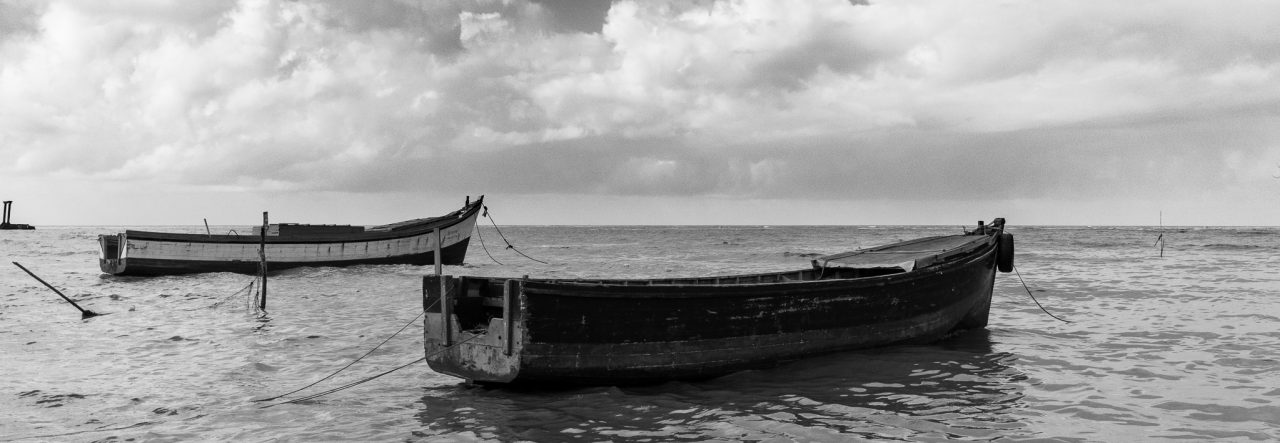
The Sepia image was taken around the same time, whenever I see something like an old house or an old boat (almost anything old) I almost instantaneously think “monochrome”, it just goes well together. When I first started doing Sepia photographs I had favoured the Canon default type on their point-and-shoot cameras, that very very vibrant, heavy on the sepia, but as I learned more and took more photographs, I learned to appreciate the lighter touches of sepia in an image.
One of my favourite types of Photographic work is an HDR (or High Dynamic Range image), I’ve played with them for some time and sometimes a scene has that nice range of light that I think would reproduce well in such an image and I just have to try it. Most people reading this would already know what an HDR image is, if not you can always Google it, but simply put, it entails the combination of several exposures of a scene (usually a minimum of three) into a sinlge one. It’s the same scene taken at different exposure levels, when combined the areas that may be too bright in one, and the areas that may be too dark in the other would than show more detail.
The three I most recently uploaded are from a trip I took with my brother André to Bamboo Landing and it’s associated base camp at Charabaru. Rommel (the gentleman who runs the concession) has a beautiful home at Bamboo Landing and in it there were areas that I though would represent well in HDR, and as I was trying that I thought I’d also give the scene from his verandah a try too.
While I am far from perfection in this, I do believe that I managed to produce some pleasant images 🙂
As for the House at Bamboo Landing, I can only say that even these HDRs do not do it justice, the building is practically all wood, all from the concession, and it has a warmth that only that natural wood has.
As an editing tool in the photographer’s arsenal, the development of an HDR image helps the photographer to give the viewer a chance to see more of what the human eye saw, since our brains process these images far better than the camera 🙂
Continuing my series of The 2010 Deck of photos, this, the twenty-first week of the year, this week’s photograph is “Another day…”
It is telling, that in a week of taking very few photographs (outside of a session at a dance) that the one I considered the best was one that reflects on a growing part of our society. So many homeless and destitute, and so many in need of help. Many times, it’s scenes like this that draw our attention, even though most of us turn a blind eye to it and pretend that it doesn’t exist.
I have come to realize that the photographs I take are an expression of my life and the events, people, places and things that affect and have an effect on me. Few things can effect changes in a person as drastically as the death of someone close. In times like this I realize that while I like taking photographs I can never seem to to capture the emotions of a scene as many of the professionals can. I can’t explain it, but I “had” to take photographs at my Grandmother’s funeral, it wasn’t something I wanted to do, or even preferred to do, I rationalized it as a job that would help keep me occupied, but it was more than that.


 The Michael Lam Collection's Blog