Photography; I shoot what I like, and sometimes people like what I shoot. All photos are copyright to Michael C. Lam unless explicitly stated otherwise.
Often enough, I happen to see a beautiful sunset when I’m in the middle of a housing area or similar, with lots of utility posts and wires mangling the view, or a very plain area with nothing of interest other than the sky itself.
Last week, it happened again, and as I was driving out I decided to stop at the closest thing approximating to a “nice” scene, and get a shot including part of the sunset that day. 🙂
After two years of doing this, I think that this is what keeps me intrigued in photography, the weekly search for a photograph. While Nikhil has embarked upon his Daily Photography project this year (I hope he goes the full 366) I know my limitations, I won’t be trying that anytime soon.
I think that this image is somewhat appropriate to the year, the crazy Armageddon stories and to my photography. If you believe the Mayan Calendar theorists and many of the other Doomsday predictions regarding the year 2012, then you’re probably hoping, like myself, that I get some really good photographs this year! 🙂
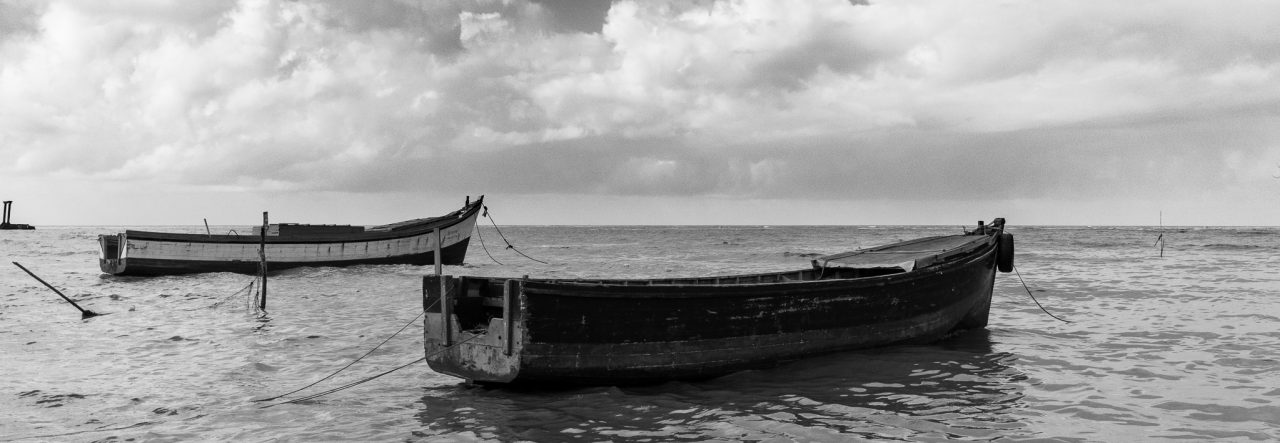
This was taken on New Year’s Day, because of my interests in HDR, I thought that I would try another Black and White HDR, this one was taken at midday, I think the originals were 2ev apart.
It was a breezy day (forgot my tripod again, so this was hand-held for all three exposures), and very overcast, lots of clouds as you can see.
Just a little ramble from me, this is not instructional in the literal sense. A fellow blogger and photographer, Nigel (or greysqrl) always asked me to write a tutorial on my monochromes and specifically my black and white photographs, but I’ve never felt that I had an “art” to it or a specific sequence of steps in the methodology to really do a tutorial type of blog, so I thought that at least I can do some rambling or musing on the subject.
Back when I shot with the Canon S5 Super-Zoom bridge camera (basically a hyped-up point-and-shoot) there were several colour modes including black and white and sepia, so I had disciplined myself to taking the scenes that appealed to me in these aspects in those modes, so I never had a full-coloured version of the photograph for any sort of comparison. So for me, the idea of a scene being in monochrome always started out before I pressed the shutter-button.
After I started using a DSLR (for now the Canon T1i or 500D) I learnt about post-processing further, using RAW images, etc. Now, I still consider many scenes in monochrome and earmark them for that specific type of processing later, but I also change my mind about some scenes that were not considered for monochrome initially.
What makes a good monochrome image? I really never thought about it, I just “feel” that some scenes make better monochromes than others. I am sure that as I continue my photographic journey I will learn more about what actually makes a good monochrome, to me it’s a “old” looking scene, or a scene with high contrasts, or in many of Nikhil’s cases one with lots of texture 🙂
How do I process a monochrome image? Since all my current images start out as full coloured, it is usually that “feel” that helps me select the ones for monochrome, either that or the new method of processing as colour and then it doesn’t quite come out the way I want and I send it over to monochrome just to see what would happen 🙂
I use Lightroom as my primary image processing and workflow application, but the majority of my monochromes are done in Nik Silver Efex (after some processing in Lightroom). I take each photo on its own merit, some need to be treated softly while others need to be more contrasty and structured. Nik Silver Efex has a range of presets that you can view easily and then do your own fine-tuning.
With scenes that have clouds (I seem to have many of those now) I always go for bringing out or enhancing the detail in the clouds. The dynamic range captured using a single exposure is not (always) a true representation of what the human eyes saw or can see. Often I would look at the scene and see the nice detail in the foreground, then look up and see the layering in the clouds, but when the photograph is taken I lose some detail, and In post=processing I try to retain that detail that I saw.
Dry Docked?
This particular photo was not intended as a monochrome image, the upper portion of the boat (or lower portion in the image, since the boat is upside down) was yellow and I had initially intended to emphasize that, but it didn’t work out as planned.
There was a challenge recently in the Guyana Photographer’s FaceBook page, it was about silhouettes, while there seemed to be various interpretations on the theme, I noticed that not everyone had the same idea of a silhouette.
Although many dictionaries seem to have similar definitions, they usually go back to the original meaning, referring to “cut-outs”, the explanation that I like the best I came across on Wikipedia (yes, I know, not always the most reliable of sources, but its accurate here), “A silhouette is the image of a person, an object or scene consisting of the outline and a basically featureless interior, with the silhouetted object usually being black”. I think this explanation covers the idea of a silhouette regardless of the medium used to illustrate it.
This image I intentionally under-exposed when I took it to capture more detail in the sky and less in the foreground and objects between myself and the horizon, although I did under-expose I apparently didn’t do so enough since I still had to adjust the black levels to get what I wanted 🙂
Although the tree-line takes prominence in this image, the real interest is the child on the wall walking into the sunset. Intentionally under-exposing the photograph is one way I know of getting the silhouettes that we try for in images like this. Getting the right exposure is important, goodness knows I’m still trying with that, but learning when to over-expose the photograph and when to under-expose it can create those moments that are more memorable than an average exposure 🙂
The Walk Home
For a better look, click on the image to see it in the Gallery.
The final week of the year, and the final photo for the Deck Project for this year. This one I can say I like, it has been “edited” a bit in addition to the standard processing, I added a “purplish” gradient to the sky for effect.
Another year has ended, I am a bit disappointed with myself, and I think I need to refocus for the new year, I plan on restarting the Deck Project, it gives me a sense of purpose for my photography, so I wouldn’t want to stop it. I think that Nikhil may be re-starting his 365 Project that he did a year ago, I look forward to that.
As we end this year and look forward to 2012, I present a photo that I think represents many Coastland Guyanese, a typical afternoon on the coast, enjoying the winds of the Atlantic and just “Shooting the Breeze” (chatting, talking, gaffing!)
I had shortlisted four images for this blog-post, two of them were too much in keeping with the general theme of the last few weeks, so I discarded those (for later publication) and one was somehow reminiscent of photos I’ve seen from Nikhil and some other local photogs, so I ended up with this one.
I titled it “Ritual at Dawn” because I had inadvertently caught some people in the frame, I think they may have been Hindus out to perform a seaside ritual (I think I should enquire more about this)
I was a bit dissatisfied with the original capture, but was taken enough by the scene to try to “salvage” the image. I tried a single image HDR tone-mapping, but that didn’t work out as I expected. I then decided to go for a pseudo-HDR, since I hadn’t actually taken multiple exposures, I created the multiple exposures in Lightroom (using a 1.5ev on the original image) In the image with the +1.5ev I wanted to get more detail from the rocks on the shore, so I used a gradient to adjust the exposure in that area. Using the three new exposures I did an HDR process in Nik HDR Efex Pro, and although the full-coloured resulting image was OK, I thought that in this instance I would get a better image using a black and white HDR rendering.
I think Week 50 was the worst photographically for me this year…. I have one photograph. According to Dwayne Hackett even if I took a hundred shots of the same subject that day and I used one, it’s still only one photograph, I didn’t take a hundred photographs, just a hundred attempts 🙂 I took three photographs of the same subject that week. Three!
If I thought things couldn’t be worse, I had forgotten to reset the settings on the camera… so they were taken in bright sunlight at ISO 1600.
Reminder to self (for the thousandth time) always reset your camera immediately after a shoot (or whatever session) or else you have to live with whatever the camera hands you next time!
This building is right behind DeSinCo Trading (Sheriff Street), in the little side street, I think its Craig Street, I had never noticed it before, I was waiting in the vehicle while my better half was in DeSinCo, I just couldn’t help myself after staring at it for several minutes, just got out of the vehicle and snapped three shots just to satisfy the little voice in my head that said “go take the photo, go take the photo!”
Church Closed
Its a sad sight to see places of worship that become abandoned, usually because of a lack of attendance over the years, I don’t know the story behind this one, but I was reminded while writing this post of my most recent experience in church, I was saddened at the poor attendance to Christ mas Eve’s Midnight Mass. I remember when I was younger (much younger) the Midnight Mass at the Cathedral was always packed, maybe some of the pews in the wings would be empty, but the centre of the church would be filled. Have we lost the faith that we once had or has the commercialisation of Christmas finally overtaken the true meaning for the Season?
Click on the image to see it better in the Gallery.
UPDATE: I was told by Dave that the property is now owned by DeSinCo, Frank (owner of DeSinCo) built a new church for the parishioners on Middleton Street (a short distance away), so this one was not closed for a lack of attendance but for a more practical and financial reason. 🙂
Monuments. That is basically what a tombstone or tomb-marker is, whether it’s a simple slab with a name on it or an obelisk, it’s a monument to the person interred, a reminder to the living of a person now dead.
These markers fade with time, and people forget, generations pass and the dead are lost to the living. Some are forgotten entirely, some are just names on a family tree. Do we all want to fade from memory like dawn fades to day, once there, once unique, never to be seen again, never to be remembered and referred to?
Most of us will do just that, but the few who are exceptional will live on as legends and icons of History. Whether we are remembered as tyrants or dictators, philanthropists or inventors, pioneers or adventurers, famous artists or infamous criminals depends on the decisions we make daily.
At times like this, when my thoughts stray to these realms, I remember two phrases from my early High School days. I attended St. Stanislaus College, it was a Catholic School before the government took everything over under early PNC rule in Guyana. Some things had remained as part of the teaching and tradition of the school.
The two phrases I remember were from different sources.
One was given to us as four letters to be written at the top of every page, I believe it was handed down from the Jesuits who taught at the school when it was a Catholic School; the letters were AMDG, a shortened form for Ad maiorem Dei gloriam, which meant “For the Greater Glory of God”, it was meant to encourage you to try to make everything you do, everything you say be geared towards that goal.
The second phrase was the school’s motto, Aeterna non Caduca, literally translated to “eternal non perishable”, but we were told that the motto translated to “Not for this Life, but for Eternity”. Whatever we do should not be just to have an effect now, in our lifetime, but for eternity.
Taken together they can be a driving force for a truly spectacular life, a life of meaning, unfortunately, not many would adhere to such a strict code.
Many people who happen to drop in to read my blog-posts are fellow aspiring photographers (in one way or another), we may never be an Ansel Adams or a Nick Brandt, a Frank Horvat or Mario Testino, an Irving Penn or a Steve McCurry, a Joe Rosenthal or a Don McCullin, an Henri Cartier Bresson or a Vivian Maier, but what we can do is aspire to show to anyone who will look, how we see the world through our eyes, our view-finders, our lenses, make them feel what we feel through visual stimulation (and if necessary a few words) 🙂
Can I do that? Can we do that? I don’t know, but I am sure going to give it a try!
Monument
This was taken during a photo-walk arranged by the Guyana Photographers Facebook group, lots of people thought it strange to arrange a walk in a cemetery 🙂
Click on the photo to see it larger in the Gallery.
This week’s photo serves two purposes, one is a short explanation of “how I did it” and the second is… well, it’s a moon shot, what’s not to like 🙂
Someone recently asked me how I got the moon with such detail, I had to have someone give me tips once, so its easy to pass along what I know, hopefully someone else can improve and even tell me other things 🙂
Shooting the moon. First tip, use a tripod, it helps to have a stable camera when you’re doing this (most of my moon shots were without tripods though), The important bit is the metering, I use a spot metering mode. I simply set the camera to spot metering, (my camera only uses the centre focus point for this), I use the centre focusing spot in the display, make sure that is centred on the moon, and half-press the shutter-button to focus, then recompose and click. Really simple.
What the spot-metering does is meter the lighting for just the moon instead of trying to evaluate the lighting of the entire scene (in this case the whole sky)
Now normally we crop these images to show the moon in its full glory, well, I crop it since this is the whole image from my maximum zoom on the Tamron 18-270 lens. I left this uncropped because I actually like it this way this time.
The moon is set against a dark sky (it was somewhat lighter before I processed), I look at it and think that it must be lonely up there, I’ll never fly into space like those great astronauts and cosmonauts, not fly to the upper atmospheres like jet-fighter pilots, but I still think that even after the initial moments of wonder and awe, it must be lonesome up there. I am thankful for the family I have, the friends I have, the co-workers that I have (even those that have moved on).
If you’re ever feeling lonely, go out under the open sky, look at the moon and remember that under that same moon, there are billions of people, and somewhere there is someone who is thinking of you.
Alone
Because of the background colour (at the time of writing this) I suggest you click on the image for a better viewing at the Gallery 🙂
Many times on a walk in the city I would take a photo of The Lodge, I don’t think I’ve ever used any of the photographs before, and since this week had very slim pickings, I chose one that I took in passing. Actually I had a choice from eight subjects, this one just seemed better than the rest. 🙂
This is one of those photos that when writing about it I feel very silly. I don’t know anything about this place and I’ve seen it all my life. Its one of those places that everyone just refers to as The Lodge, and they give you a knowing look, so I never asked, and was never told. I’m sure those conspiratorial glances were more ignorance rather than knowledge.
So it seems to me that maybe I should ask someone… what is that place and what really goes on in there? Do you think I’ll get answers on the blog? 🙂


 The Michael Lam Collection's Blog