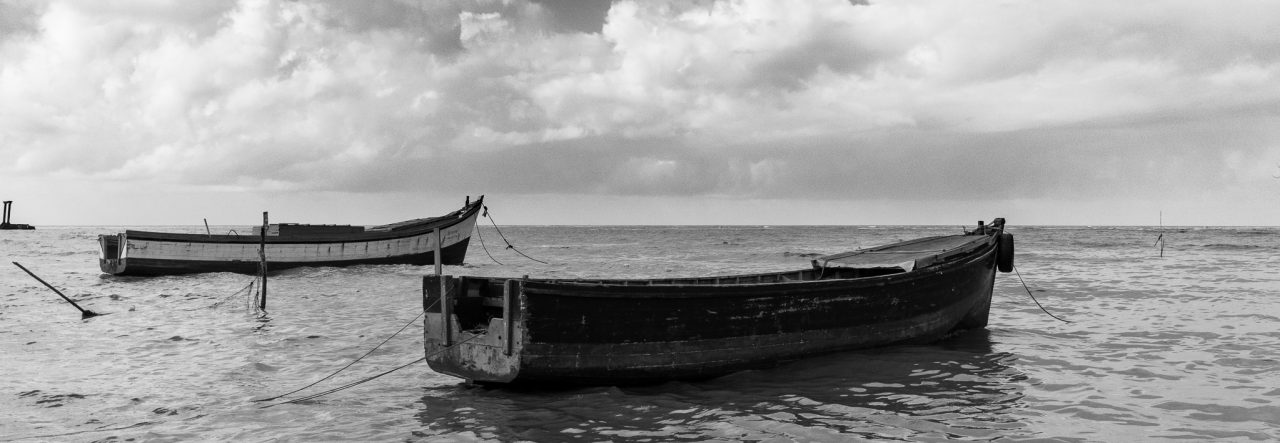
2012 Deck – Week 39

Finding inner peace is not an easy task, and often times the path to it is fraught with despair.  With the myriad of daily struggles that we all endure, and the unexpected arrival of ones that we have no control over, it is no wonder that finding inner peace is difficult, and some may even say impossible.

Take a few minutes and get away from it all, go sit on the seawall in the shade of a tree, or the lee of a rock, and stare at the seemingly boundless ocean, towards the distant horizon, let your mind wander, free from the stress that has a vice grip on your soul… just relax, find a touch of inner peace in a moment of outward calm.

Click on the image to see it larger in the Gallery.

2012 Deck – Week 38

Many moons ago, I sometimes took a few minutes to stare up at the stars and the moon, and let my mind wander, I haven’t done that in quite some time.  If you look at a child’s drawing, or an icon that is supposed to represent night, the moon is shaped in the crescent form, probably because the full moon would look like just a circle, and can be interpreted in many ways, but the crescent shape is instantly recognizable as the moon.

In Guyana it is not very common, but I’ve often seen drawings or paintings, and scenes in a movie or show where an old outhouse (the pit latrine) had a Crescent Moon carved on the door.  Many people see it as being decorative, the true significance have been forgotten by many and almost lost to the ages.  Apparently in ancient times the doors of the latrines were marked to identify the gender, the sun or star being for males (after the sun god Helios or similar deity) and the moon for the women (after the goddess of the moon, Celine or Selene, or similar deity).  So far the working theory as to why one with the sun or star symbol has been seen or recorded is that the women took better care of their out-houses 🙂

One night I got a message from Savita asking if I’d seen the moon that night, I hadn’t, and I told her so, she was excited that there was a star right next to the moon in the sky, and she hoped one of us could get a decent photo of it… I tried.

Not sure if you’ll see the star… but it’s there  🙂  Click on the image to see it better in the Gallery, along with a few other images in the Night album

2012 Deck – Week 37

I have a few rules or guidelines that I try to abide by in my photography, and I’m not referring to the Rule of thirds or Rules of composition, I’m referring to ones that will guide me as a photographer and help me to get those photos that I want.

Rule #2:  STOP and take the shot

Many times we regret not stopping, for one reason or another, to take the “shot” that we could see in our mind; we saw it, we thought of how to compose it, maybe even how to process it afterwards, but unless we actually stopped and took the shot, everything else is supposition and a wasted opportunity.

I was driving down the Railway Embankment heading home and saw the colours in the sky developing into what could be a lovely sunset, I saw the clouds low on the horizon and the sun dipping towards them and I knew I had to take a photo of it.

A photo of a sunset, is a photo of a sunset, unless you have something else in the photo that adds interest, then its just a photo of a sunset, and there’s a million of those.  As I was driving down, looking for something to use in the foreground, I remembered the Chimney at Chateau Margot, and quickly diverted towards the main Public Road.  As chance would have it, I ended up behind some slow moving traffic and could not get to the spot as quickly as I’d have liked, but I got there, didn’t try to change lenses, but grabbed what was there and just shot a few exposures to get it.

Although I could have gotten the sky as I saw it earlier, from the road with houses around and utility wires all over the frame, I spent a few precious minutes to get to a spot I felt better about, and I think I can live with that  🙂

Click on the image above for a better view in the Gallery.

2010 – Flood Waters at the Park – HDR

As coastal dwellers we are always mindful of the flooding of our properties, growing up it never seemed that much of a problem, but now it seems more frequent.

Six feet Under –  A phrased usually reserved for the dead and buried, is also the correct description of Georgetown, the capital of Guyana.  The city is six feet below sea level, and all that protects us from the might of Neptune’s oceans is the famous Seawall, which was built by the Dutch when they colonized the area, back in the nineteenth century.  It’s a good thing the Dutch know how to build these things!

When rain falls heavily (sometimes it just has to drizzle) and the tides are high, areas within the city, and even along the coast, become flooded to various degrees, most times it may just be an over-topping of the drainage canals and trenches.  One good side effect of this is the lovely reflections of scenic places in the calm, still waters.
I’d shot multiple exposures for an intended HDR image, as these things turn out, I never got around to it until now.  I’ve gone into detail on what an HDR is and even twice detailed how I approach the processing, but since it has been a little while since those posts, I’ll just give a brief description on HDRs here.

HDR stands for High Dynamic Range, it is a technique used in imaging and photography to produce in the resulting image a wide (or high) range in the luminance of an image.  Simply put, it attempts to retain as much detail as possible in the lighter (brighter) areas as well as in the darker (shadow) areas.
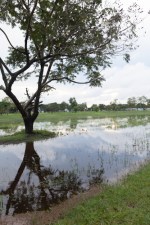
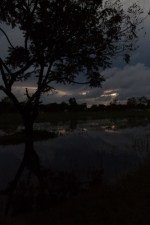
These two images show (a) the underexposed image that is used to capture the detail in the lighter areas, notice that the rest of the image is very dark, and (b) the overexposed image that is used to capture the detail in the darker areas, notice that the sky and water in this are very bright and show little detail.

When these are combined with the neutral or “normal” exposure image, the dynamic range of the final image is increased.

After combining or layering the images in an HDR software, the process by which the photographer renders the final image is called tone-mapping.  In this process, various sliders are employed to adjust things like brightness, contrast, light, shadows, and, depending on the HDR software being used, a variety of “specialty” sliders.  The resulting image is usually to the photographer’s taste, some with a desire to approach realistic images with a higher dynamic range than a standard exposure, others go for a more surreal result, some can carry this as far as having a very high contrast, high saturated look that is more illustration than photography, but that’s a debate for others.  To the left is a small image processed for effect, very vibrant very “artsy”.  It is also possible to tone-map a single exposure to achieve some of the same HDR effect, although I do not personally call this an HDR, I refer to them as Tone-Mapped Images, another possibility is to use a single exposure to create the various over and under exposures in software, then combine them, this I refer to as a Pseudo-HDR, but these are only my terms and distinctions.
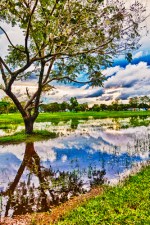
My preference lies in trying to produce an image that resembles the scene that I saw, but could not reproduce in a single exposure, for some scene this will result in a photo that may have people wondering whether or not it is an HDR, and in other cases it will leave no question that it’s not a standard exposure, but definitely and HDR, especially when I try to reproduce the great detail that is there in a cloudy sky (such as my “Doomed” from the Coastal Wanderings exhibition at the National Art Gallery).   The results of this particular HDR processing? I’ll let you decide.

Dump

I can’t remember where we were going this day, but I do remember wanting to get the photograph, although we were quite a distance away, so I used the long telephoto to quickly snap this.

This is where the City’s garbage dump meets the Body Dump, or more respectfully called the Le Repentir Cemetery.

The smoke was drifting across from the burning garbage (it apparently spontaneously combusts periodically), the excavator was clearing some paths and moving some garbage, and the birds were just hanging around for the “disturbed” earth and garbage.  🙂

Click on the image for a better view in the Gallery!

Wake Up Call

Humankind has relied on various methods to awaken them throughout the ages, as in to awaken them in the morning for the new day.

From the bright rays of the newly risen sun on your face, to the crow of the rooster, from that great invention; the alarm clock, to the thump from an angry wife who wants the garbage taken out, from the gentle sounds of the animals in nature, to the roar of early morning traffic (if you wake that late), from the shouts of a mother “You’re late for school!” to the electronic beeps of new messages on your cell-phone, maybe even something like the much exalted smell of fresh coffee in the morning, there have been things to awaken you.

My phone has an annoying alarm that certainly wakes my wife, and eventually myself, but nothing can compare to the sound of a regular visitor we have to our area.  For years he (or one of his family members, at any rate) has come during the first minutes of the brightening day to begin his rat-a-tat outside my home and continue for what seems like hours (ok, maybe one hour).  A Pilleated Woodpecker who lives somewhere in the vicinity, chooses the utility post in front of my house to sharpen his beak every morning, and he doesn’t only peck at the wood, he pecks upon the galvanised metal protector that runs up the post too!  He actually seems to prefer that!

So what did I do about it?  One morning I took out my Canon and shot him… several times… at least until I was fairly certain that at least one of the shots would produce a good photo  🙂

Click on the image to see it in the gallery along with other Sunrise and Sunset images.


No animals were hurt during the writing of this blog nor in any of the events leading up to it.  🙂


A Photo’s Worth

Recently, Dwayne Hackett posted a question on Facebook, looking to garner from others what they thought, “What is a picture worth?”, and of course at least one person used the old adage of “a thousand words”.  I am sot certain of Dwayne was trying to get at philosophical or monetary answers  🙂

For more than a century we’ve heard that a picture is worth a thousand words, usually meaning that a complex idea can be expressed in a single image, but what is a photo actually worth?  My answer was “A photo’s worth is weighed differently by each viewer, it depends on how the photo affects them.”  For me this answer works for both the philosophical and monetary.

The most expensive Photograph on record (as of today) is the Rhein II by Andreas Gursky, which sold at auction last year for $4.3 Million, the cheapest may be that passport sized one you recently got for your American Visa Application 🙂  Which one is worth more?  To the Visa applicant, it is certainly the passport sized one, without which they can’t submit the forms, to an artist, the Rhein II certainly surpasses the “mug-shot” 🙂

While the simplicity and boldness of the Rhein II appeals to my artistic senses, a photo that sold for one-seventh of its value appealed to me much more, that would be Ansel Adams’ “Moonrise”, but that is because of how that photo affects me, and so I find more “worth” in that image.

Last year I dealt with this similarly in my post for the 23rd Week of the Deck Project, you can check it there for reference  🙂

I had taken this photo while on a walk with Nikhil and Sharon, hen I had downloaded the images, I had decided that this one was not going to make the cut, and left it aside, but after Dwayne’s question, something sparked an interest in the image.  I had used ISO500, I had shot into the sun, and I had done this dangling the camera downward simply because I was too lazy to get down in the rocks to properly compose the image, so I wasn’t enthusiastic about it  🙂

I didn’t think the resulting image was worth my time and effort to process, but I went back and while it is grainy from the high ISO and from the subsequent processing, I like it.  It may not have the same impact on a Christian as it would on a Hindu, it would not have the same effect on a North American as it would on someone from the Caribbean, each would decide it’s worth, it’s value as a photograph differently.  For many this may be worthless, for me, it was worth saving, worth the time and effort in processing, and if anyone reading this blog-post realizes the worth in their own photos, then this blog-post was worth writing.

2012 Deck – Week 35

In June of this year Imran Khan had done an article on the new insurgence of young (and not so young) Photographers in Guyana in the form of the Facebook Group Guyana Photographers, this was recently re-blogged on the GuyanaPhotographers.com site.  In it he mentioned that the Seawalls seem to be a favourite or default location for their “treks”, this is very true.

With most of the population of Guyana living on the Atlantic coast, this is inevitable; with the majority of (accessible) roads meandering along the coast, this is inevitable; with the majority of the coastland given over to farming (and now housing) leaving the only scenic areas being the seawalls stretching from east to west along the coast, this is inevitable.

I’m not saying that there aren’t more places that would make nice photographs, there are, they are just not as “easy” to get to.  You can read “easy” as being “not too expensive to get to”, “not too arduous to get to”, “not needing to plan a trip weeks in advance” and  ‘not requiring a four wheel drive vehicle with a winch and hi-lift” to get there.  🙂

So, for someone who has a full-time job but would still like to get a nice photograph, as Imran so accurately pointed out, the Seawall becomes the “default” location  🙂

With that said… here’s a pair of Jhandi Flags… on the sea shore, just in front of the Seawall

Click on the image to see it better in the Gallery, along with all the other entries for this year’s Deck Project.

Here today…

Someone may have to correct me if I am wrong (and I may very well be), but it seems that the Government can usually get funding (international) for the “construction” of a hospital or a new building at the hospital compound, but not funding to maintain and keep the existing structures.

The Public Hospital is a sea of ever-changing tides, and as the years go by the shape and structure of the hospital change with the funding.  I remember when this portion was new, and it had the brand new Emergency Room and Ambulance driveway, now it is no longer there, I had taken this last year on a walk to town.

I think that a photographic history of the Public Hospital would be fascinating, I wonder if anyone has ever tried it?  🙂

Click on the image above to see it in the Gallery along with other “Odds and Ends”  🙂

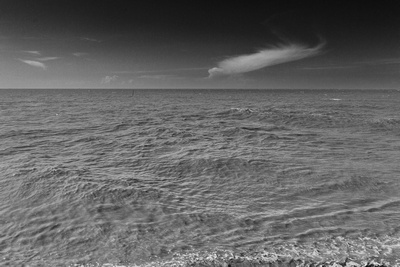
Water

Sometimes using a “rule” works in your favour.  One of the most harped-upon rules of photography is the Rule of Thirds, I think every beginner in the field knows this one.  Divide the viewfinder in three parts, both vertically and horizontally, then use that to help compose the image, whether putting subjects into the portions or onto the dividing lines.

Nikhil always tells me that we should know the rules, so we’ll know when to break them with greater effect on the resulting image, or in this case use it as literally as possible  🙂

I tried my hand at another seascape, and remembered that sometime back I was told that more than two-thirds of the earth’s surface is covered by water, so I covered two-thirds of my image with the sea-water  🙂

Click on the image for a better view in the Gallery.