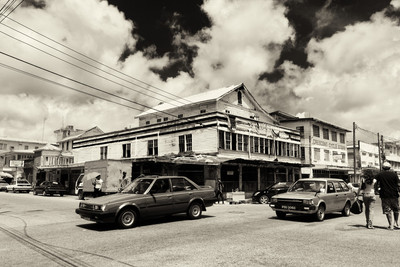
Princess Alice, Mona and Papine

Yesterday we took a drive down the hill to go get some fruits and some tea bags.  Our route would carry us to pass by the house where I walked for the first time (not made my first steps, but actually walk), it was in Princess Alice Drive, the house itself had changed, so although I took a photo of it I didn’t bother to post it, I sufficed with a photo of the street sign:

On our way to the market we next made a drive through the Mona Campus of the University of the West Indies, to see the University Chapel where many of my family who grew up in Jamaica got married (according to my cousin)  🙂

Then we finally made it to the market in Papine, where we wandered around for a bit while Nyuk Lan bought some fruits:

Of course, before we left to head back home Alexis insisted we stop at Tastee to buy Jammie Patties and Coco Bread.  I have to admit that I prefer the Jamaican Patties from Tastee over those from Juici, but will eat either  🙂  The Coco Bread is very similar to what we call Butterflaps in Guyana.

Into the Mountains – Part 1

Veteran Guyana Safari expeditionist Cecil Beharry (CB to his friends), told me to just let him know when I’m in Jamaica, so I told him I was coming down for a family reunion, and he insisted that he take me into the mountains, how could I refuse?

The day after I arrived in Jamaica, he took me and my cousin Alexis (I’m told he is my First cousin Once Removed, although I prefer not to have him removed) on a mountain drive, some of these spots were apparently where he “practiced” for the Pakaraima Mountain Safari in Guyana.  He had just gotten back his vehicle from the last Safari, and we were going to give it another mountain drive  🙂

As it happened, we were on the road near Irish Town when we noticed some strange sounds coming from the vehicle, on stopping and checking (Alexis being a hobby mechanic and Cecil being Jamaica’s Power-steering specialist) it was discovered that there was a leak somewhere, Cecil called his son Craig to come exchange vehicles (a Trooper to the rescue)

I didn’t mind stopping / breaking down in that spot, I got a few photos, my two favourite are below:

With a new vehicle at our disposal (ok, we’ll apologise to Craig for the dents and scratches and the dirt…), we headed onto Newcastle where there was on old colonial army base that is now housed and maintained by member of the Jamaican Armed Forces (restoration work was being undertaken while we were visiting), I’ll share two photos from that location, one of the “barracks”,as I thought of them, and one of the cemetery, I must say that the view from the cemetery was very tranquil 🙂

On the way to Newcastle, we stopped to take in one of the breathtaking views of the hills/mountains, but I was also captivated by the walls along the road, they are apparently built to help retain the earth on the sides of the hills and prevent landslides, in these “walls” are holes which are meant for the drainage of water caught behind the walls, the holes are called Weeping Holes.

From Newcastle, we moved onto Holywell, where there is a camping ground, there were quite a number of youths there camping and playing.   The air is crisp and cool,and the views are pretty:

And if you want to just sit and enjoy the view, here’s the chair:

After Holywell, we went to visit an old abandoned Coffee Mill, from somewhere back in the colonial days.  Some of the building(s) is still intact, and the mill mechanism can still be seen there, what I was impressed to see was the waterwheel that drove the mill, I had never seen one before and I was excited about it, especially when Alexis tried to push it and it actually turned!

There was an archway in the rear wall to access the “Tennis Courts” and to see the building from the side with the water wheel.  I think that archway would make a pretty nice night-time photo  🙂

I realised that this post suddenly had a lot of images, so I decides to split it, so this is it for the first part, we actually left this building and went down to the stream/creek behind it to have our lunch; KFC, stale bread and liquid refreshment (in my case a bottle of Coconut Water)  🙂
2012 Deck – Week 26

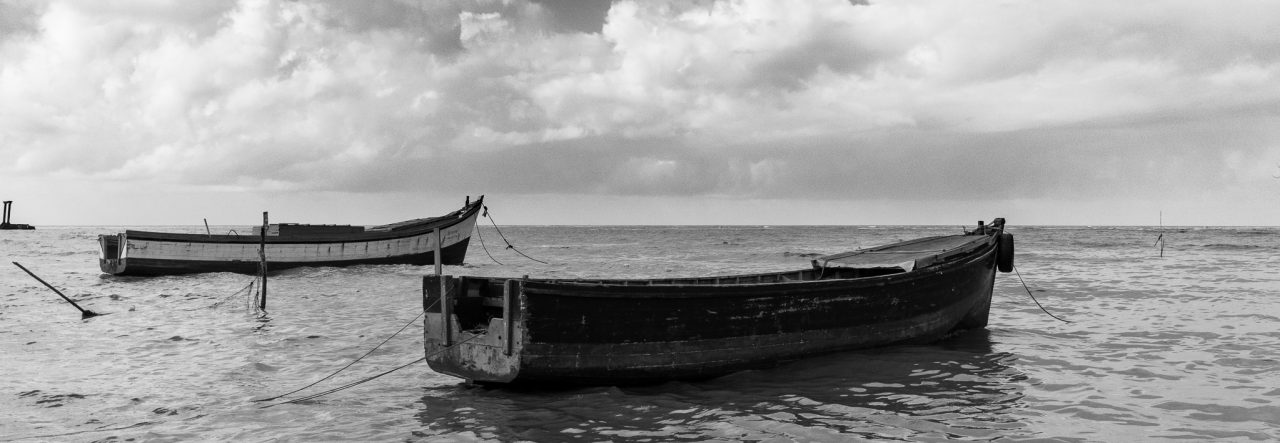
Nikhil does more unusual cropping than I do, often times he’ll use the cropping to help emphasise the subject, and this is something I don’t often do, usually when I crop I try to keep the same proportions as the original image, and I try to crop very little, usually only as a corrective method (to rotate the image correctly of to remove something at the edge(s) that shouldn’t be included).  I often forget that I can crop for emphasis and to strengthen the composition.

This week’s image is such an example, I originally thought that it was a good image, but for some reason it wasn’t as strong as I’d originally thought, so after some monochrome work on it I tried an unusual crop, and I think it worked.

Click on the image for a better view in the Gallery.

2012 Deck – Week 24

A Drive up the Rupert Craig Highway carries you past the villages of Plaisance and Sparendaam on the East Coast of Demerara.  My dad had once pointed out that what most people referred to as the “Catholic Church in Plaisance” was actually situated in Sparendaam (this would be the Church of St John the Baptist), and I couldn’t help but notice that the Saint Paul’s Anglican Church at Plaisance is also in Sparendaam.

I suppose that quibbling about the name of the location is minor since the street that marks the division of the two villages is the same street that both churches are on.  Now the street, that has name issues of its own…

As with most of the place names in Guyana, they reflect our past colonisations and our change from Colonial rule to Independence, the name Plaisance is of French origin, and Sparendaam comes from the Dutch.  Our last colonial masters were the British, when our country was known as British Guiana, and the two main streets running the length of Plaisance were (and to some extent still are) Queen Victoria Road and Prince William Drive.

During the “Burnham years”, one of the changes (some might call it an attempt to eradicate our history) was to rename streets that held “colonial names” to names that were more meaningful to a country emerging from colonial rule and striving for successful Independence.  In Georgetown one of the more notable changes was the renaming of Murray Street to Quamina Street.  John Murray was the Lieutenant Governor of Demerara from 1813 to 1824, Quamina was a slave involved in one of the largest slave revolts in Demerara during that time (in 1823 actually).

In Plaisance, Queen Victoria Road was renamed to Ben Profitt Drive, and Prince William Street was renamed to Andries Noble Avenue.  Ben Profitt was a notable village chairman of Plaisance, and Andries Noble is touted to be one of the best midwives of Guyana, there’s probably very few people over the age of 35 from Plaisance and Sparendaam whom she didn’t help bring into this world.

Although the name changes were made more than a couple of decades ago, the streets are still referred to by many using the original names, although most people who have grown up in the villages know them by both names,  So St Paul’s Anglican Church is sometimes referred to as being on Queen Victoria Road, and sometimes on Ben Profitt Drive, likewise it is also sometimes referred to as being in Sparendaam, as well as being in Plaisance..

I started this blog post just wanting to say something about St Paul’s Anglican Church other than “Here is a photo of the church with it’s cemetery as seen through a gate in its fence”, one thing led to another and now the post is almost 500 words long.

Without further ado; “Here is a photo of the church with it’s cemetery as seen through a gate in its fence” 🙂

St. Paul’s Anglican Church

Click on the image to see it better in the Gallery, along with other images from this year’s Deck Project.

2012 Deck – Week 23

I’ve heard people say (this would be either in person, in books or on television) that they can tell a lot about a person by “certain things”, like their shoes, their watch, their friends, what they read, etc. etc. etc.

I’m sure some psychiatrist / psychologist / psychic can probably try that, I won’t even think of trying, given the wide range of books that I’ve read so far, I’d probably be classified as insane or at least as having no particular taste….  I was going to indicate here what I have read, in a broad sense, but I think I’ll keep the idea of me being insane to a minimum for now.

Recently they were tidying and packing up some books that belonged to persons of significance in Guyana’s history, the books belonged to Forbes and Viola Burnham.  They have both died, Viola outliving her husband by a number of years.  Forbes (Linden Forbes Sampson) Burnham, was the second president of Guyana, although he preferred to be known as the first Executive President, that made Viola the First Lady of the time.  Under his presidency our country saw a lot of change, mainly the change that means losing what was then known as British Guiana to the new identity known today (and I use “today” to span the last 30 years) as Guyana.  The politics of it I will avoid, as there is no end to that type of discussion (it’s as bad as or worse than discussing religion).

A few books on the table caught my eye and I took a photograph, I just thought it strange to see those titles together, or maybe not so strange?  🙂

Forbes was quite likely Guyana’s greatest orator, one of the brightest, some of the books I saw were prizes won by him through his school years, and all looked “read”, not for show.

Due to the condition of the dust covers, some of the titles are not complete; they are:  Picket and the Pen, Jurisprudence, Mauritania and Profile of a Prodigy.

For anyone trying to “read” anything into this, it’s just a photograph, honestly!

Walk and Talk

I was processing this photo from 2009 and the title that immediately sprung to mind was “Walk and Talk”, obviously because that’s what the girl was doing; walking leisurely on the jetty, and talking on her cell phone (or mobile phone, or cellular phone, depending on your custom).

Then, of course, being a Caribbean Man, the song from “reggae great” Pluto Shervington popped into my mind as well; that would be “Ram Goat Liver”

As I am fairly certain that not many people outside of the Caribbean would know the song, I’m including the lyrics from the chorus:

Ram goat liver good fi mek mannish water
Billy goat teeth mek the earring for you daughter
Curried goat lunch put de bite in your bark
It mek you daughter … It mek you daughter walk and talk

I think that it is a good bet that the young lady in the photograph may likely be of East Indian descent, so the idea that she might have had Curried for lunch would not be too far fetched, and she can certainly walk and talk 🙂

Walk and Talk.
A cropped telephoto image. Click on it to see it better in the Gallery.

These days I have to wonder if the cell phone is more of a convenience or an intrusion.  As it is, they are now more than just phones, they’re basically what was once your home computer, now in the palm of your hand.  I remember when I owned a PC with a 386 processor that had an 80MB Hard Drive and at the time, that was considered large; now my smartphone has more than that amount of memory built-in and an additional card that can hold an additional 8GB of data.

But I digress.  It is convenient to have a phone always with you, rather than being tied to a land-line.  It is convenient to be able to check your e-mail, your Facebook and Twitter accounts, check stock trades and the latest news, and so much more.  There are, however, times when you can do without the constant interruptions, the unpredictable yet persistent “ping” or “bleep” or whatever “ring-tone” you’ve chosen to notify you of every event that the phone is now capable of alerting you to.  After weighing the Pros and Cons, I came to a decision that the mobile phone is as much as a convenience as you want it to be, and conversely, as much of an inconvenience as you want it to be.

My phone goes on silent when I go to Church, to meetings and to various functions where I prefer not to be disturbed, I feel the vibrations and I am aware that when I finish whatever it is I am doing that, after the hour or two, I will have a few (or quite more than a few) messages to read and maybe calls to return.  But I am the master of the phone, it is not the master of me, and quite frankly, that is how it should be.

Now I’m hungry for some Curried Goat!

2012 Deck – Week 21

Georgetown is changing, every day; some may say it is for the better, newer buildings, more businesses, a boost to the economy, others look at it as a neglect of the traditional, our history, our heritage and, ultimately, our past.

While others countries, even other Caribbean nations, strive to preserve and maintain the “Heritage” buildings, our politicians can’t seem to grasp the idea of Tourism generated by the longing to see just such buildings, they apparently think that tourists come here just to see the Kaieteur Falls.

Although my photograph for this week is not one of the exalted buildings, I think the point can be made that there are many buildings worthy of being preserved, saved and cherished.

There is a Heritage Building Corridor that runs through the heart of historic Georgetown, it stretches from the head of High Street where the building that houses the Canadian High Commission marks the first notable Historic building, and stretches down through Main street and into Avenue of the Republic where the Parliament buildings and Saint Stanislaus’ College mark the end of the designated corridor.

Among the numerous buildings in the corridor are the Prime Minister’s Ressidence, Red House, City Hall, the Demerara Mutual building, City Hall, Cameron and Shepherd, The Victorian Law (High) Court and St Andrew’s Kirk.  The National Trust of Guyana has earmarked twenty-four sites along the corridor as Heritage sites.  Some are kept in good condition, whilst others are falling steadily into disrepair.

This photograph is of a junction off the corridor, and while it may not be a historically important building, or of architectural value, it shows that many buildings are ageing, and unlike rum, some of which are said to be “aged to perfection”, this one has passed its prime, and is definitely somewhere the other side of perfection 🙂

Parliament Building

Almost two years ago, I was invited to accompany Nikhil into our Parliament Buildings to do some photography, this being the first time I had stepped foot onto these premises, I was very excited.

And I think, like my first time at the Falls at Kato, I may have been too excited, too excited to properly take in what I was seeing and translate it into photographs.

When I first started processing these two years ago I was very excited and began with my HDR image of the grand staircase which I showcased in my blog-post “Into the Halls of Power”.  After that the rest paled somewhat by comparison and I only went back to them recently.

I started off with my “Mail Drop Box” image that I had posted to my Facebook page, then a second HDR, of the Parliament Chamber, which I did a blog about.

After going through them all, I think that I’ve finally accepted what I had as better than I had thought, and I have processed my favourites from the set and uploaded them to a Gallery on my site.

I think I’d like to do a complete photo essay of this building one day, but for now I have a small selection to show; these include a few exterior shots, a few views of the famous Stabroek Market tower as seen from Parliament, a few corridor shots and even one that includes the St. Andrew’s Kirk.

If I had included a small version of each photo, this blog-post would be longer and have more space allocated to photographs then for words, so I’ve done a small graphical “film strip” with a few select images, and encourage you to click on the film strip to visit the Gallery and see the collection over on the site.

2012 Deck – Week 19

This week almost passed without me having taken any photos.  I had some slim pickings, but I think I got a nice one.

Nikhil has often used the word “Grok” especially as relating to “grokking the scene”.  It has become more important to grok the scene if you want to capture and express through the photograph what it is the scene says to you.

Even though I thought I had heard the word before, no one lese I know has ever used it as often as he does.

I check it up on Wikipedia and then thought to myself, “that’s where it came from!”, apparently coined by the author Robert Heinlein in his novel “Stranger in a Strange Land”.  I love the definition given for it in the novel (keep inmind that it is a Science Fiction novel set on Mars)

Grok means to understand so thoroughly that the observer becomes a part of the observed—to merge, blend, intermarry, lose identity in group experience. It means almost everything that we mean by religion, philosophy, and science—and it means as little to us (because of our Earthling assumptions) as color means to a blind man.

Can we understand a scene so completely that we become as one with it?  That is probably something to aim for, to achieve it would be great,

Here’s a photo of Nikhil, Grokking the scene  🙂

Click on the image for a better view in the Gallery, and if you haven’t seen the other entries for the Deck project they’re all over there in the Gallery.

Old(er)

Age is a relative thing, something (or someone) is either younger (or newer) or older than another by a certain amount of time, whether it is by minutes, days, years, decades, centuries, etc.

I’ve grown up knowing the Hand-in-Hand Insurance Building (and others of its time) and they’ve become landmarks to me, that makes them old, or older than the stuff that went up in the last decade anyway.

They may not be of the Victorian era, so their architectural aesthetics may be less appealing, but they are certainly a lot more appealing than many of the concrete boxes that are being erected these days.

The Hand-in-Hand building always reminded me of a concrete and stone attempt to look Victorian, or maybe semi-Greco-Roman, but I’m not an architect and my terms may be far off the mark.

I had always admired its arches, the wrought-iron fence, the wrought-iron “fret-work” that created the arches between the columns, the low-sprawling style of the building.

When I took this photo I never intended to process it in Sepia tone, yet that is what appealed to me when I began processing, and to help the age along a bit, I added a light vignette (hopefully not too noticeable)

So this building is Newer than Victorian, but probably older than I am 🙂

Hand-in-Hand – 7216