2013 Deck – Week 42

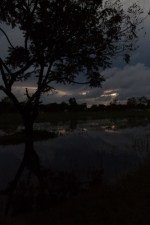
This week, there was a photo-walk to Hope Beach to see the sunrise, then onto the Mahaica River.  I knew from the outset, once I had seen the sunrise, that most likely my choice for this week would be a Sunrise photo.

I had already uploaded a landscape oriented one to the group, but I had taken a few portrait oriented ones as well, and it was one of these that I had already made up my mind to use for the Deck Project.

I had tried to get low, for a low perspective, and I was using the Sigma Ultra-wide again, I liked the texture in the rock I was using as a foreground object, but because I was hand-holding the shots, I knew that I wouldn’t do an HDR, not while balancing and trying not to fall into the water 🙂   But since I knew that I wanted that texture to come through, I had already decided on my post-processing… some shadow reduction and some dodging on the rock’s surface to bring out those textures.

I hope you like it


Click on the image to see it in the Gallery

2013 Deck – Week 28

I had stopped near the Shell Service Station at Ogle on the off-chance that there’d be something over the seawall to shoot, this was one of those times when I was not disappointed….  I took quite a number of photos trying to capture the mood, and I think this one comes close…  I have others that I may use at a later date, but this one reflects a lot of what I saw… and hopefully conveys the mood to you as well.

It’s 2 o’clock in the afternoon (remember we live in the tropics here in Guyana), but instead of a harsh overhead sun, we had very overcast skies, very fluffy clouds, not that dead-pan grey sky that depresses me, and the light filtering through the clouds was just enough to really lend something special to the scene.

As soon as I started walking along the wall I had company… a dog, apparently resident to the general area, but that’s a photo for another day  🙂  I photographed from on top the wall, from an eastern viewpoint, a western viewpoint, then went over the wall for another series of shots… all the while thinking about what’s the best angle…. what’s the best composition.

There are other photos, with other elements, but this one simplifies it for me and gets the idea across better 🙂


Canon EOS 60D, Canon 18-135mm Kit Lens  |  1/400s, f/13, ISO320, 18mm


Click on the image to view it in the Gallery, while there check out the other images for this year’s Deck Project, and other albums as well.

Every Tool

I’m not a purist; I don’t hold the belief that whatever JPG comes out of the camera is the reality that existed in front of the lens.  I do, however, believe that there is a certain amount of “truth” in my photographic work.  Friends and colleagues, other photographers and budding photographers in the Guyana Photographers’ Facebook group have heard me make the distinction between Processing and Editing many times.  And I will briefly make it here again…

Since I shoot in RAW format, the camera does no processing to the file (whenever you shoot JPEG the camera applies certain adjustments to the image, contrast, brightness, etc.) so I have to Process it in software, often referred to as Post-processing.  This usually involves adjusting sliders in a software like Aperture, AfterShot, Lightroom, LightZone, etc., things that are adjusted range from brightness and contrast, to hue and saturation, cropping, temperature, white balance, noise levels and more.  Although this is usually applied over the entire image, some software allows you to do it to parts as well.

Where I draw the distinction between Processing and Editing, is when the image is altered so as to become a new image, distinct from the original in content.  Simply put, if I add something or remove something from the original photograph, then it is no longer the same, it is now a work of graphic design, not only photography.

Do I Process my images? Always.  Do I Edit my images? Sometimes.  I’ve cloned out trash that otherwise marred the scene (the lone plastic bottle on a grassy stretch), but have often left in loads of trash because it was part and parcel of the scene.  I don’t have anything against editing, but I don’t think its fair to call it a photograph after you’ve added in entire clumps of trees, removed several utility posts and added muscles to an individual… that is definitely in the realm of photo-illustration or Graphic Design.

I am also a big proponent of using every tool that you need to get the image that you saw with your eyes, and in your mind across to the viewer.  Whether its special filters on the lens to get a mood or effect, an angled lens in the developer of a dark room to create a distorted view, using Black and White (Film or processing) for an aged or structured look, using long and super-long exposures for light trails or flowing water, external flashes and reflectors for extra lighting on a subject, gels and filters for colour enhancements, or even doing some of this on the software end, I am for it, but I believe in being true to the original vision as much as possible.

Fancy processing and editing is no substitute for a good original image.  I am no expert or professional, many of my images come out of the camera looking very disappointing, and I often discard or simply not process them.  Yes, you can “save” them, I have even done so on some occasions, simply because I believe that they were worth saving, but they had to have something good in them to begin with; a good composition, a relatively good exposure, and maybe even compelling elements to the composition.

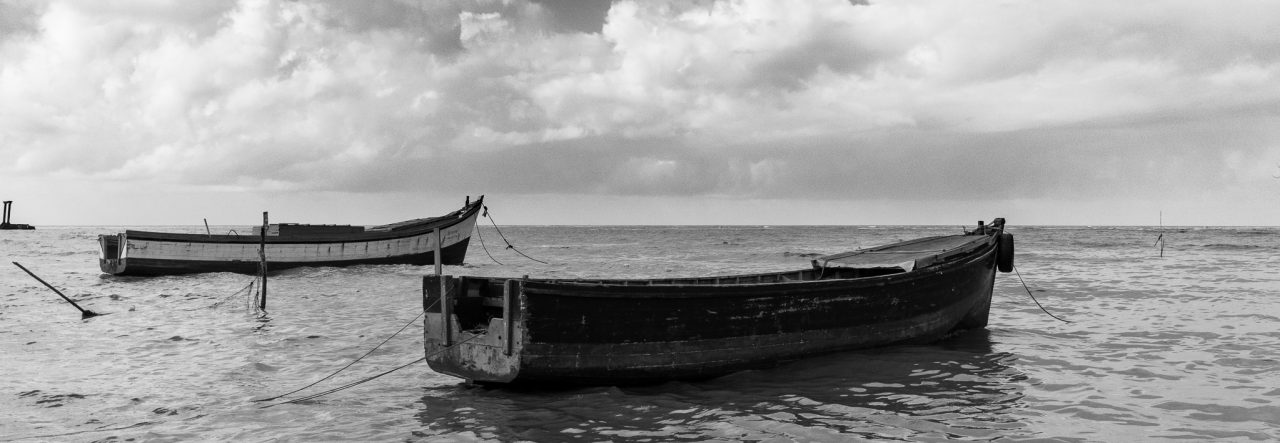
I’ve rambled enough… time for a photo.  This is one of those photos that I “saved”…  The original was good, maybe better than good, but it was not what I wanted….  I wanted more detail in the sky, more of a structured appearance than the original coloured version, and (because of an architectural quirk) more symmetry.


Canon EOS 60D  |  Tamron 18-270mm  |  21mm, 1/160s, f/7.1


I used Lightroom to create five different exposures from the original, each 2 stops apart in exposure, then I used Nik HDR Efex Pro to merge my new exposures and coax the detail I wanted from the overall scene, then I used Photoshop (I know, I’m a horrible person) to skew the perspective ever so slightly to gain some symmetry.

Although I did not add or remove anything, I normally would consider this edited since I used Photoshop to change the original proportions of the image, but in this case I’d let that slide 🙂

Click on the image to see it in the Gallery along with others in the Black and White series.
2013 Deck – Week 23

Keeping a photo project going is not easy, I found that many times I “force” the images by going out looking for things to shoot… and often times I’m not entirely satisfied with the results.  Most of the images that I like are the ones that I just happen to see, being in the right place at the right time  🙂

I was on the pavement near the intersection of Regent Street and Avenue of the Republic when I noticed the reflection of City Hall in the flooded pavement and road near to me, I actually had my camera in hand and tried to compose a few shots between people walking by me, and vehicles splashing the waters occasionally.

Some people can go out and “make” the photos, others are just the instrument that is manoeuvred into the right place at the right moment to see and capture what is shown to them  🙂


Canon Rebel T1i  |  Sigma 17-50mm  |  17mm, f/8, ISO400


Click on the image to see it in the Gallery along with the other images in the 2013 Deck Project.


Sunset’s Ghostly Walker

I still think that some of my favourite photos are from my pre-DSLR days, but that is probably because those were the days of learning about photography… I’m still learning, but at a slower pace 🙂

Since switching to a DSLR, I found that I take less of the images that excited me back then… I take less Macro photos and I take less long exposures in the evening…

I’m sharing one of the those evening ones today,


Rupert Craig Highway, the Green Light you see there is the traffic light at the Conversation Tree junction.

October 22, 2008, 6:02pm  |  6s, f/8, ISO 80  |  Canon PowerShot S5 IS


Click on the image to see it in the Gallery, along with some other Sunset / Sunrise photos

Goodbye Uncle Harry

Growing up, my maternal grandfather was seldom seen in the congregation of the church, he was always at the back “helping out” Uncle Harry.  I grew up knowing Uncle Harry as Uncle Joe, then others called him Harry, when I asked my grandfather about it he said that he is Harry Joe!  You never question wisdom like that!

Uncle Harry would be there to open the church, he’d be there to close the church, he was the man to go to to get your weekly Catholic Standard, or the tickets for the next Festival of Carols.  He would hand out the collection baskets to the people who would be needing them for each mass, and he’d have Bibles, Hymnals and other little books on sale too.

He was as grumpy as he was jovial.  He was a New Year baby, born on the 1st of January, worked for many years at Banks DIH, from all the way back when it was known as D’Aguiar’s, and he worked at the Cathedral of the Immaculate Conception for as long as my memory serves, up until he was retired a few years ago.

After retirement from his duties in the church he’d try to attend either the early morning 6:00 am mass, or the next one at 7:30 am on Sundays, rain or shine, in his long pants, dress shoes, shirt-jac, umbrella, hat and his spectacle case and pen in his top pocket.

He died on Sunday 17th March 2013, St Patrick’s Day, at around 2am; it was his time.  May his Soul Rest in Peace.

I had taken that photograph of him (candidly) two days before my own birthday in 2011, and he was sitting there staring towards this altar below:


2012 Deck – Week 52

I don’t know about anyone else, but I think this is the way to spend the last weekend of the year, with family and family friends, relaxing near a pool, sleeping under the stars (in a tent), far away from town, and I have my camera, spare batteries and spare memory cards  🙂


Click on the image above to see it in the Gallery along with all the other images for the 2012 Deck Project.

Reflecting on the year, it’s been great in some areas, specifically Photography.  Even though my personal photography has not been great this year, and by that I mean I am not happy with the overall amount and scope of the photos that I have taken this year, it’s been a great year for my photography in the following ways;

Neil Marks lobbied and secured for Nikhil and myself the opportunity to exhibit some of our work in a joint exhibition at the National Art Gallery (Castellani House) early this year; our involvement in the Guyana Photographer’s group has brought us into contact with many many talented local photographers, and we have seen the group blossom and grow under the guidance of the Admins and our fearless leader Fidal; the Ministry of Culture, Youth and Sport revived the biennial art competition (after a 20 year absence) and included Photography as one of the new categories, in which Nikhil won Gold, Sharon won Silver and I won the Bronze medal, I had a photo of mine selected to be used as the Cover Image for Caribbean Beat, the official magazine of Caribbean Airlines (an MEP Publication), and three local firms are using a few of my images in their 2013 Calendars.

If my count is correct this is my 300th Blog post, also an achievement, since I never thought I’d have anything to write that anyone would want to read…of course, the photos help!  🙂  Now, I just have to make 2013 count!  🙂

Have a great Old Year’s Night, and a very happy and prosperous New Year in 2013.

2012 Deck – Week 47

Last night (Friday 14th December 2012) I stood alongside two friends and fellow photographers, on a stage populated by artists, art-lovers and art patrons, among Giants in the Guyanese art-sphere who are masters in Painting, Sculpture, Drawing, Crafts, and I felt exalted and elated.

I am not a painter, nor a sculptor, I cannot draw nor mould, but this year the Guyana Visual Arts Competition and Exhibition committee included Photography as an art form, the first time in Guyana.  I was given the Bronze Medal, for third place in the Photography category, and was excited that my long time friend and photo-buddy, Nikhil, won the Gold, and his wife, Sharon copped the Silver.

I was thrilled to be included as a prize-winner, but even more astounded that I was chosen from what is reportedly a heavily contested segment, especially knowing that many other members of the Guyana Photographer’s Facebook group also entered amazing pieces.

To me, winning the Bronze was a giant step, but being among the first Photographers to be so honoured in Guyana is even more special.  To have our work judged meritorious is always gratifying, to have them judged by “Artists”; sculptors and Painters, Curators and Critics, and not by photographers is validation of Photography as Art in Guyana.

This is but a “drop in the bucket”, I look forward to the works of fellow photographers, fellow artists, as the future Competitions promise to be even better.

This brings me to my photo for the Deck Project for Week 47 of this year, “A Ripple in the Fabric”, I say to other Photogs, to other Artists, to all Guyanese who love art, “Look to the future, for this ripple in the fabric of the Guyanese art-world will not subside, but grow and change the way we Guyanese see Photography”

A Ripple in the Fabric

I don’t normally try Cyanotype processing, but I thought that this image looked better with a tinge of blue  🙂  I could be wrong….  Click on the image above to see it in the Gallery!

2012 Deck – Week 42

Sometimes, in any art form, you have to break away from the norm, step away from the straight and narrow line that you’ve followed all along, and try something different.

I’ve broken the rule about shooting into the sun before, so this is not new…. but trying to get the palm tree and horse as the focus while doing so was different for me, and even then I was not ecstatic about it, when processing, I went for a duotone processing that I don’t do, and I though that the result was pleasing.

Although the original duotone processing had much more colour to it, I toned it down a bit to bring the focus back to the photo rather than the duotone, and the result; “sunset Liliendaal” 🙂

sunset Liliendaal

Click on the image for a better view in the Gallery!

2010 – Flood Waters at the Park – HDR

As coastal dwellers we are always mindful of the flooding of our properties, growing up it never seemed that much of a problem, but now it seems more frequent.

Six feet Under –  A phrased usually reserved for the dead and buried, is also the correct description of Georgetown, the capital of Guyana.  The city is six feet below sea level, and all that protects us from the might of Neptune’s oceans is the famous Seawall, which was built by the Dutch when they colonized the area, back in the nineteenth century.  It’s a good thing the Dutch know how to build these things!

When rain falls heavily (sometimes it just has to drizzle) and the tides are high, areas within the city, and even along the coast, become flooded to various degrees, most times it may just be an over-topping of the drainage canals and trenches.  One good side effect of this is the lovely reflections of scenic places in the calm, still waters.

I’d shot multiple exposures for an intended HDR image, as these things turn out, I never got around to it until now.  I’ve gone into detail on what an HDR is and even twice detailed how I approach the processing, but since it has been a little while since those posts, I’ll just give a brief description on HDRs here.
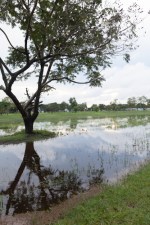
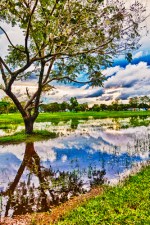
HDR stands for High Dynamic Range, it is a technique used in imaging and photography to produce in the resulting image a wide (or high) range in the luminance of an image.  Simply put, it attempts to retain as much detail as possible in the lighter (brighter) areas as well as in the darker (shadow) areas.

These two images show (a) the underexposed image that is used to capture the detail in the lighter areas, notice that the rest of the image is very dark, and (b) the overexposed image that is used to capture the detail in the darker areas, notice that the sky and water in this are very bright and show little detail.

When these are combined with the neutral or “normal” exposure image, the dynamic range of the final image is increased.

After combining or layering the images in an HDR software, the process by which the photographer renders the final image is called tone-mapping.  In this process, various sliders are employed to adjust things like brightness, contrast, light, shadows, and, depending on the HDR software being used, a variety of “specialty” sliders.  The resulting image is usually to the photographer’s taste, some with a desire to approach realistic images with a higher dynamic range than a standard exposure, others go for a more surreal result, some can carry this as far as having a very high contrast, high saturated look that is more illustration than photography, but that’s a debate for others.  To the left is a small image processed for effect, very vibrant very “artsy”.  It is also possible to tone-map a single exposure to achieve some of the same HDR effect, although I do not personally call this an HDR, I refer to them as Tone-Mapped Images, another possibility is to use a single exposure to create the various over and under exposures in software, then combine them, this I refer to as a Pseudo-HDR, but these are only my terms and distinctions.

My preference lies in trying to produce an image that resembles the scene that I saw, but could not reproduce in a single exposure, for some scene this will result in a photo that may have people wondering whether or not it is an HDR, and in other cases it will leave no question that it’s not a standard exposure, but definitely and HDR, especially when I try to reproduce the great detail that is there in a cloudy sky (such as my “Doomed” from the Coastal Wanderings exhibition at the National Art Gallery).   The results of this particular HDR processing? I’ll let you decide.