2014 Deck – Week 20

This week I got access to my third DSLR Camera, I now have access to a full frame Canon EOS 6D, and as with both my previous Cameras, I wanted the first exposure to be a good one, not necessarily great or extra-special, but a good one.

I decided this time that instead of just finding a nice scene to capture that I know would come out well, I wanted to do an experiment…  I know that I would get a vignette if I used a lens made for a crop sensor camera on a full-frame camera, so I thought I’d try to use it creatively… not sure what others would think, but I think it came out rather well…

So, now I’ve tried it, and probably won’t be doing it again 😀


Canon EOS 6D, Sigma 10-20mm Lens


Click on the image to see it in the Gallery

2014 Deck – Week 18

36 Days Old.

So I don’t really do portraits, but my wife and sister-in-law were all gung-ho to do a few photos of our daughter Malina that were “staged” .

So I obliged.

It’s not ground-breaking (been done a million times), but it’s what they wanted 😀


Click on the image to see it in the Gallery.

2014 Deck – Week 17

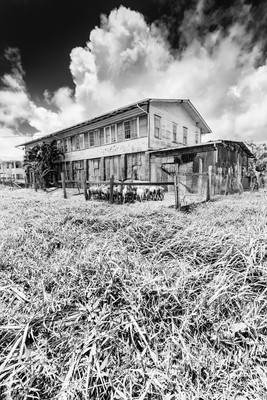
Always Stop!

When you see something that you think might be remotely worth photographing, don’t doubt yourself, just stop to take the photo.  Of course, I’ve had many instances where stopping just wasn’t possible, practical or prudent (read that last one as lawful), so some photos remain as electrical impulses in the synapses of our brains.  When it’s possible to stop, just stop and take out the camera and go shoot a few exposures, if not, you’ll be kicking yourself for some time after.

This was one of those times that I stopped.  I’ve driven past this building many times, and always thought that there’s a good photo there somewhere… this particular day I saw the sheep in the corralled area, the sky beyond the building, and as I turned the corner, mentioned to my wife “that’s a nice photo”, she said stop, so I stopped in the corner, got out my camera and trekked back to the junction.


Canon EOS 60D  |  Sigma 10-20mm  |  10mm, 1/160s, f/9.0, ISO100


Click on the image to see it in the Gallery.

2014 Deck – Week 16

The evolution of each photographer never really stops, and by this I mean their knowledge of the craft, their view on what makes a good composition, their approach to colour, their use of tools… it is a process that each of us goes through, and it really doesn’t stop.

We may settle into a favoured style, and we may be known for things such as capturing facial expressions, or the use of colour in portraits, or known as a black and white street photographer, but often these are not things a photographer does to the exclusion of all else, but merely a focal point (pardon the pun) at a given period in his/her evolution as a photographer.

While I have read about this before, the realization was brought home to me when I was preparing images for my recent presentation at Moray House, and I went in a somewhat unexpected direction (for myself, anyway), I presented all black and white images of areas along Guyana’s coast, and I liked what I chose… I really did (although the worry was still there that no one else would like it).

So, after all that rambling, today I veer in the opposite direction, to an image that I think helps define how I think colour should be used in a photograph, not just to be there as part of the whole, but to make a point.


Canon EOS 60D  |  Canon EF40mm  |  1/100s, f/3.5, ISO100


Click on the image to see it in the Gallery along with other images from this year’s Deck Project.

2014 Deck – Week 14

I am scheduled to do a presentation of some of my select works on October 9th at Moray House (part of the Moray House Trust’s foray into encouraging local photographer to express their vision of their art), and I am very nervous about the whole thing, I am not sure what to say.

I often don’t mind sharing my work, but to talk about it makes me feel queasy; I’m usually afraid I’ll either come off as not knowing what it is I’m talking about, or as being pretentious, trying to pass off what I do as “art”…

But, I’ve committed to it and I’ll either make a complete mess of the whole thing or come out the other end, not much worse for wear 🙂

The title I chose for my Seascape collection is “Oniabo”, an Arawak word meaning water, I’ve decided to use an extended version of this title for this presentation at Moray House, which will include most or all of the 6 photos in the Oniabo series as well as other images at the seawall.

That being said, the photo I offer for this week was one under consideration to be part of that presentation, but was subsequently side-lined.  Although it in no way resembles Hiroshi Sugimoto’s work, it reminded me that Sugimoto’s Seascapes collection is the reason I had decided to begin a Seascape project in the first place,

Sugimoto begins his description of his series like this:

Water and air. So very commonplace are these substances, they hardly attract attention―and yet they vouchsafe our very existence.

My seascapes invariably often include some “land” or earth (a third element?), but this one I titled “Born of Air and Water” as a reminder to myself of Sugimoto’s words.


Canon EOS 60D  |  Sigma 10-20mm  |  10mm, f/4.0, ISO100


Click on the image to see it in the Gallery along with other images from this year’s Deck Project

2014 Deck – Week 13

It really wouldn’t matter what photos I took during week 13 of this year, I’d still choose this one.  I could have gotten a spectacular milky way shot, or the best Kaieteur photo ever, even if I had captured the perfect Cock-of-the-rock photo, or gotten the chance to do a photo shoot of Bon Jovi, I’d still choose this one.

We welcomed our second daughter into our family, so I‘ll just stop jabbering and show you the photo I chose, although many of you might have already seen it on Facebook 🙂


Canon EOS 60D  |  Canon EF 40mm  |  1/60s f/2.8 ISO200


Click on the image to see it in the Gallery.

Colour or Monochrome

When film (or plate) was the way to capture photographs, there were many many debates, just like there are now.  They didn’t debate sensor sizes, they debated film sizes (and that had so many I won’t even start on that), and just like many enthusiasts and professionals now debate colour vs monochrome, so it also went back then.

While there were specific films developed for both types back then, in the digital age we are pretty much guaranteed that the camera you buy, whether the one in your mobile phone, compact camera, mirrorless or DSLR camera, it will in all likelihood take the photos in colour, which you can then convert to monochrome (black and white, sepia, etc) in post-process, whether in-camera or in software on the PC.  This changed when Leica developed their Leica M Monochrom, it was the first major brand to produce a high-end digital camera that produced only black and white photographs, and rumor has it Sony is working on a black and white version of their RX 1.  I don’t want to get into a debate myself over the need or desire to have a camera that only shoots monochrome, I can only say that it is unlikely I would ever buy one myself, but that is probably only my wallet talking.

In the genre of Street Photography, there is usually a preference for black and white images, but there are many many great coloured Street Photographs out there, more than you’d think.  Henri Cartier-Bresson’s work in street photography was very definitive for the genre, and all his work was in black and white, he also experimented with coloured film but was never satisfied with the results; of course, he only had access to the types of film available then (the 1950s) and if you look back at coloured prints from those days you’d see the limitations of the coloured film of the time.  I dare say that if he had lived in a later era, he may have at least given the coloured films a chance.

When I first started taking photographs on a slightly more serious basis than just snapshots, I didn’t do much black and white processing, and even when I did, it was more for the novelty than because I knew why it should be done and to which photographs.  Now I do a lot more processing in black and white…

What have I learnt that changed my views?

I’ve learnt that not all photos look good in monochrome, the tonal range and subject matter is very important for an image to look good in monochrome.  Monochrome images tend to showcase textures, shapes and form better, and by removing colour from the image you are left with just the elements that make up the composition, and if those elements are not functioning correctly in the overall composition, it will feel off, or look cluttered.

When used correctly, colour will catch the eye and hold it, this works for some compositions, but for others, that same thing tends to shift the focus of the viewer from the overall composition and have them concentrate almost solely on one portion of the image.

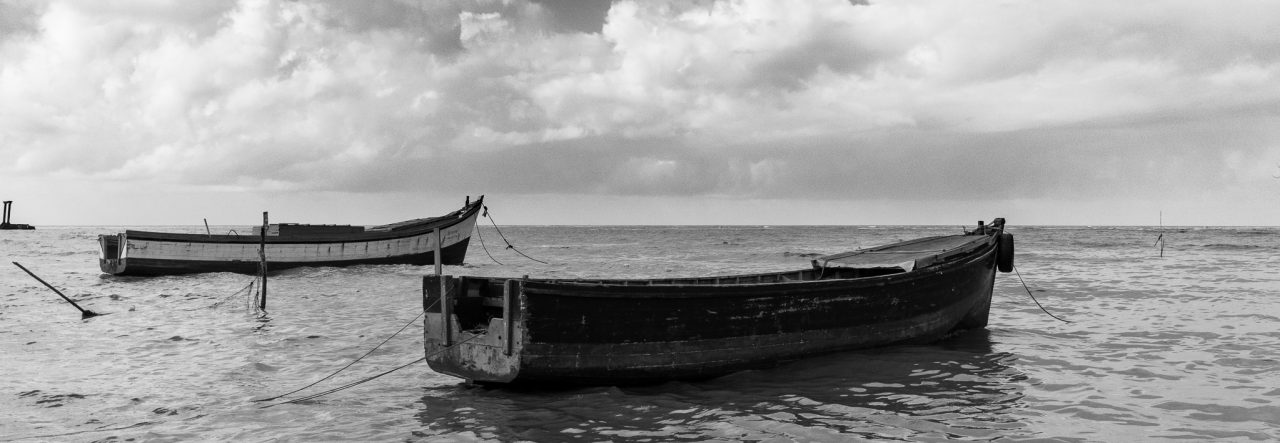
I’m no expert, but this is how I see it; recently I took a few photographs of some Jhandi flags on the Kingston seashore, and I chose two that I liked, and I processed them quite differently, and primarily for the reasons stated above.

This one I chose colour, because the main subject and the focus of the image is the Jhandi flags themselves, the various colours chosen as they contrast with each other, the browns of the sand and the blues of the sky.

The second image I processed in black and white to articulate the relationship between the clouds in the sky with the sands on the ground, the change from dark to light in both the sky and the land as they meet at the horizon, the sharpness of the shadow from the midday sun, and the contrast between the flags on the pole so close to the viewer against what seems to be a smaller post in the distance to the left of the frame.

These are my decisions, they may quite well not be anyone else’s choice.


In the end, these are choices I make in how I express myself artistically now, it is not how I did it a few years ago, it may not be how I do it five years from now.

Click on the images to see them in their respective galleries.
2014 Deck – Week 12

For this week I actually had quite a few photos to choose from, mostly along the seawalls.  Fidal Bassier had invited me along to shoot with him, he was doing part of a photo-shoot for Miss Earth Guyana, Ms Stacy Ramcharran, and even though I was late getting there, I decided to stop anyway and see what was going on.

The talented team from Bravo Arts under the direction of Steve Bravo had already done an amazing job of the body paint etc., and Stacy’s entourage were well in attendance and assisting her with all the necessaries.

Fidal was setting up on a mound on the southern side of the National Park, the winds had picked up a bit and he asked me to help hold one soft-box in position while I was there…  but I’m a photographer, and I just couldn’t resist the urge to click the shutter button.

Whilst holding the soft-box in one hand (the wind was trying very hard to tug it out of position and out of my hands), I slung my backpack to the side and extracted the camera with one hand, the lens on the camera would have to work… it was the Sigma 10-20mm, so I suspected that cropping after was most likely.

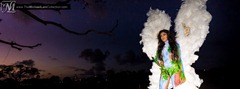
I took only two photos, mainly because Fidal decided at that moment to switch locations, and by the time we had set up at the next spot, it was time for me to say adieu.  One photo I had cropped and sent to Stacy, she ended up using it as the Cover image for the official Facebook Page for Miss Earth Guyana 2014:

IMG_3953-2


The second one, I did not crop, it was the one I preferred, and I had decided since then that I would likely use it for the Deck project, so here it is:


Click on the image to see it in the Gallery along with other images from this year’s Deck Project

All-in-all, it was educational to watch these folks at work, and that I clicked the shutter twice, and got two photos that were usable, I feel good 🙂

Bask

In going over older photographs, I usually have an easy time of picking out the ones I want to keep and those that I either will never use or would come back to later (eventually).

This one sort of nagged me.  I don’t think it’s a particularly great shot, but I kept going back to it, I decided yesterday to process it and see what developed, and although I still think it’s just a photo of a rock on the seashore, I’m partial to it.


Click on the photo to see it in the gallery along with others in the Black and White Collection.


Bask

Battered by the pounding waves
at times of high water,
stood upon as a refuge
from the swirling foam…
pinched by crabs as an anchor
from the pull of the receding waters,
Covered by shifting sands,
and uncovered by the waves,
ebb tide is past and
the waters are gone
basking in the warmth
of the sun, this fine dawn.