A walk on the beach

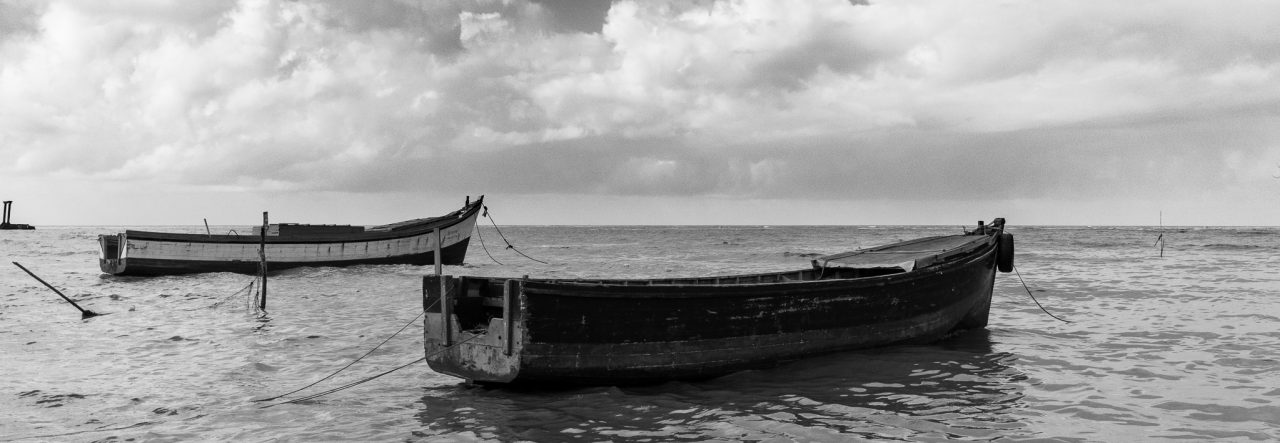
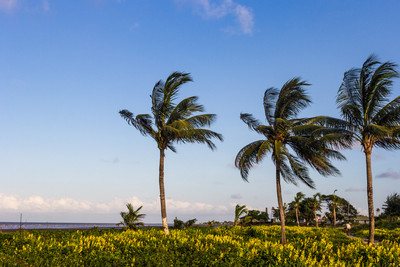
A few Fridays back, I joined a few other photographers on a walk down to the large jetty (pier/groin) that marks the end of the Kingston seashore and the beginning of the Demerara River mouth.

As with all walks with photographers you go hoping to come back with a good image, or even a great one, yet when I downloaded my haul I was very disappointed, maybe I was hoping for too much.

Does this mean that the walk was not a success?  No.  It was what it was… a walk on the beach.  To be with friends, people with a similar pursuit, and enjoy the conversation, the breeze… that was enough.

All the photos were not horrible, but not jumped out at me, yet I decided to process at least one to make a show of reaping something from the toil of the harvest.

As I look at the image I processed, I wonder if this scene will get worse or better with the development of the new Hotel on the seashore.


Click on the image to see it in the Gallery along with other Seawall related photos

A Good Photo

For my Deck Photo last week I used a black and white image of a bird walking across a wet expanse, one of my friends and fellow photographers told me that she didn’t like the photo, because it made her feel sad and lonely

When she told me that she didn’t like the photo, I was a little disappointed to tell the truth, but when she told me that it was because it made her feel sad and lonely, I was elated.


One of the things that makes a good photograph is the conveyance of some sort of emotion to the viewer.  For most photos, we look at them and move on, it was a photo of a sunset, or a flower, or an insect, or a door, or a building, or a bird, or any other subject you can think of, but when someone can say that a photo of mine made them reminisce or feel happy or sad, of any other emotion, then I feel that the photo was not only good, but better than I’d hoped for.


Each photo has the potential to reach past the optics of the viewer and into their emotions, when it does, then the photo was worth taking, it was worth the pixels that were spent on it, and the time it took to take and process.

None of these photos are new, but each one has had an emotive response from a viewer, it may not do it to everyone, but to me, that is what makes photography a challenge, to reach into as many of the viewer’s hearts as possible, but to even reach one, is usually enough for me.

As usual, click on the images to see them in their respective Galleries in the Collection.

Working With Wides

Well, I wanted to say “Playing with a Wide-angle Lens”, but I couldn’t resist the alliteration. 🙂

The word wide is relative, so I’ll describe how I use the terms, these are probably not industry accepted descriptions, so don’t quote me 🙂   Your basic entry-level DSLR usually comes with a kit lens that has a range of focal lengths from 18mm to 55mm, this I consider to be a wide telephoto lens, at the widest end (18mm) you get a nice wide view and at 55mm you get closer to close up of the subject, I consider somewhere around 33mm (on the crop-sensors) to be somewhere around “normal” (mind you, I’ll be talking from the stand-point of an APS-C sensor or crop sensor, a full frame or micro-four-thirds is an entirely different scenario)

Since this is the standard kit lens that most people get, we don’t often see it as wide, so that’s when we go Ultra-wide.

My favourite wide-angle lens (OK, the only one I have in the Ultra-wide category) is the Sigma 10-20mm, this produces pleasing images for me, and I love working with it.  You get some amount of distortion at the wider end (understandable) but this tends to be good in certain circumstances.

Often, in architectural photography, you can use wides and ultra-wides to capture more of the interior, and convey more of the sense of space and more of what encompasses the room.

At other times, you can use them closer to the subject to give an increased sense of distance, even accentuate the distortion by being close (do this with people’s faces, and you’ll get some weird effects)

I used the ultra-wide to capture the corner of this building (New Building Society), along with parts of the sidewalk and sky (and a pedestrian) 🙂

There are many things you can do with a wide, many of which I don’t do, I don’t normally put it right up to people’s faces and click, but I’ve seen those photos, and it’s a neat effect  🙂

What I did in this next image was to use the ultra-wide to adjust the sense of scale, I used a fire-hydrant in the foreground to dwarf a three-story building in the background.  One thing that I liked about this shot was that I didn’t have to worry about electricity wires!

The best way to see what your wide-angle lens or your ultra-wide angle lens can do is to put it on the camera and go have fun.  Sometimes it makes compositions tricky as it tends to include everything, even things you may not want, but like working with any focal-length, it’s up to the photographer to adjust framing and composition for these things.

I mentioned using wide-angle lenses for interior architecture, well I doubt if a tent falls under the category of architecture, but I suspect the engineers who came up with the idea for this tent would appreciate the use of the wide-angle for impact  🙂  And would you look at the view!  🙂


All images above were shot with the Sigma 10-20mm on a Canon body, Click on the images to see them in the Collection along with others in their respective Galleries.


Pretty and Poisonous

When I was much younger, we watched movies with Cowboys and Indians, and that sort; and we were fascinated by weapons such as arrows (and bows), blow darts and spears.  Something about them made you associate the primitiveness and the simple basic but deadly form with skill, rather than the crude but equally deadly firearms.

Reading stories and watching films that included “poisoned darts” was fascinating and intriguing, and it also made you wonder where the poison came from, was it man-made or natural?

One of Guyana’s major tourist attractions is the Kaieteur Falls, situated in the Kaieteur National Park, in this area, there lives a species of the Poison Dart Frogs, Colostethus beebei, it is commonly referred to as the Kaieteur Golden Frog.  It is a tiny frog, of a brilliant golden yellow, that lives in the watery areas in the giant bromeliad leaves that are popular around the waterfall.

This frog produces a toxin that (dependent on the dosage) can kill small insects up to larger arthropods, I do know that they tell you NOT to touch the frog, it’s skin secretes the poison, only it’s feet have no poison glands.

On my first visit to Kaieteur in 2009, I was fortunate to see a few of them, and to get a fairly decent shot of one… not great, but decent  🙂

Expression

During this season when many people wish for World Peace, Goodwill among Men, we also see many young lovers finding new ways to express their love for each other.

Many novels and movies have lines like “I’ll shout it to the Heavens”, but it seems that in Guyana, we have a new method… “I’ll paint it on the Seawall!”

Some man (or woman, we are living in a new age) seriously meant for the subject of their amorous intent to see the writing on the wall  🙂

Click on the image above to see it in the Gallery along with other images done using the HDR (High Dynamic Range) multiple exposure method.


This image is an HDR composite of three exposures, I stood there waiting for the traffic to clear long enough for the three exposures  🙂


Changing Roles

There are lessons to be learnt from our children, if only we could be as open and as innocent as they are, this world may be a better place.

Recently, the Sunday School program planned (although I use that word loosely in their case) a pageant for the Christmas Season, to perform the Nativity after the Sunday morning mass.  We showed up on Saturday for what we thought was the first rehearsal, with my daughter thinking she would be a shepherdess, only to realize that it was to be the ONLY rehearsal, and that since the girl who was slated to be Mary was absent, they asked Miriam if she would substitute.  Needless to say I was livid, but my daughter was overjoyed to be part of the pageant, and looked forward to playing the part of Mary.

So, her shepherd staff went to Joseph, and we had to ask my mum for an outfit for her (my mother runs St Jude’s Playgroup, and they carry on the Nativity Pageant every year, so the basics for the costume were there) 🙂

The adults who were supposed to be organising the pageant should be chastised (the ladies who actually conducted the rehearsal and executed the pageant were not the original organisers, and they pitched in and did all they could for the children), and ashamed of themselves, but the children who pulled off a last minute pageant that went almost flawlessly, should be more than proud of themselves, and their parents should be equally proud of their children, I know that I am proud of them, especially my daughter (I am very biased) 🙂

2010 – Flood Waters at the Park – HDR

As coastal dwellers we are always mindful of the flooding of our properties, growing up it never seemed that much of a problem, but now it seems more frequent.

Six feet Under –  A phrased usually reserved for the dead and buried, is also the correct description of Georgetown, the capital of Guyana.  The city is six feet below sea level, and all that protects us from the might of Neptune’s oceans is the famous Seawall, which was built by the Dutch when they colonized the area, back in the nineteenth century.  It’s a good thing the Dutch know how to build these things!

When rain falls heavily (sometimes it just has to drizzle) and the tides are high, areas within the city, and even along the coast, become flooded to various degrees, most times it may just be an over-topping of the drainage canals and trenches.  One good side effect of this is the lovely reflections of scenic places in the calm, still waters.
I’d shot multiple exposures for an intended HDR image, as these things turn out, I never got around to it until now.  I’ve gone into detail on what an HDR is and even twice detailed how I approach the processing, but since it has been a little while since those posts, I’ll just give a brief description on HDRs here.

HDR stands for High Dynamic Range, it is a technique used in imaging and photography to produce in the resulting image a wide (or high) range in the luminance of an image.  Simply put, it attempts to retain as much detail as possible in the lighter (brighter) areas as well as in the darker (shadow) areas.
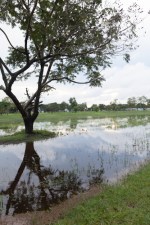
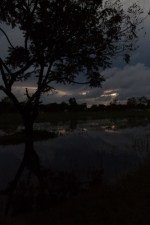
These two images show (a) the underexposed image that is used to capture the detail in the lighter areas, notice that the rest of the image is very dark, and (b) the overexposed image that is used to capture the detail in the darker areas, notice that the sky and water in this are very bright and show little detail.

When these are combined with the neutral or “normal” exposure image, the dynamic range of the final image is increased.

After combining or layering the images in an HDR software, the process by which the photographer renders the final image is called tone-mapping.  In this process, various sliders are employed to adjust things like brightness, contrast, light, shadows, and, depending on the HDR software being used, a variety of “specialty” sliders.  The resulting image is usually to the photographer’s taste, some with a desire to approach realistic images with a higher dynamic range than a standard exposure, others go for a more surreal result, some can carry this as far as having a very high contrast, high saturated look that is more illustration than photography, but that’s a debate for others.  To the left is a small image processed for effect, very vibrant very “artsy”.  It is also possible to tone-map a single exposure to achieve some of the same HDR effect, although I do not personally call this an HDR, I refer to them as Tone-Mapped Images, another possibility is to use a single exposure to create the various over and under exposures in software, then combine them, this I refer to as a Pseudo-HDR, but these are only my terms and distinctions.
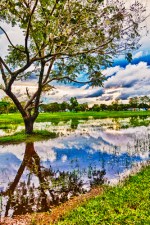
My preference lies in trying to produce an image that resembles the scene that I saw, but could not reproduce in a single exposure, for some scene this will result in a photo that may have people wondering whether or not it is an HDR, and in other cases it will leave no question that it’s not a standard exposure, but definitely and HDR, especially when I try to reproduce the great detail that is there in a cloudy sky (such as my “Doomed” from the Coastal Wanderings exhibition at the National Art Gallery).   The results of this particular HDR processing? I’ll let you decide.

Dump

I can’t remember where we were going this day, but I do remember wanting to get the photograph, although we were quite a distance away, so I used the long telephoto to quickly snap this.

This is where the City’s garbage dump meets the Body Dump, or more respectfully called the Le Repentir Cemetery.

The smoke was drifting across from the burning garbage (it apparently spontaneously combusts periodically), the excavator was clearing some paths and moving some garbage, and the birds were just hanging around for the “disturbed” earth and garbage.  🙂

Click on the image for a better view in the Gallery!

Wake Up Call

Humankind has relied on various methods to awaken them throughout the ages, as in to awaken them in the morning for the new day.

From the bright rays of the newly risen sun on your face, to the crow of the rooster, from that great invention; the alarm clock, to the thump from an angry wife who wants the garbage taken out, from the gentle sounds of the animals in nature, to the roar of early morning traffic (if you wake that late), from the shouts of a mother “You’re late for school!” to the electronic beeps of new messages on your cell-phone, maybe even something like the much exalted smell of fresh coffee in the morning, there have been things to awaken you.

My phone has an annoying alarm that certainly wakes my wife, and eventually myself, but nothing can compare to the sound of a regular visitor we have to our area.  For years he (or one of his family members, at any rate) has come during the first minutes of the brightening day to begin his rat-a-tat outside my home and continue for what seems like hours (ok, maybe one hour).  A Pilleated Woodpecker who lives somewhere in the vicinity, chooses the utility post in front of my house to sharpen his beak every morning, and he doesn’t only peck at the wood, he pecks upon the galvanised metal protector that runs up the post too!  He actually seems to prefer that!

So what did I do about it?  One morning I took out my Canon and shot him… several times… at least until I was fairly certain that at least one of the shots would produce a good photo  🙂

Click on the image to see it in the gallery along with other Sunrise and Sunset images.


No animals were hurt during the writing of this blog nor in any of the events leading up to it.  🙂