Smoke Signals

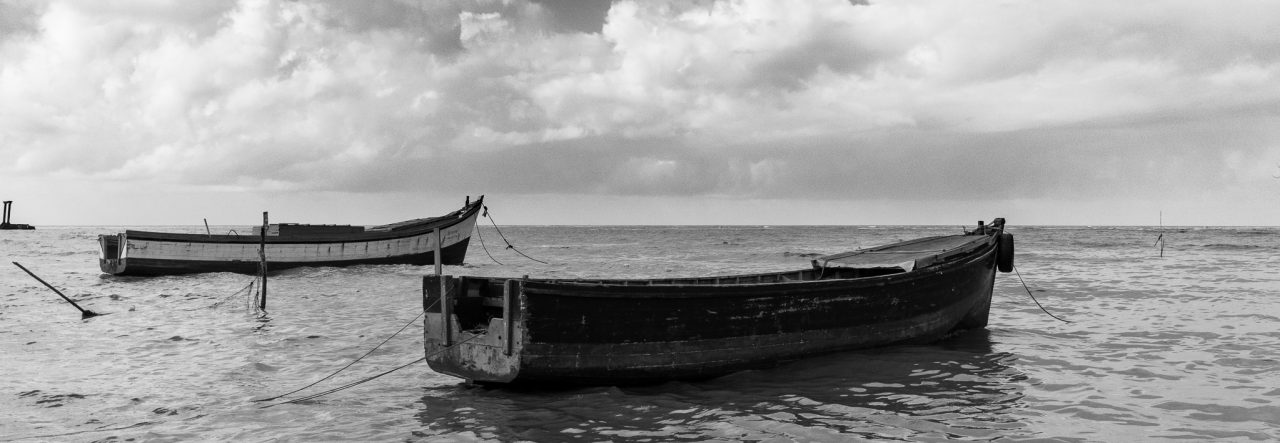
There was this “plume” of clouds in the sky that reminded me of the smoke signals I remember seeing in old Western movies, except that it was more contiguous than the separate puffs that I remember from the movies.

I was trying to get an average exposure, but no matter what I did that day the birds in the boat just “glowed”, the intensity of the afternoon sun I guess was just too much for my camera lens/sensor.

I only looked back at this image today and decided to process it through anyway 🙂


Canon EOS 60D  |  Sigma 10-20mm EX Lens (@20mm, 1/125s, ISO100)


Click on the image to see it in the Black and White Gallery, along with many other of my Black and White images.


2014 Deck – Week 52

Another year, another 52 images for the project.  Almost thought I wouldn’t make it this year…  My fascination with Jhandi flags on the shore as well as my focus on seascapes has spurred some thoughts to the cohesion of images into proper collections…  My Oniabo collection is still taking shape and I hope that the new year will bear fruit in similar manner.

The last photo of the year exhibits the theme nicely, in colour, so it would not be a part of my Oniabo Collection, but it is a seascape with Jhandi flags at Lusignan.

After taking a series of images here, with both the Canon 60D and the Canon 6D, I then used my phone to snap one for Instagram, and I rather like that one!


Canon 60D, Sigma 10-20mm  |  1/250s, f/11, ISO 100  |  Lusignan ECD.


Click on the image to see it in the Gallery along with all the images from this year’s Deck Project.


2014 Deck – Week 46

I could have just kept on walking, but while I visit the seawall fairly often, scenes like this don’t occur with much frequency while I am there, and the juxtaposition that I noticed in walking could not be ignored, so I shot it, a few times…

In a small print or viewed small this won’t look like much, I really do have to set this one aside for a large print.

And yes, I did keep it in colour, shocking, isn’t it? 🙂


The Open Temple  –  Kingston, Georgetown.  Canon EOS 60D, Sigma 10-20mm


Click on the image to see it in the Gallery.


2014 Deck – Week 43

Washed clean by the receding tide, the patterned sand drew my attention, the reflection of the sky and clouds in the still foreground waters belied the turmoil and power that the distant waves possess.

In my learnings about landscape photography, I’ve learnt that it is often important to include a point of interest to grab the viewer’s attention, especially when the scene can be described as plain or boring or bland…  I thought so of this scene at first, others may still think so.


Sands – Kingston Seawall, Georgetown.  Canon 60D, Sigma 10-20mm


Click on the image to see it in the Gallery.


Photographs and Memories

Karran Sahadeo recently did a presentation at Moray House with this title, when I chose this photo for this week’s entry for the Deck Project, it popped into my head.

Often, all we have of moments and events of our younger days are memories… with the current deluge of photos being taken with various cameras, smartphones, tablets, webcams, etc., the current generation may have a different take on it in 20 years.

I can look back at what might be considered a relatively large amount of photos from my younger days, relative to the general population at the time in Guyana at any rate, and I can sometimes remember the moment, the event, the atmosphere, the sounds and other tiny things that made the moment memorable, but there are many more points in my life that have no such record, and all I have are memories.

I was out on the seawall on the way to work one morning when I saw the sky to the south as I approached the portion of the wall right behind my old school ground (Saint Stanislaus College), as I stopped to take the photo, memories of times there came back to me.

I’m not a sportsman, never really was, but I do remember trying a few sports, simply because the teachers said you had to “try”…  I remember being left behind in the 100m sprint, I remember being lapped once in some one of the longer runs, I remember wanting to try the shotput, but being a small fellow, no one would let me, I remember trying the long jump and not doing too badly (as in, at least one other person fell shorter than I did); I also remember getting sunburnt, falling in the grass and bruising my knees, climbing the pavilion steps, eating snow-cones and icicles, and drinking Blackcherry Soda… (Both Banks DIH and DDL had lost their Cola franchises, Banks brought out the ICEE Blackcherry to fill the void), I could go on, but my point is, I can look back on “this” photo and have those memories renewed even though I don’t have photos of any of those moments to look at.

While this photo can mean that to me, for you, it may just be a very plain, very empty black and white photo; for me, the field is filled with students; the pavilion with teachers, students, parents; the gateway and fence lined with vendors selling snow-cones, tamarind syrup and green-mango 🙂


Canon EOS 60D, Sigma 10-20mm | 1/100s @ f/7.1, 10mm, ISO100


Click on the image to see it in the Black and White Gallery from the Collection, while there, take a look at the other images in the growing Black and White Gallery.


2014 Deck – Week 20

This week I got access to my third DSLR Camera, I now have access to a full frame Canon EOS 6D, and as with both my previous Cameras, I wanted the first exposure to be a good one, not necessarily great or extra-special, but a good one.

I decided this time that instead of just finding a nice scene to capture that I know would come out well, I wanted to do an experiment…  I know that I would get a vignette if I used a lens made for a crop sensor camera on a full-frame camera, so I thought I’d try to use it creatively… not sure what others would think, but I think it came out rather well…

So, now I’ve tried it, and probably won’t be doing it again 😀


Canon EOS 6D, Sigma 10-20mm Lens


Click on the image to see it in the Gallery

2014 Deck – Week 19

Buildings with character always fascinate me, but often I will look at the scene as I am passing and think, “it doesn’t feel right”; that has worked against me a few times already when one day I pass by and the building has been demolished.  If it were just for a record of the building, then any photo would do, but I don’t just want a record, I want a photo that speaks to me.

There’s a mosque / masjid at La Bonne Intention (LBI) that I often pass, and consider that there’s a photo there somewhere, but I seldom see what it is that I should be photographing, I’ve stopped to photograph it twice, the first time I was trying to force the photo, but the second time, I was about three villages away and saw the skies to the south and thought that this was a good opportunity to try the photo(s) that I wanted.

Even before reaching the mosque I knew that I’d be using multiple exposures for some HDR processing after.


Canon EOS 60D, Sigma 10-20mm  |  HDR from 3 Exposures.


Click on the image to see it in the Gallery.

2014 Deck – Week 17

Always Stop!

When you see something that you think might be remotely worth photographing, don’t doubt yourself, just stop to take the photo.  Of course, I’ve had many instances where stopping just wasn’t possible, practical or prudent (read that last one as lawful), so some photos remain as electrical impulses in the synapses of our brains.  When it’s possible to stop, just stop and take out the camera and go shoot a few exposures, if not, you’ll be kicking yourself for some time after.

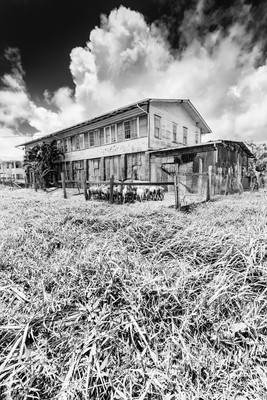
This was one of those times that I stopped.  I’ve driven past this building many times, and always thought that there’s a good photo there somewhere… this particular day I saw the sheep in the corralled area, the sky beyond the building, and as I turned the corner, mentioned to my wife “that’s a nice photo”, she said stop, so I stopped in the corner, got out my camera and trekked back to the junction.


Canon EOS 60D  |  Sigma 10-20mm  |  10mm, 1/160s, f/9.0, ISO100


Click on the image to see it in the Gallery.

2014 Deck – Week 14

I am scheduled to do a presentation of some of my select works on October 9th at Moray House (part of the Moray House Trust’s foray into encouraging local photographer to express their vision of their art), and I am very nervous about the whole thing, I am not sure what to say.

I often don’t mind sharing my work, but to talk about it makes me feel queasy; I’m usually afraid I’ll either come off as not knowing what it is I’m talking about, or as being pretentious, trying to pass off what I do as “art”…

But, I’ve committed to it and I’ll either make a complete mess of the whole thing or come out the other end, not much worse for wear 🙂

The title I chose for my Seascape collection is “Oniabo”, an Arawak word meaning water, I’ve decided to use an extended version of this title for this presentation at Moray House, which will include most or all of the 6 photos in the Oniabo series as well as other images at the seawall.

That being said, the photo I offer for this week was one under consideration to be part of that presentation, but was subsequently side-lined.  Although it in no way resembles Hiroshi Sugimoto’s work, it reminded me that Sugimoto’s Seascapes collection is the reason I had decided to begin a Seascape project in the first place,

Sugimoto begins his description of his series like this:

Water and air. So very commonplace are these substances, they hardly attract attention―and yet they vouchsafe our very existence.

My seascapes invariably often include some “land” or earth (a third element?), but this one I titled “Born of Air and Water” as a reminder to myself of Sugimoto’s words.


Canon EOS 60D  |  Sigma 10-20mm  |  10mm, f/4.0, ISO100


Click on the image to see it in the Gallery along with other images from this year’s Deck Project

Colour or Monochrome

When film (or plate) was the way to capture photographs, there were many many debates, just like there are now.  They didn’t debate sensor sizes, they debated film sizes (and that had so many I won’t even start on that), and just like many enthusiasts and professionals now debate colour vs monochrome, so it also went back then.

While there were specific films developed for both types back then, in the digital age we are pretty much guaranteed that the camera you buy, whether the one in your mobile phone, compact camera, mirrorless or DSLR camera, it will in all likelihood take the photos in colour, which you can then convert to monochrome (black and white, sepia, etc) in post-process, whether in-camera or in software on the PC.  This changed when Leica developed their Leica M Monochrom, it was the first major brand to produce a high-end digital camera that produced only black and white photographs, and rumor has it Sony is working on a black and white version of their RX 1.  I don’t want to get into a debate myself over the need or desire to have a camera that only shoots monochrome, I can only say that it is unlikely I would ever buy one myself, but that is probably only my wallet talking.

In the genre of Street Photography, there is usually a preference for black and white images, but there are many many great coloured Street Photographs out there, more than you’d think.  Henri Cartier-Bresson’s work in street photography was very definitive for the genre, and all his work was in black and white, he also experimented with coloured film but was never satisfied with the results; of course, he only had access to the types of film available then (the 1950s) and if you look back at coloured prints from those days you’d see the limitations of the coloured film of the time.  I dare say that if he had lived in a later era, he may have at least given the coloured films a chance.

When I first started taking photographs on a slightly more serious basis than just snapshots, I didn’t do much black and white processing, and even when I did, it was more for the novelty than because I knew why it should be done and to which photographs.  Now I do a lot more processing in black and white…

What have I learnt that changed my views?

I’ve learnt that not all photos look good in monochrome, the tonal range and subject matter is very important for an image to look good in monochrome.  Monochrome images tend to showcase textures, shapes and form better, and by removing colour from the image you are left with just the elements that make up the composition, and if those elements are not functioning correctly in the overall composition, it will feel off, or look cluttered.

When used correctly, colour will catch the eye and hold it, this works for some compositions, but for others, that same thing tends to shift the focus of the viewer from the overall composition and have them concentrate almost solely on one portion of the image.

I’m no expert, but this is how I see it; recently I took a few photographs of some Jhandi flags on the Kingston seashore, and I chose two that I liked, and I processed them quite differently, and primarily for the reasons stated above.

This one I chose colour, because the main subject and the focus of the image is the Jhandi flags themselves, the various colours chosen as they contrast with each other, the browns of the sand and the blues of the sky.

The second image I processed in black and white to articulate the relationship between the clouds in the sky with the sands on the ground, the change from dark to light in both the sky and the land as they meet at the horizon, the sharpness of the shadow from the midday sun, and the contrast between the flags on the pole so close to the viewer against what seems to be a smaller post in the distance to the left of the frame.

These are my decisions, they may quite well not be anyone else’s choice.


In the end, these are choices I make in how I express myself artistically now, it is not how I did it a few years ago, it may not be how I do it five years from now.

Click on the images to see them in their respective galleries.