2014 Deck – Week 45

That photo I used for Week 44 was different, yes, I think it’s good, is that what I want to be doing at this time?

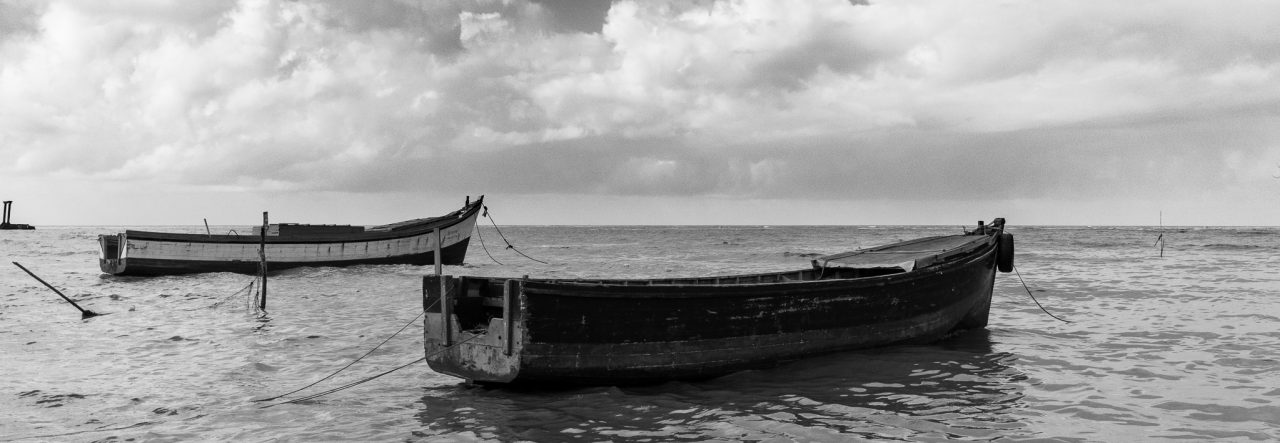
So, back to our regular programming…  a high contrast monochrome from the seashore.  I was hoping that the fisherman/sailor would just sit and stare at the sea for a while, at the time I shot this I think he was securing the bow line.

This is a scene that was a no-brainer for me, it had everything I usually want… Jhandi flags, a boat, a fisherman, a good sky and little garbage in sight within the frame 🙂


24mm, 1/1250s, f/5.0, ISO 200


Click on the image to see it in the Gallery along with other images from this year’s Deck Project


2014 Deck – Week 44

Looking for more meaning.

Although I did not intend for this photo to be associated with these thoughts, this is where Fate stepped in.

I have finally gotten to have a series of photographs that I think embodies an idea that I can convey through a collection, and then I had a very short but enlightening (maybe even a little dampening) conversation with Mr Carl Hazelwood, the chief judge at the 2014 Guyana Visual Arts Competition.  He basically told me that while I have “nice” photographs, the ones he sees lack that little something extra that would make it more than a pretty picture… and here in the last two years I thought I had gotten past the pretty picture stage 🙂

This man knows what he’s talking about, and if he says that I don’t make the cut, then I don’t, and I am grateful for that honesty, I may never make that transition, but I will surely try.

I processed this photograph last week (I only had this conversation last night with Mr Hazelwood), and I almost chose a different photo, one more in keeping with my seascape series of recent,  but this one had a few elements that appealed to me a little bit more, and I wanted the diversity for the Deck Project 🙂

This one probably would not hang in a gallery among great works of art, but I ask myself if I would hang this on a wall, yes I would, but would you?


Seashore – Canon EOS 6D, Canon 24-105, 105mm, f/9.0, ISO200


Click on the image to see it in the gallery.

2014 Deck – Week 41

People write all sorts of things in the sands at the seawalls… and beaches worldwide, from Love Letters (Pat Boone sang about this), to drawings, to directions to the nearest Qik Serv, to Hearts with cupid’s arrows through it and the Lovers’ names inscribed, all to be washed away with the next high tide.

Those messages are as transient to us as we are to the timeless sea; and yet, we keep making those markings and the sea wipes them out again.

I snapped a photo in passing this fellow as he used quite a long stick to mark out something in the sand, I have no idea what it was he was drawing, maybe it was a message to an extra-terrestrial ship 🙂


Midday Markings – Kingston Foreshore, Georgetown.


Click on the image to see it in the Gallery.

2014 Deck – Week 38

This photo was included as part of my extended Oniabo collection  which I presented at Moray House in a slide-show presentation in October.

The Oniabo collection started as a collection of 6 images, but when I was offered the opportunity to present something at Moray House, I revisited the idea and extended the collection to 16 Images.

I now have a better grasp of the collection and what I want it to be, and by early next year I hope to have concluded the set, omitting some that are there now and including others that are still in the making 🙂

Compositionally I was going for the three layers that I saw; the cloudy sky beyond the horizon, the mud-flats and the receded sea, and the rocky foreground,  it was fairly dark already, but I knew that the some-what even lighting would make a good shot.  A couple being there helped to make this shot even better.


“couple”  –  Lusignan, East Coast Demerara


Click on the image to see it in the Gallery, also the visit the Oniabo collection as presented at Moray House.


2014 Deck – Week 14

I am scheduled to do a presentation of some of my select works on October 9th at Moray House (part of the Moray House Trust’s foray into encouraging local photographer to express their vision of their art), and I am very nervous about the whole thing, I am not sure what to say.

I often don’t mind sharing my work, but to talk about it makes me feel queasy; I’m usually afraid I’ll either come off as not knowing what it is I’m talking about, or as being pretentious, trying to pass off what I do as “art”…

But, I’ve committed to it and I’ll either make a complete mess of the whole thing or come out the other end, not much worse for wear 🙂

The title I chose for my Seascape collection is “Oniabo”, an Arawak word meaning water, I’ve decided to use an extended version of this title for this presentation at Moray House, which will include most or all of the 6 photos in the Oniabo series as well as other images at the seawall.

That being said, the photo I offer for this week was one under consideration to be part of that presentation, but was subsequently side-lined.  Although it in no way resembles Hiroshi Sugimoto’s work, it reminded me that Sugimoto’s Seascapes collection is the reason I had decided to begin a Seascape project in the first place,

Sugimoto begins his description of his series like this:

Water and air. So very commonplace are these substances, they hardly attract attention―and yet they vouchsafe our very existence.

My seascapes invariably often include some “land” or earth (a third element?), but this one I titled “Born of Air and Water” as a reminder to myself of Sugimoto’s words.


Canon EOS 60D  |  Sigma 10-20mm  |  10mm, f/4.0, ISO100


Click on the image to see it in the Gallery along with other images from this year’s Deck Project

Colour or Monochrome

When film (or plate) was the way to capture photographs, there were many many debates, just like there are now.  They didn’t debate sensor sizes, they debated film sizes (and that had so many I won’t even start on that), and just like many enthusiasts and professionals now debate colour vs monochrome, so it also went back then.

While there were specific films developed for both types back then, in the digital age we are pretty much guaranteed that the camera you buy, whether the one in your mobile phone, compact camera, mirrorless or DSLR camera, it will in all likelihood take the photos in colour, which you can then convert to monochrome (black and white, sepia, etc) in post-process, whether in-camera or in software on the PC.  This changed when Leica developed their Leica M Monochrom, it was the first major brand to produce a high-end digital camera that produced only black and white photographs, and rumor has it Sony is working on a black and white version of their RX 1.  I don’t want to get into a debate myself over the need or desire to have a camera that only shoots monochrome, I can only say that it is unlikely I would ever buy one myself, but that is probably only my wallet talking.

In the genre of Street Photography, there is usually a preference for black and white images, but there are many many great coloured Street Photographs out there, more than you’d think.  Henri Cartier-Bresson’s work in street photography was very definitive for the genre, and all his work was in black and white, he also experimented with coloured film but was never satisfied with the results; of course, he only had access to the types of film available then (the 1950s) and if you look back at coloured prints from those days you’d see the limitations of the coloured film of the time.  I dare say that if he had lived in a later era, he may have at least given the coloured films a chance.

When I first started taking photographs on a slightly more serious basis than just snapshots, I didn’t do much black and white processing, and even when I did, it was more for the novelty than because I knew why it should be done and to which photographs.  Now I do a lot more processing in black and white…

What have I learnt that changed my views?

I’ve learnt that not all photos look good in monochrome, the tonal range and subject matter is very important for an image to look good in monochrome.  Monochrome images tend to showcase textures, shapes and form better, and by removing colour from the image you are left with just the elements that make up the composition, and if those elements are not functioning correctly in the overall composition, it will feel off, or look cluttered.

When used correctly, colour will catch the eye and hold it, this works for some compositions, but for others, that same thing tends to shift the focus of the viewer from the overall composition and have them concentrate almost solely on one portion of the image.

I’m no expert, but this is how I see it; recently I took a few photographs of some Jhandi flags on the Kingston seashore, and I chose two that I liked, and I processed them quite differently, and primarily for the reasons stated above.

This one I chose colour, because the main subject and the focus of the image is the Jhandi flags themselves, the various colours chosen as they contrast with each other, the browns of the sand and the blues of the sky.

The second image I processed in black and white to articulate the relationship between the clouds in the sky with the sands on the ground, the change from dark to light in both the sky and the land as they meet at the horizon, the sharpness of the shadow from the midday sun, and the contrast between the flags on the pole so close to the viewer against what seems to be a smaller post in the distance to the left of the frame.

These are my decisions, they may quite well not be anyone else’s choice.


In the end, these are choices I make in how I express myself artistically now, it is not how I did it a few years ago, it may not be how I do it five years from now.

Click on the images to see them in their respective galleries.
2014 Deck – Week 11

This week’s photo is about Implied Motion.  OK, I lied, it’s a photo of a Jhandi flag at the Kingston seashore, but as it turns out it is one of those images that displays implied motion (at least for me)

Whenever we try to convey the idea of motion in a still photograph we usually do one of two things, we either have the main subject show motion blur with the background or rest of the scene in focus (such as light trails at night on the street, or a speeding cyclist, slightly blurred with the track sharply in focus)  or we do the reverse, with the main subject in focus but the background blurred (such as in panning shots, or a pedestrian in front of a speeding minibus – by “in front of” I mean with respect to the camera, not the business end of the minibus – although that would make a dramatic photo of a different sort).  🙂

Another method might be to blur everything, such as taking a photo from inside a moving vehicle, creating that “vortex” look (on a side note, using the zoom on the camera while standing still produces neat effects too)

Chrono Photography is also a neat trick used to convey motion, by capturing multiple instances of a moving subject and then layering them in your favourite photo software creates a good sense of the subjects path through the frame.

After babbling about all these ways to create a sense of motion in a still photo, I will just say that I used none of the above for this photo.

This photo is either serendipitous or pure photographer’s luck (hmm, maybe one has something to do with the other).  I had stepped out of my office intending to walk around a few blocks, upon looking up at the sky I notices the clouds in a lovely “blown” pattern, I decided to walk to the seawall instead.  I have taken many photos of the roundhouse before (and will probably take many more), I have also  taken many photos of Jhandi flags before (and will likely take many many more), but that day I saw the clouds in a dispersed pattern, a Jhandi flag blowing in the wind with the roundhouse as a backdrop, and I decided to compose and shoot it, I took a few exposures, then saw five birds flying from the roundhouse towards me… Serendipity!

I was also shooting with the Sigma 10-20 Ultra-wide lens on the camera, so I also got a bit of lens distortion at the edges that helped with the appearance of motion in the clouds toward the edges even more.

That’s a lot of preamble for one photo, but I hope I bored you enough that the photo is now more pleasing 🙂


Canon EOS 60D  |  Sigma 10-20mm

1/250s, f/11, ISO 100  |  6°49’34” N 58°9’45” W


Click on the image to see it in the gallery along with other images from this year’s Deck Project

Perception

Lately, I’ve been very busy, although depending on your point-of-view I might also have been giving priorities to the “wrong” things; for my myself, I say I’ve been busy.

I tell people that I’ve been busy, so I haven’t updated this blog, and updated the Deck Project, they look at me askance and think I’m either lying or stretching the truth, but it’s a matter of perception I suppose.

Often, what we see in a photograph is also a matter of perception, this image is one I overlooked when choosing my photo for week 9 of the Deck Project this year; when I say “overlooked”, I mean that I did not see then the potential that I saw when going back through the images the second time.

I was looking at a photograph recently of what appeared to be a woman holding a young girl lying limp across her arms, I later realized that it was a young man in her arms, but the combination of dark hair and a dark material near the head gave the long hair I usually associate (firstly) with girls, the features of the youth were very smooth and “pretty”, and he was attired in a hospital gown, all adding together to skew my perception.

I’ve also been trying to look at scenes differently and change my perspective, also altering my perception of the scene itself.  Anyway, all of this preamble is just to introduce you tot he image that I had also titled “Perception” 🙂


12:55 pm  |  Red filter  |  Canon 60D, Sigma 10-20mm lens

1/320s, f/11, ISO 100, 10mm  –  Processed in Lightroom and Nik Silver Efex


Click on the image to see it larger in the Black and White Gallery of the Collection.

2014 Deck – Week 03

Even though I don’t get out too often to take the landscape photos I yearn for, I do enjoy picking my daughter up from her Saturday “Revision Classes” on a Saturday and heading out to the seawall, she goes hunting for rocks and shells, and I hunt for photos.

This tyre with it’s bright paint caught my eye, and I was going for a simple photo then my daughter began running on the far side… resulting in an even better photo 🙂

I’ve been working in LightZone again for this one, and I really believe that it has a lot of potential, I really miss the gradient tool that I’ve become accustomed to in Lightroom, but it’s just like switching cameras, you just need to use the tools at hand to achieve a finished product that you can be satisfied with.

I used two localised masks in this one just to see how that would work, and it did a good job, I wanted some more clarity on the tyre itself without affecting the entire image, and I wanted to make local adjustments to the sky (I didn’t have a polarizer on the lens)

I hope you like it.


Clink on the image to see it in the Gallery.

2014 Deck – Week 01

Welcome back to my Deck Project, a photography project of one photo for every week of the year, giving me 52 photos for the year. (and there are 52 cards in a Deck of normal standard cards, not counting Jokers, hence the name Deck Project)

I start the year at a very familiar place, the seawalls, living on the coastland of Guyana gives us easy access to the sea and the extensive shoreline.

Recently there was a discussion about how Guyanese (among many others) prefer to use pirated software instead of paying.  This has primarily to do with a difference in income levels and the cost of many software can easily exceed the salaries of the average or even above-average Guyanese.  The cost of such popular photo-processing software as Adobe Lightroom and Corel AfterShot Pro has declined in recent years making it more affordable, but the habit of acquiring pirated copies persists.  After this discussion I remembered Nikhil posting about an Open Source photo-processing software called LightZone, and I decided to give it a good try (even though I do own and use Adobe Lightroom)

This photo for the first week of the 2014 Deck Project was processed primarily in LightZone (but since I use Lightroom to interface with my website, I used Lightroom to tag/keyword and upload the image)  LightZone is surprisingly versatile and powerful, I think I’ll be using it  a bit more to experiment with some features as well as to encourage those who can’t afford Lightroom or AfterShot to try something that’s Free but also pretty powerful.


Canon 60D, Sigma 10-20mm  |  1/125s, f/8, ISO100, 10mm

Seawalls near Thomaslands, Georgetown


Click on the image to see it in the Gallery