Photography; I shoot what I like, and sometimes people like what I shoot. All photos are copyright to Michael C. Lam unless explicitly stated otherwise.
Recently (December 14, 2022), Fidal shared a post on the Guyana Photographers’ Facebook Group, about a crowd funded Book project by well-known street photographer Nils Jorgensen, and it surprised me to see that the Kickstarted campaign had failed to raise enough pledges to complete the project in the time allotted.
“Street photography is the purest form of photography, stripped to its barest minimum; you, a camera and what you see. A mundane scene, an everyday event in an ordinary setting, can be transformed into an image which may be humorous, sad, surreal or simply graphic.”
Nils Jorgensen – nothinglikesomething.com
Now, while I don’t personally go for the many images Nils has of just leg portions, his take on street photography is distinct and worth looking at, and sharing. Many of them can individually generate trains of thought that blossom into stories, conjured from a simple single image.
If Nils, with his thousands of social media followers, his skillfully taken photos, his ability to tell a story in monochrome or colour, can fail to garner the funds for a book project, what chances have we?
This brings me to our own local scene, I have often played with the idea, and discarded many a plan simply because I don’t think my work is good enough, and more often than not because of the capital required for such projects, without crowd-funding. Recently I was thrilled to see a book published by local photographer Keno George, as he explained it, it was funded by a grant from the Government of Guyana. The book is a magnificent piece of work that tells the story of the 2018 No Confidence Motion in Guyana’s Parliament. The photography is top notch, as I’ve come to expect from Keno, and the production is definitely above par for local artistes. I’ve always thought of Keno as an exceptional PhotoJouralist, although his work covers more than just that, but his eye for images on the streets or during a tumultuous event is uncanny. I encourage you to check the book out, buy it online or through him directly. One regret for me is the lack of captions (even a reference at the back of the book) to indicate names of people in the photos, for the less politically educated and for historical reference.
I hope to see more photographers dip their toes into the realm of published works, other than the works of Robert J. Fernandes (Bobby), and that of Rex Lucas, there are few is any others that avidly represent our genre adequately. Bobby’s work was instrumental in showing many of us parts of Guyana that we thought we’d never see, and through the eye of a skilled photographer, Rex’s work pull’s at the strings that releases nostalgia among the diaspora more than locals. There are, of course, other books , such as that by world-renowned photographer Pete Oxford, as well as one that I’ve mentioned before by James Broscombe (still a favourite of mine)
As in the years leading up to 2020, we now approach 2023, we are at a crossing, what path we take determines not only our own involvement with the art of photography, but also the impact we can have on the art itself, its local development, and upon other photographers, those already established and known as well as those upcoming and striving to make their own mark.
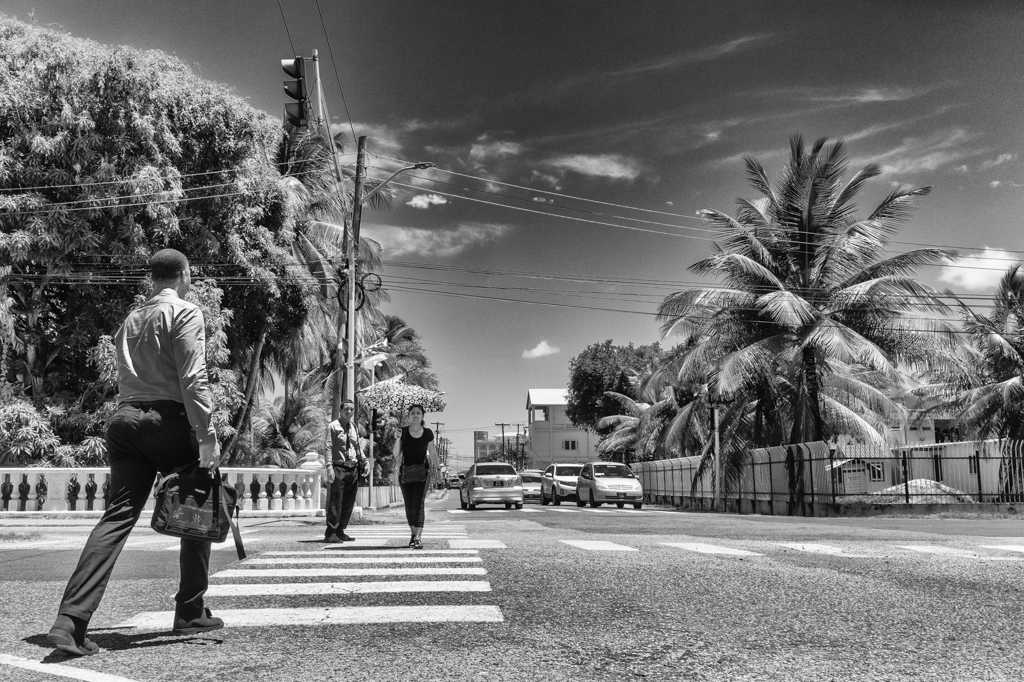
I’ve always been more known for my landscapes and seascapes, but in the course of my photographic journey, I have developed a love for street photography as well, though my images pale in comparison to other local street photographer, they are no less demonstrative of life in Guyana, I share one with you that I took in 2020, perhaps only days before mask mandates went into effect for the COVID-19 pandemic.
To my fellow photographers, visual artists, whatever you wish to refer to yourselves as, keep shooting, keep sharing!
Click on the image above to see it in the Gallery along with other Street photographs. Feel free to comment, every response is a chance for me to learn as well.
I recently saw (again) a panorama of Kaieteur that James Broscombe had done, and I remember the one I had done with a Canon PowerShot S5 IS, point and shoot, so I went to look for it and upload it to my page. It’s the one seen here:
Seeing James’ panorama also reminded me that I was meaning to write this post and share with whoever might stumble across it.
I had the distinct pleasure of meeting Sarah and James Broscombe a few years ago, Sarah was working in remote areas of our country with some of the Amerindian communities and James seemed to tag along camera in hand 🙂
These two talented people made quite an impression on me, and on most (if not all) people who they’ve met and interacted with.
Whatever their initial intent on coming to Guyana, the mark they’ve left on me was most likely not in the original plans… and I daresay there are others who may feel the way I do.
I was introduced to Sarah through her blog, one that she kept as a record of her “adventures” here, what struck me about her writing was the clarity of expression, and the vividness with which I could visualise everything she described. Her grasp of the English language and her ability to use it to reach across miles of terrain and to describe the nuances of a culture that engulfed her made her writing a compelling read for me.
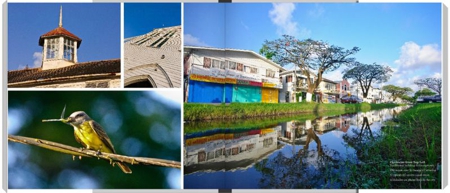
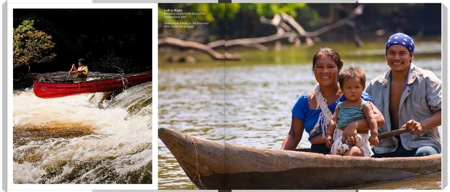
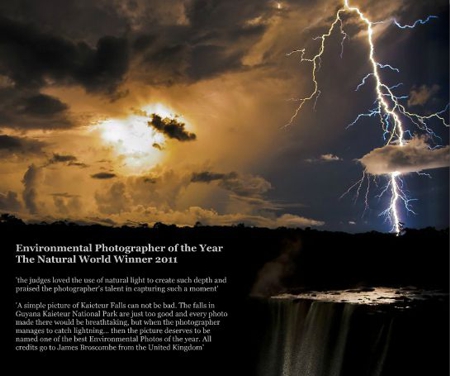
But this post is more about the work of her husband, James. James dealt not with the expression of the written word, but with the capturing of scenes from their stay in photographs. From the streets of the capital to the trails of the Rupununi, he captured an amazing array of cityscapes, landscapes, portraits and other scenes. His amazing panoramas are breath-taking in the book, so I can only image what they’d look like printed large. His, now iconic, photograph of lighting over Kaieteur is featured alongside many photographs that showcase the life of the Amerindian communities they spent time in.
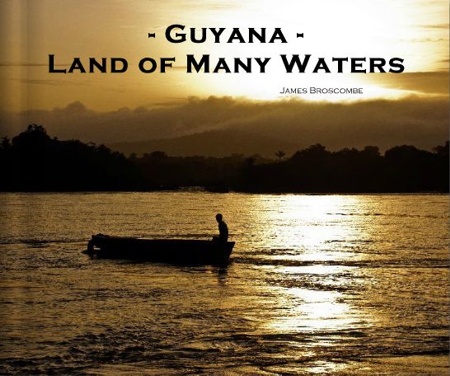
The book is titled “Guyana: Land of many waters”, and although t can’t cover everything, it covers more than any other book of its kind. As a book of photographic work it is packed, no, it is crammed full of beautiful imagery. The only thing that could have made this book better would have been short stories written by Sarah. Although I’ve seen most or all of the images online in his blog, it was so much more satisfying to turn leaf by leaf through the book!
If you are Guyanese, or love Guyana, or even just love photography, this is a boo to own, and at that price, it is a steal considering the sheer magnitude of its content. The book is available here, and below I’m putting some samples I think may peak your interest even more.
The cover alone, should make you want to delve into it 🙂
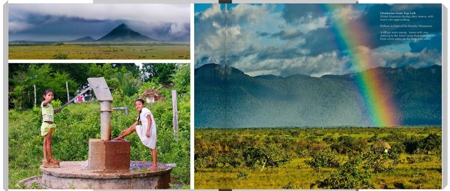
Pages 24 and 25
Pages 58 and 59
Pages 124 and 125
and the Back Cover, the amazing image of Lightening over Kaieteur
At the list price, James isn’t making any kind of profit, so I suggest you get one before he changes his mind about that price 🙂 Get your copy of “Guyana – Land of Many Waters”, you won’t regret it.
Well, it’s not the first time I’ve had a photo used in a project, but this is the first time since I started a blog 🙂 I had two photographs printed in the 2010 Calendar for the Guyana National Trust.
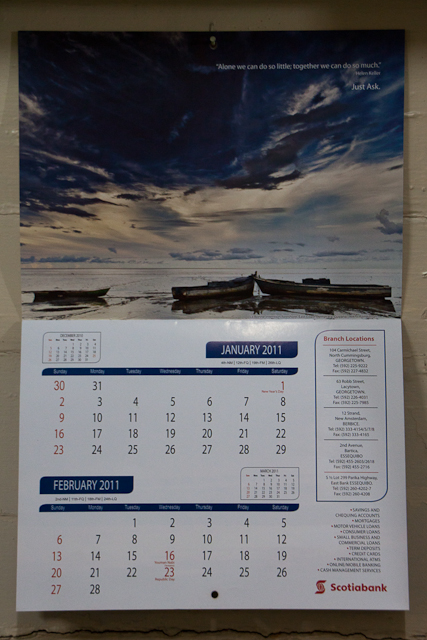
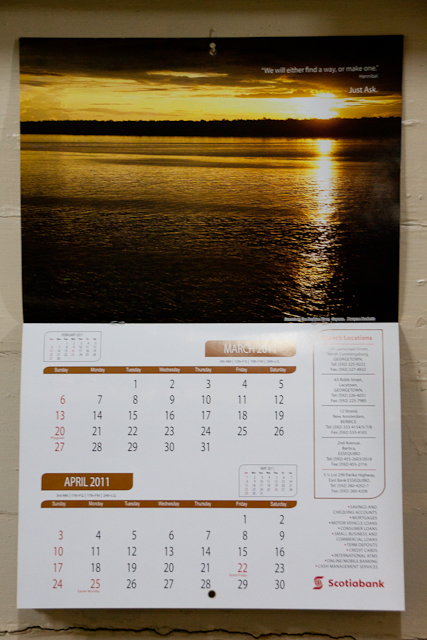
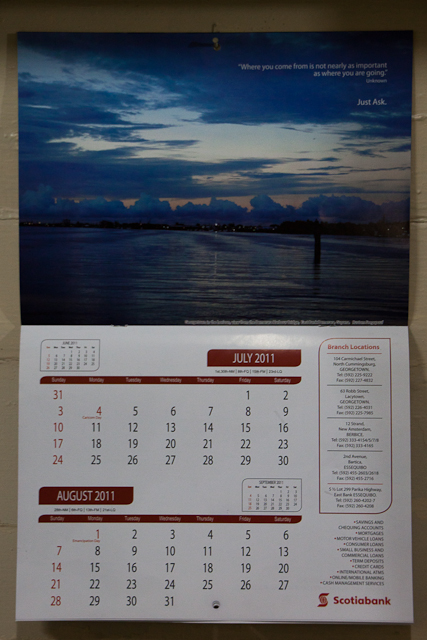
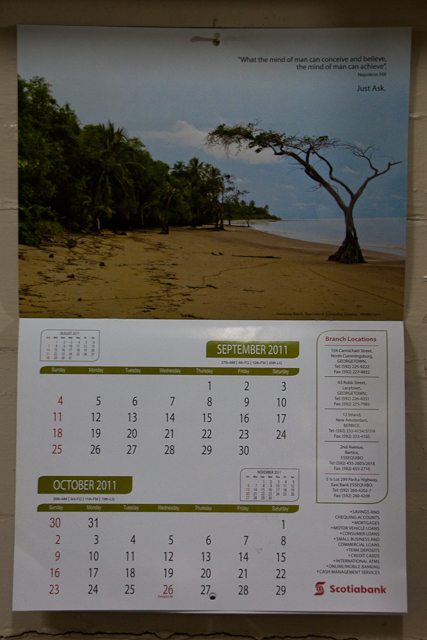
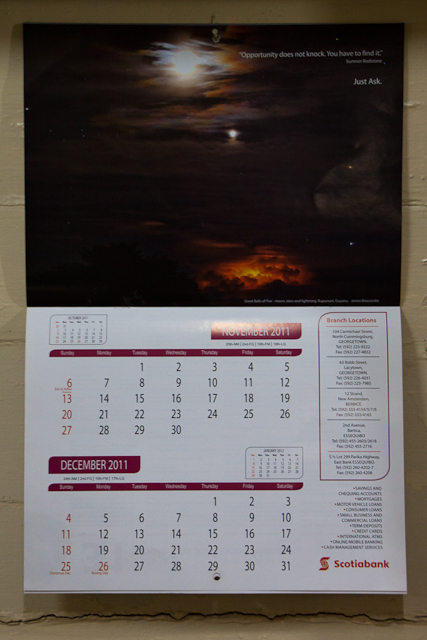
Scotiabank (Guyana) did their 2011 Calendars through a firm called KRITI, who approached a number of photographers who had some local scenes with a slight emphasis on the skies above, be it dramatic skies, overcast skies or just beautifully clouded skies. Of the six photographs featured, there were five “local” photographers and one foreign photographer (who lived here for two years, so he’s as local as foreigners get).
Below are some snapshots of the calendar with links to the photographer’s pages that I could get. (Click on the photos to go to the photographer’s pages)
Starting of was Nikhil’s image along the LBI (La Bonne Intention) shore,
Nikhil Ramkarran: LBI Foreshore
Then Dwayne Hackette’s Sunset along the Berbice River,
Dwayne Hackette: Sunset on the Berbice River
Phillip William’s Earth Station photograph,
Philip Williams: Earth Station, Carifesta Avenue, Georgetown, Guyana
Rustom Seegopaul’s Georgetown from the Harbour Bridge crossing the Demerara River
Rustom Seegopaul: Georgetown in the Horizon, view from the Demerara Harbour Bridge, Demerara River
My Lonesome Tree photograph from the Hamburg (Tiger Island) in the Essequibo River (taken when I shot with a Canon S5 Bridge Camera
Michael Lam: Lonesome Tree, Tiger Island, Essequibo River
and to top it all off with James Broscombe’s Great Balls of Fire, from the Rupununi
James Broscombe: Great Balls of Fire
To be absolutely frank, the image of James’ Great Balls of Fire in the calendar does not do the original photo Justice, definitely click on the image above for a good look at the photo on his blog.
It should be noted that these cover all three major rivers of Guyana, the Georgetown Coastline and the Interior. If you are a Scotiabank Guyana customer, make sure to collect your copy 🙂
Thanks to Scotiabank and a special thanks to Sita at KRITI.


 The Michael Lam Collection's Blog