2014 Deck – Week 14

I am scheduled to do a presentation of some of my select works on October 9th at Moray House (part of the Moray House Trust’s foray into encouraging local photographer to express their vision of their art), and I am very nervous about the whole thing, I am not sure what to say.

I often don’t mind sharing my work, but to talk about it makes me feel queasy; I’m usually afraid I’ll either come off as not knowing what it is I’m talking about, or as being pretentious, trying to pass off what I do as “art”…

But, I’ve committed to it and I’ll either make a complete mess of the whole thing or come out the other end, not much worse for wear 🙂

The title I chose for my Seascape collection is “Oniabo”, an Arawak word meaning water, I’ve decided to use an extended version of this title for this presentation at Moray House, which will include most or all of the 6 photos in the Oniabo series as well as other images at the seawall.

That being said, the photo I offer for this week was one under consideration to be part of that presentation, but was subsequently side-lined.  Although it in no way resembles Hiroshi Sugimoto’s work, it reminded me that Sugimoto’s Seascapes collection is the reason I had decided to begin a Seascape project in the first place,

Sugimoto begins his description of his series like this:

Water and air. So very commonplace are these substances, they hardly attract attention―and yet they vouchsafe our very existence.

My seascapes invariably often include some “land” or earth (a third element?), but this one I titled “Born of Air and Water” as a reminder to myself of Sugimoto’s words.


Canon EOS 60D  |  Sigma 10-20mm  |  10mm, f/4.0, ISO100


Click on the image to see it in the Gallery along with other images from this year’s Deck Project

Colour or Monochrome

When film (or plate) was the way to capture photographs, there were many many debates, just like there are now.  They didn’t debate sensor sizes, they debated film sizes (and that had so many I won’t even start on that), and just like many enthusiasts and professionals now debate colour vs monochrome, so it also went back then.

While there were specific films developed for both types back then, in the digital age we are pretty much guaranteed that the camera you buy, whether the one in your mobile phone, compact camera, mirrorless or DSLR camera, it will in all likelihood take the photos in colour, which you can then convert to monochrome (black and white, sepia, etc) in post-process, whether in-camera or in software on the PC.  This changed when Leica developed their Leica M Monochrom, it was the first major brand to produce a high-end digital camera that produced only black and white photographs, and rumor has it Sony is working on a black and white version of their RX 1.  I don’t want to get into a debate myself over the need or desire to have a camera that only shoots monochrome, I can only say that it is unlikely I would ever buy one myself, but that is probably only my wallet talking.

In the genre of Street Photography, there is usually a preference for black and white images, but there are many many great coloured Street Photographs out there, more than you’d think.  Henri Cartier-Bresson’s work in street photography was very definitive for the genre, and all his work was in black and white, he also experimented with coloured film but was never satisfied with the results; of course, he only had access to the types of film available then (the 1950s) and if you look back at coloured prints from those days you’d see the limitations of the coloured film of the time.  I dare say that if he had lived in a later era, he may have at least given the coloured films a chance.

When I first started taking photographs on a slightly more serious basis than just snapshots, I didn’t do much black and white processing, and even when I did, it was more for the novelty than because I knew why it should be done and to which photographs.  Now I do a lot more processing in black and white…

What have I learnt that changed my views?

I’ve learnt that not all photos look good in monochrome, the tonal range and subject matter is very important for an image to look good in monochrome.  Monochrome images tend to showcase textures, shapes and form better, and by removing colour from the image you are left with just the elements that make up the composition, and if those elements are not functioning correctly in the overall composition, it will feel off, or look cluttered.

When used correctly, colour will catch the eye and hold it, this works for some compositions, but for others, that same thing tends to shift the focus of the viewer from the overall composition and have them concentrate almost solely on one portion of the image.

I’m no expert, but this is how I see it; recently I took a few photographs of some Jhandi flags on the Kingston seashore, and I chose two that I liked, and I processed them quite differently, and primarily for the reasons stated above.

This one I chose colour, because the main subject and the focus of the image is the Jhandi flags themselves, the various colours chosen as they contrast with each other, the browns of the sand and the blues of the sky.

The second image I processed in black and white to articulate the relationship between the clouds in the sky with the sands on the ground, the change from dark to light in both the sky and the land as they meet at the horizon, the sharpness of the shadow from the midday sun, and the contrast between the flags on the pole so close to the viewer against what seems to be a smaller post in the distance to the left of the frame.

These are my decisions, they may quite well not be anyone else’s choice.


In the end, these are choices I make in how I express myself artistically now, it is not how I did it a few years ago, it may not be how I do it five years from now.

Click on the images to see them in their respective galleries.
2014 Deck – Week 09

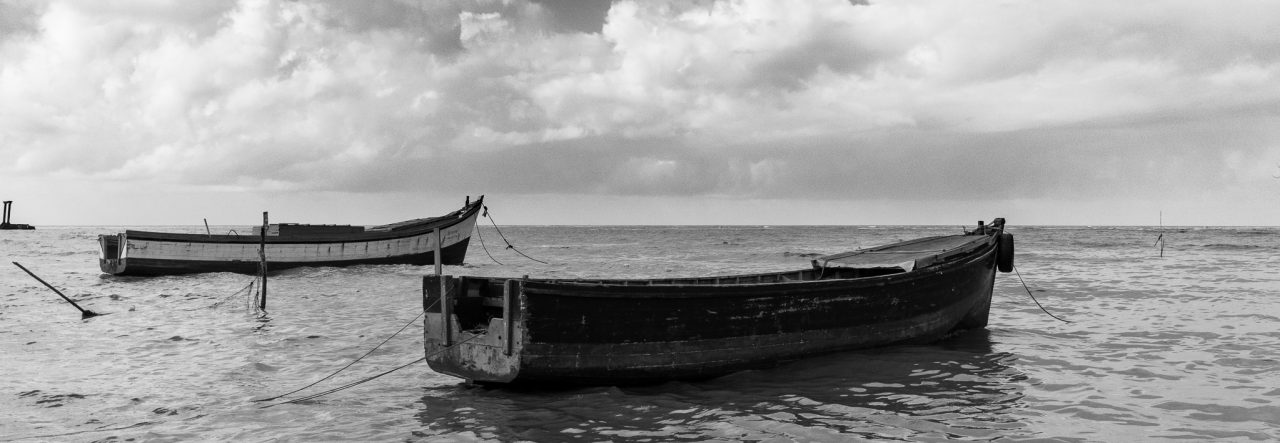
The fascination with all things coastal continues!  Of course, it’s more like searching for images that I like and since most of my time seems spent on the coast, that’s what you’ll get 🙂

The fishing boats at Lusignan, always seem to compel me to take a few photos, even if I never use them, but this one worked well for me, I think my processing went a tad overboard (no pun intended) but at the end of it all I still liked the final image.

I was considering a Dutch title for the image since the word Moored comes from the Dutch word Meren (according to some dictionary I was reading), but then the name Lusignan was from France, so I went with a French title instead (not that anyone really cares) 😀


Canon EOS 60D, Sigma 10-20mm  |  1/250s, f/10, ISO 100


Click on the image to see it in the Gallery along with the other images for this year’s Deck Project

Bob

I was walking along the seawall last year when I spotted these three birds on the rocks near the waterline, I was fortunate enough to get off one photo of them together before they separated further (in no small part to my approach)

Whenever I see three birds together I always think of Brother Bob, Bob Marley, simply because of those words in the song… “Three little birds, Pitch by my doorstep”

The song was actually called “Three Little Birds”, but most everyone I know refers to it as “Don’t Worry” or “Every Little thing’s Gonna be alright”

So these aren’t exactly little birds, and they certainly weren’t singing sweet songs, but they still reminded me of the song.

Hope you like it:


Canon EOS 60D, Sigma 17-55mm  |  1/500s, f/8, 50mm, ISO 100


Click on the image to see it in the Gallery along with other Bird photos

Fly

Something from last year 🙂  2013 was a good year, but then I think upon reflection, every year is a good year, there are always rough patches, but we live, we learn, we love, we laugh, we lose some hair, we leave behind the things we prefer not to follow us into the new year.

Where my photographs are concerned, I think I got a few good ones, a few great ones, but overall, I think I just got less time to go out and get photos from farther afield.  But I think that I did a fair job of the Deck Project.

For the new year, I encourage anyone reading this to “Fly”, spread your wings and soar above the troubles of the world and find peace within yourself, I will be trying to do this myself.


Canon T1i, Tamron 18-270mm  |  65mm, ISO 200, 1/320s, f/10


Click on the image to see it in the Gallery along with a few other Avian (Bird) Photos

2013 Deck – Week 52

Skies above and oceans below,
Soar above the tethered boats
Down winding creeks and rivers brown,
Past piers, docks and abandoned forts.

Wind beneath my outstretched wings
Sun upon my feathered spans
Gliding, soaring, questing far
Over seas and distant lands.

See upon a curved horizon
Tree-lined coasts, and wave-swept beach
Flying high above ocean’s blue
Soaring forward, to sometime reach

A land with trees laden with fruit
Ponds and lakes with fish aplenty,
Seeking always rich lands afar
Always knowing, there will be many.

Returning home, back to my shore,
To mangrove clumps and fishing boats,
To fly along the creeks that wind
And from its waters, slake my throat.


Click on the image above to see it in the Gallery along with the entire collection for this Year’s Deck Project!

2013 Deck – Week 48

Many times, I just want to sit upon the seawall and not think… to just forget that there is a world where I have to work, where there is anything of purpose to be done… to just sit and stare out to sea.

The problem with me going and sitting and relaxing, is that it is at just those times, when my mind is almost blank that all the thoughts that I’ve been avoiding or maybe not even thinking about come rushing to the fore and I cannot block them out.

When I sit upon the shore and stare out to see, when I enjoy the sea-breeze, the open-ness of the ocean before me, I think, and my thoughts are somewhat clearer, less muddled…

This was one of those brief moments… and I took a photo to remind me to try once in a while to leave the world behind, and breathe.


Click on the image to see it in the Gallery

2013 Deck – Week 47

Every once in a while I will look at a scene and I would be moved to try to photograph it using the technique known as High Dynamic Range (HDR), and on even fewer occasions, I would look at the scene and think that it would make a good Black and White HDR.

I had just picked up my daughter from her “After-Classes” and we took a drive by the seawall, as soon as we pulled up and parked I saw the way the tide was out, and how the sky was over-cast with some low hanging clouds, I knew I wanted to try a few photos near the metal piling that’s been there for ages, and I thought it would render nice in HDR.

I tried to keep her from running ahead and getting footprints all over the area, but it wouldn’t have mattered, her footprints didn’t last too long in that mud 🙂

I tried a few angles around the sheet of metal, and decided after on this portrait oriented one, The way the shape of the puddle, the arc of the wet and dry sands (mud), the curve of the receding water-line and the straight horizon all clashed, made the scene seem more fluid to me.

I hope you like it. (Three exposures blended for an HDR image)


Click on the image to see it in the Gallery

2013 Deck – Week 40

This year, I think most of my photos come from the Seawall areas along the coast of Demerara, simply because I’ve had little opportunity to go elsewhere…  but the amazing thing about the seawalls, is that I think you can take a photo there every week and still come away with something interesting

This one I was tempted to call “Low T”, but knowing the western mind-set it would probably be a bad idea 😀

Took this using a low perspective, with the Sigma Ultra-wide 10-20mm, even at 1/200s the bird in the sky shows motion blur 🙂 (Probably added a bit to that with the wide-angle distortion at the edges of the lens)

I hope you like it.


Click on the image to see it in the Gallery

2013 Deck – Week 38

This photo appealed to me as soon as I took it.  Even on the camera display I thought that this may very well be the photo I choose for the Deck Project.  And even now, looking at the takings for the week, I haven’t changed my mind.

It was a simple log, driftwood (a sizeable one), that sat upon the seashore, this was under a bright midday sun, and I used a Red filter in post-process to give me the drama I was looking for.

I called it “Between the Groynes”, of course we’ve called them Jetties since I was young 🙂


Click on the image to see it in the collection