2012 Deck – Week 42

Sometimes, in any art form, you have to break away from the norm, step away from the straight and narrow line that you’ve followed all along, and try something different.

I’ve broken the rule about shooting into the sun before, so this is not new…. but trying to get the palm tree and horse as the focus while doing so was different for me, and even then I was not ecstatic about it, when processing, I went for a duotone processing that I don’t do, and I though that the result was pleasing.

Although the original duotone processing had much more colour to it, I toned it down a bit to bring the focus back to the photo rather than the duotone, and the result; “sunset Liliendaal” 🙂

sunset Liliendaal

Click on the image for a better view in the Gallery!

Hermes

Hermes – God in the Greek Pantheon, often associated with speed and cunning, the messenger of the Gods.

I took of photo of an old Hermes typewriter whilst on a short walk down Main Street, I mainly took it because it made me remember how I first learned to type, on a Hermes typewriter, just like that one, but in better condition 🙂

At the time I didn’t like the resulting photo and just left it there in my catalogue, but on looking through some of my older stuff, I came across it again and decided to try processing it, after deciding on using a sepiatone process, I still wasn’t entirely happy, then I realized what was bothering me, it was the buildings in the background that showed in the upper portion of the photo, after judiciously cropping that out I was left with an image that I was more pleased with  🙂

Sometimes speed and efficiency can let images that are good slip away, simply because what needed to be done was to let the pixels age, and your outlook on the image mature.

Click on the Image for a better view in the Gallery, along with other Sepia-toned images in the collection.

2010 – Flood Waters at the Park – HDR

As coastal dwellers we are always mindful of the flooding of our properties, growing up it never seemed that much of a problem, but now it seems more frequent.

Six feet Under –  A phrased usually reserved for the dead and buried, is also the correct description of Georgetown, the capital of Guyana.  The city is six feet below sea level, and all that protects us from the might of Neptune’s oceans is the famous Seawall, which was built by the Dutch when they colonized the area, back in the nineteenth century.  It’s a good thing the Dutch know how to build these things!

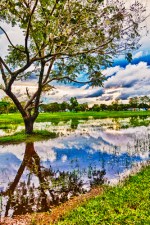
When rain falls heavily (sometimes it just has to drizzle) and the tides are high, areas within the city, and even along the coast, become flooded to various degrees, most times it may just be an over-topping of the drainage canals and trenches.  One good side effect of this is the lovely reflections of scenic places in the calm, still waters.
I’d shot multiple exposures for an intended HDR image, as these things turn out, I never got around to it until now.  I’ve gone into detail on what an HDR is and even twice detailed how I approach the processing, but since it has been a little while since those posts, I’ll just give a brief description on HDRs here.

HDR stands for High Dynamic Range, it is a technique used in imaging and photography to produce in the resulting image a wide (or high) range in the luminance of an image.  Simply put, it attempts to retain as much detail as possible in the lighter (brighter) areas as well as in the darker (shadow) areas.
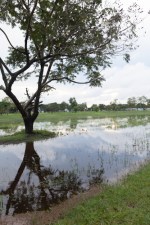
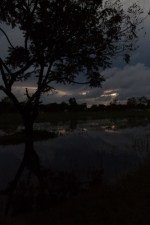
These two images show (a) the underexposed image that is used to capture the detail in the lighter areas, notice that the rest of the image is very dark, and (b) the overexposed image that is used to capture the detail in the darker areas, notice that the sky and water in this are very bright and show little detail.

When these are combined with the neutral or “normal” exposure image, the dynamic range of the final image is increased.

After combining or layering the images in an HDR software, the process by which the photographer renders the final image is called tone-mapping.  In this process, various sliders are employed to adjust things like brightness, contrast, light, shadows, and, depending on the HDR software being used, a variety of “specialty” sliders.  The resulting image is usually to the photographer’s taste, some with a desire to approach realistic images with a higher dynamic range than a standard exposure, others go for a more surreal result, some can carry this as far as having a very high contrast, high saturated look that is more illustration than photography, but that’s a debate for others.  To the left is a small image processed for effect, very vibrant very “artsy”.  It is also possible to tone-map a single exposure to achieve some of the same HDR effect, although I do not personally call this an HDR, I refer to them as Tone-Mapped Images, another possibility is to use a single exposure to create the various over and under exposures in software, then combine them, this I refer to as a Pseudo-HDR, but these are only my terms and distinctions.
My preference lies in trying to produce an image that resembles the scene that I saw, but could not reproduce in a single exposure, for some scene this will result in a photo that may have people wondering whether or not it is an HDR, and in other cases it will leave no question that it’s not a standard exposure, but definitely and HDR, especially when I try to reproduce the great detail that is there in a cloudy sky (such as my “Doomed” from the Coastal Wanderings exhibition at the National Art Gallery).   The results of this particular HDR processing? I’ll let you decide.

Dump

I can’t remember where we were going this day, but I do remember wanting to get the photograph, although we were quite a distance away, so I used the long telephoto to quickly snap this.

This is where the City’s garbage dump meets the Body Dump, or more respectfully called the Le Repentir Cemetery.

The smoke was drifting across from the burning garbage (it apparently spontaneously combusts periodically), the excavator was clearing some paths and moving some garbage, and the birds were just hanging around for the “disturbed” earth and garbage.  🙂

Click on the image for a better view in the Gallery!

Into the Mountains – Part 2

After lunch on my second day in Jamaica, we drove up to Cinchona Gardens, what was once a beautiful Botanical Gardens, a destination for families and tourists, an old Colonial house and out buildings, gardens and ponds, and bamboo copses.  The road up to it is impassable by regular cars, so Cecil’s Safari enthusiasm came out as he tackled the mountain with gusto.

Before even going towards the Cinchona Gardens proper, the view to the right of us as we drove up was very compelling, so I just had to take a few photos in the hope that one would help express what I saw,the tops of the range were obscured by low-hanging clouds:

The Gardens stand in a spot of the mountains that is five thousand two hundred feet above sea level (5200ft), and there is usually a constant “misting” from the clouds, so most everything is wet.  The first steps into the garden proper brings you to some tree stumps of tree cuttings, makes great seats for the weary 🙂

From an upper vantage point, you can see the seating area in the walled section of the garden with a small man-made pond, the sky had begun to clear a bit so that I could get more than just a blanket of gray clouds in the photos  🙂

Alexis stood for quite a while admiring the view of the valley below and the mountains in the distance, he even went as far as shouting out to hear the echo… which he got  🙂

The main building was cordoned off with a “Danger” tape,warning visitors not to go in, I was tempted to venture in, but Cecil wisely told me not to try it, so I satisfied myself with a few photos from the outside.

As the skies were clearing a bit, I took another set of photos of the view into the valley and across at the Blue Mountains, this time I could actually see the tops of the range in some areas.

From the Cinchona Gardens we were to make our way towards the Blue Mountain to visit Whitfield Hall, where people desirous of climbing the peak would start their trek, on the way there as we neared Hagley Gap, we stopped to take photos of and near an old bridge that appears to be out of use.

We stopped along the road to get a few photographs of a beautiful view down another valley, this was probably about 15 minutes outside of Whitfield Hall.

Whitfield Hall is an old House and Coffee farm, it is snuggled beneath some very very tall trees and is such a tranquil spot, we sat and ate the rest of our food before heading back home.

On the way back I couldn’t resist a passing shot of the hills/mountain showing the barbed demarcation of the end of the road, where the cliff drops down to the valley below.

Into the Mountains – Part 1

Veteran Guyana Safari expeditionist Cecil Beharry (CB to his friends), told me to just let him know when I’m in Jamaica, so I told him I was coming down for a family reunion, and he insisted that he take me into the mountains, how could I refuse?

The day after I arrived in Jamaica, he took me and my cousin Alexis (I’m told he is my First cousin Once Removed, although I prefer not to have him removed) on a mountain drive, some of these spots were apparently where he “practiced” for the Pakaraima Mountain Safari in Guyana.  He had just gotten back his vehicle from the last Safari, and we were going to give it another mountain drive  🙂

As it happened, we were on the road near Irish Town when we noticed some strange sounds coming from the vehicle, on stopping and checking (Alexis being a hobby mechanic and Cecil being Jamaica’s Power-steering specialist) it was discovered that there was a leak somewhere, Cecil called his son Craig to come exchange vehicles (a Trooper to the rescue)

I didn’t mind stopping / breaking down in that spot, I got a few photos, my two favourite are below:

With a new vehicle at our disposal (ok, we’ll apologise to Craig for the dents and scratches and the dirt…), we headed onto Newcastle where there was on old colonial army base that is now housed and maintained by member of the Jamaican Armed Forces (restoration work was being undertaken while we were visiting), I’ll share two photos from that location, one of the “barracks”,as I thought of them, and one of the cemetery, I must say that the view from the cemetery was very tranquil 🙂

On the way to Newcastle, we stopped to take in one of the breathtaking views of the hills/mountains, but I was also captivated by the walls along the road, they are apparently built to help retain the earth on the sides of the hills and prevent landslides, in these “walls” are holes which are meant for the drainage of water caught behind the walls, the holes are called Weeping Holes.

From Newcastle, we moved onto Holywell, where there is a camping ground, there were quite a number of youths there camping and playing.   The air is crisp and cool,and the views are pretty:

And if you want to just sit and enjoy the view, here’s the chair:

After Holywell, we went to visit an old abandoned Coffee Mill, from somewhere back in the colonial days.  Some of the building(s) is still intact, and the mill mechanism can still be seen there, what I was impressed to see was the waterwheel that drove the mill, I had never seen one before and I was excited about it, especially when Alexis tried to push it and it actually turned!

There was an archway in the rear wall to access the “Tennis Courts” and to see the building from the side with the water wheel.  I think that archway would make a pretty nice night-time photo  🙂

I realised that this post suddenly had a lot of images, so I decides to split it, so this is it for the first part, we actually left this building and went down to the stream/creek behind it to have our lunch; KFC, stale bread and liquid refreshment (in my case a bottle of Coconut Water)  🙂

2012 Deck – Week 25

For many students in the trimester system, it is now the end of the school year, the end of projects and assignments, the end of homework, the last of the tests and exams until the next academic year begins.

I find it fitting that the image I chose reflects some of this; hands raised in joy as the sun sets on another day.  The end of one thing usually marks the beginning of another, soon we begin the “August” or summer holidays, although those in the semester system have already begun theirs  🙂

Hands Up!

2012 Deck – Week 20

Aday.org had come up with an idea to present “A day in the world” through photographs, they wanted photographers worldwide, from amateurs to professionals, basically anyone with a camera, to take a few photos on May 15th and upload them to their site.  They had so many uploads they quickly got problems handling it and I am still not sure if my photos are there and if they are eligible for the final project, I think a lot of the information went AWOL during the upload.  At the time of writing this blog-post, they are still sorting out everything to relaunch the website.

I took a few photos within the city to contribute, and I am choosing one of those to share as my photograph for Week 20 of this year.

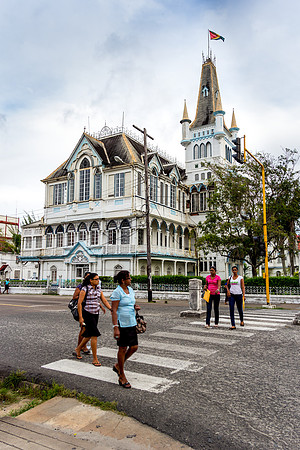
Its a very familiar scene in Georgetown, this was “after-work” and these people are most likely workers on their way from their jobs to get transportation home, and I used City Hall as a backdrop for some added familiarity 🙂

Click on the image to see it better in the Gallery.

2012 Deck – Week 16

By The Manatee Pond

I’ve been staring at this photo for weeks, and finding the right words to accompany it in the blog seems to be hard…

It’s a great spot, it has the Kissing Bridge, popular with brides and lovers, photographers and kids who like to run over it back and forth.  The pond has the manatees, where kids come to feed them on afternoons, there are little spots where families picnic and relax, and it’s where budding artists sit and sketch simply because there is so much of interest around.

Does it have too much?  is the photo crowded?  Am I just being hard on myself?  Who knows….  but this is the photo for Week 16  🙂

Click on the photo for a much better view in the Gallery

Palm Sunday 2012

This year I was away from town for Holy Week.  I was on the tenth Pakaraima Mountain Safari, and although I have not yet sorted all my photos from the trip, nor written any sort of account, I did choose this image for Palm Sunday to share.

It was taken at “58 Mile”, an area known for being 58 miles out of Linden, and for the “pit stop” establishment there know as “Peter and Ruth”, anyone heading to Lethem, or Kurupukari, or Mahdia usually stops here.

The photo is not of Peter & Ruth’s establishment, but of a little church opposite  🙂

Co-incidentally I was back in this spot on Good Friday at 3pm (most Catholics will know the significance of that) 🙂

So, although I got a lot of flak for not covering the Palm Sunday Mass (it seems there are some who look forward to my photos from that), I did manage a fairly nice shot that day anyway  🙂

Please click on the image to see it larger in the Gallery.