2012 Deck – Week 37

I have a few rules or guidelines that I try to abide by in my photography, and I’m not referring to the Rule of thirds or Rules of composition, I’m referring to ones that will guide me as a photographer and help me to get those photos that I want.

Rule #2:  STOP and take the shot

Many times we regret not stopping, for one reason or another, to take the “shot” that we could see in our mind; we saw it, we thought of how to compose it, maybe even how to process it afterwards, but unless we actually stopped and took the shot, everything else is supposition and a wasted opportunity.

I was driving down the Railway Embankment heading home and saw the colours in the sky developing into what could be a lovely sunset, I saw the clouds low on the horizon and the sun dipping towards them and I knew I had to take a photo of it.

A photo of a sunset, is a photo of a sunset, unless you have something else in the photo that adds interest, then its just a photo of a sunset, and there’s a million of those.  As I was driving down, looking for something to use in the foreground, I remembered the Chimney at Chateau Margot, and quickly diverted towards the main Public Road.  As chance would have it, I ended up behind some slow moving traffic and could not get to the spot as quickly as I’d have liked, but I got there, didn’t try to change lenses, but grabbed what was there and just shot a few exposures to get it.

Although I could have gotten the sky as I saw it earlier, from the road with houses around and utility wires all over the frame, I spent a few precious minutes to get to a spot I felt better about, and I think I can live with that  🙂

Click on the image above for a better view in the Gallery.

A Photo’s Worth

Recently, Dwayne Hackett posted a question on Facebook, looking to garner from others what they thought, “What is a picture worth?”, and of course at least one person used the old adage of “a thousand words”.  I am sot certain of Dwayne was trying to get at philosophical or monetary answers  🙂

For more than a century we’ve heard that a picture is worth a thousand words, usually meaning that a complex idea can be expressed in a single image, but what is a photo actually worth?  My answer was “A photo’s worth is weighed differently by each viewer, it depends on how the photo affects them.”  For me this answer works for both the philosophical and monetary.

The most expensive Photograph on record (as of today) is the Rhein II by Andreas Gursky, which sold at auction last year for $4.3 Million, the cheapest may be that passport sized one you recently got for your American Visa Application 🙂  Which one is worth more?  To the Visa applicant, it is certainly the passport sized one, without which they can’t submit the forms, to an artist, the Rhein II certainly surpasses the “mug-shot” 🙂

While the simplicity and boldness of the Rhein II appeals to my artistic senses, a photo that sold for one-seventh of its value appealed to me much more, that would be Ansel Adams’ “Moonrise”, but that is because of how that photo affects me, and so I find more “worth” in that image.

Last year I dealt with this similarly in my post for the 23rd Week of the Deck Project, you can check it there for reference  🙂

I had taken this photo while on a walk with Nikhil and Sharon, hen I had downloaded the images, I had decided that this one was not going to make the cut, and left it aside, but after Dwayne’s question, something sparked an interest in the image.  I had used ISO500, I had shot into the sun, and I had done this dangling the camera downward simply because I was too lazy to get down in the rocks to properly compose the image, so I wasn’t enthusiastic about it  🙂

I didn’t think the resulting image was worth my time and effort to process, but I went back and while it is grainy from the high ISO and from the subsequent processing, I like it.  It may not have the same impact on a Christian as it would on a Hindu, it would not have the same effect on a North American as it would on someone from the Caribbean, each would decide it’s worth, it’s value as a photograph differently.  For many this may be worthless, for me, it was worth saving, worth the time and effort in processing, and if anyone reading this blog-post realizes the worth in their own photos, then this blog-post was worth writing.

2012 Deck – Week 35

In June of this year Imran Khan had done an article on the new insurgence of young (and not so young) Photographers in Guyana in the form of the Facebook Group Guyana Photographers, this was recently re-blogged on the GuyanaPhotographers.com site.  In it he mentioned that the Seawalls seem to be a favourite or default location for their “treks”, this is very true.

With most of the population of Guyana living on the Atlantic coast, this is inevitable; with the majority of (accessible) roads meandering along the coast, this is inevitable; with the majority of the coastland given over to farming (and now housing) leaving the only scenic areas being the seawalls stretching from east to west along the coast, this is inevitable.

I’m not saying that there aren’t more places that would make nice photographs, there are, they are just not as “easy” to get to.  You can read “easy” as being “not too expensive to get to”, “not too arduous to get to”, “not needing to plan a trip weeks in advance” and  ‘not requiring a four wheel drive vehicle with a winch and hi-lift” to get there.  🙂

So, for someone who has a full-time job but would still like to get a nice photograph, as Imran so accurately pointed out, the Seawall becomes the “default” location  🙂

With that said… here’s a pair of Jhandi Flags… on the sea shore, just in front of the Seawall

Click on the image to see it better in the Gallery, along with all the other entries for this year’s Deck Project.

Water

Sometimes using a “rule” works in your favour.  One of the most harped-upon rules of photography is the Rule of Thirds, I think every beginner in the field knows this one.  Divide the viewfinder in three parts, both vertically and horizontally, then use that to help compose the image, whether putting subjects into the portions or onto the dividing lines.

Nikhil always tells me that we should know the rules, so we’ll know when to break them with greater effect on the resulting image, or in this case use it as literally as possible  🙂

I tried my hand at another seascape, and remembered that sometime back I was told that more than two-thirds of the earth’s surface is covered by water, so I covered two-thirds of my image with the sea-water  🙂

Click on the image for a better view in the Gallery.

Rent

Under clouds of gloom, tread lightly in fear,

unknown dangers may lurk quite near

Yet onward walk, for we must see

what lies upon yonder sea

It is our goal, our sole intent

today to capture the coming rent

in clouds that cover, yet soon shall show

upon the sea a hopeful glow

for but a moment shall it be

a fleeting time, then it too shall flee

as the sun continues its descent

we try to capture the fleeting rent.

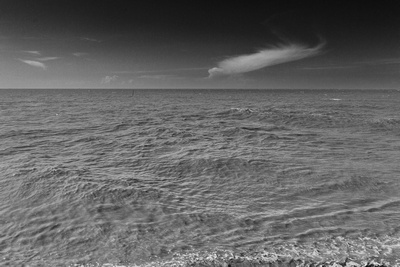
Seascape

Every time I view the sea, I feel a calming sense of security, as if visiting my ancestral home; I embark on a voyage of seeing.

– Hiroshi Sugimoto

In 1980 Sugimoto began working on a series of Seascapes from around the world, he uses different exposure times (sometimes up to three hours) and he composes them with the horizon bisecting the photograph.  Oh, he uses an old-fashioned large format camera to do this, serious stuff!

Sugimoto I’m not, but his reflection on how the view of the sea affects him made me thing of all the times I’ve visited our own Seawall, and even when the tide is high and the waves are rough, there’s a sense of sereneness that permeates me, calms me and makes me forget my worries.  His last phrase there also reminds me of how we often stand (or sit) and face the waters and stare out to sea, as if in a daydream, “on a voyage of seeing”.

I won’t try to mimic his work, but the simplicity of his work made me wonder if I could try a simple seascape, something without the occasional boat or human element, or the rocks along a shore.

This image was taken in the afternoon, and I processed it using Nik Silver Efex, with an orange filter for effect.

Click on the image for a better view in the Gallery, along with others in the Black and White series.

2012 Deck – Week 27

Gone Fishing?

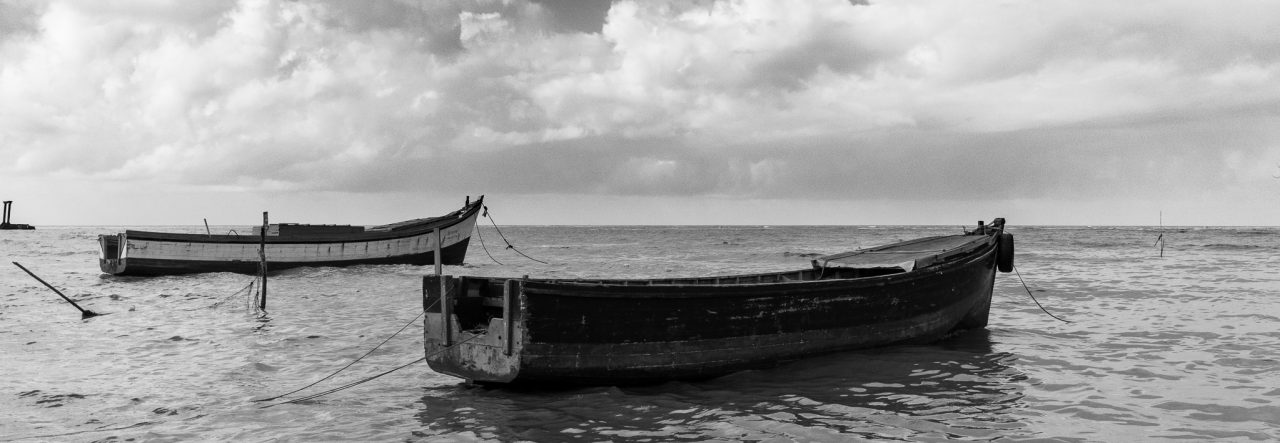
Getting out to take photographs seems harder recently, but living on the coast means that there is always the seawall  🙂  I took a drive up to Enterprise to pick up something and thought I’d just drive up to the wall and see what, if anything, there was to photograph.  There were a couple boats out there, but it didn’t move me, but there were two bicycles left near/on the wall where two boys had left them to go over the seawall.

This posting is somewhat appropriate as I (that is, my family and I) are about to go to a family reunion.  So, while we will be leaving the comforts of our home, the familiarity of other family and friends near to us, we do so knowing that the material things we leave temporarily are being taken care of by people we know, and the people we leave behind have their own family and friends to keep them occupied while we’re away 🙂

2012 Deck – Week 25

For many students in the trimester system, it is now the end of the school year, the end of projects and assignments, the end of homework, the last of the tests and exams until the next academic year begins.

I find it fitting that the image I chose reflects some of this; hands raised in joy as the sun sets on another day.  The end of one thing usually marks the beginning of another, soon we begin the “August” or summer holidays, although those in the semester system have already begun theirs  🙂

Hands Up!

2012 Deck – Week 24

A Drive up the Rupert Craig Highway carries you past the villages of Plaisance and Sparendaam on the East Coast of Demerara.  My dad had once pointed out that what most people referred to as the “Catholic Church in Plaisance” was actually situated in Sparendaam (this would be the Church of St John the Baptist), and I couldn’t help but notice that the Saint Paul’s Anglican Church at Plaisance is also in Sparendaam.

I suppose that quibbling about the name of the location is minor since the street that marks the division of the two villages is the same street that both churches are on.  Now the street, that has name issues of its own…

As with most of the place names in Guyana, they reflect our past colonisations and our change from Colonial rule to Independence, the name Plaisance is of French origin, and Sparendaam comes from the Dutch.  Our last colonial masters were the British, when our country was known as British Guiana, and the two main streets running the length of Plaisance were (and to some extent still are) Queen Victoria Road and Prince William Drive.

During the “Burnham years”, one of the changes (some might call it an attempt to eradicate our history) was to rename streets that held “colonial names” to names that were more meaningful to a country emerging from colonial rule and striving for successful Independence.  In Georgetown one of the more notable changes was the renaming of Murray Street to Quamina Street.  John Murray was the Lieutenant Governor of Demerara from 1813 to 1824, Quamina was a slave involved in one of the largest slave revolts in Demerara during that time (in 1823 actually).

In Plaisance, Queen Victoria Road was renamed to Ben Profitt Drive, and Prince William Street was renamed to Andries Noble Avenue.  Ben Profitt was a notable village chairman of Plaisance, and Andries Noble is touted to be one of the best midwives of Guyana, there’s probably very few people over the age of 35 from Plaisance and Sparendaam whom she didn’t help bring into this world.

Although the name changes were made more than a couple of decades ago, the streets are still referred to by many using the original names, although most people who have grown up in the villages know them by both names,  So St Paul’s Anglican Church is sometimes referred to as being on Queen Victoria Road, and sometimes on Ben Profitt Drive, likewise it is also sometimes referred to as being in Sparendaam, as well as being in Plaisance..

I started this blog post just wanting to say something about St Paul’s Anglican Church other than “Here is a photo of the church with it’s cemetery as seen through a gate in its fence”, one thing led to another and now the post is almost 500 words long.

Without further ado; “Here is a photo of the church with it’s cemetery as seen through a gate in its fence” 🙂

St. Paul’s Anglican Church

Click on the image to see it better in the Gallery, along with other images from this year’s Deck Project.