A Photo’s Worth

Recently, Dwayne Hackett posted a question on Facebook, looking to garner from others what they thought, “What is a picture worth?”, and of course at least one person used the old adage of “a thousand words”.  I am sot certain of Dwayne was trying to get at philosophical or monetary answers  🙂

For more than a century we’ve heard that a picture is worth a thousand words, usually meaning that a complex idea can be expressed in a single image, but what is a photo actually worth?  My answer was “A photo’s worth is weighed differently by each viewer, it depends on how the photo affects them.”  For me this answer works for both the philosophical and monetary.

The most expensive Photograph on record (as of today) is the Rhein II by Andreas Gursky, which sold at auction last year for $4.3 Million, the cheapest may be that passport sized one you recently got for your American Visa Application 🙂  Which one is worth more?  To the Visa applicant, it is certainly the passport sized one, without which they can’t submit the forms, to an artist, the Rhein II certainly surpasses the “mug-shot” 🙂

While the simplicity and boldness of the Rhein II appeals to my artistic senses, a photo that sold for one-seventh of its value appealed to me much more, that would be Ansel Adams’ “Moonrise”, but that is because of how that photo affects me, and so I find more “worth” in that image.

Last year I dealt with this similarly in my post for the 23rd Week of the Deck Project, you can check it there for reference  🙂

I had taken this photo while on a walk with Nikhil and Sharon, hen I had downloaded the images, I had decided that this one was not going to make the cut, and left it aside, but after Dwayne’s question, something sparked an interest in the image.  I had used ISO500, I had shot into the sun, and I had done this dangling the camera downward simply because I was too lazy to get down in the rocks to properly compose the image, so I wasn’t enthusiastic about it  🙂

I didn’t think the resulting image was worth my time and effort to process, but I went back and while it is grainy from the high ISO and from the subsequent processing, I like it.  It may not have the same impact on a Christian as it would on a Hindu, it would not have the same effect on a North American as it would on someone from the Caribbean, each would decide it’s worth, it’s value as a photograph differently.  For many this may be worthless, for me, it was worth saving, worth the time and effort in processing, and if anyone reading this blog-post realizes the worth in their own photos, then this blog-post was worth writing.

2012 Deck – Week 35

In June of this year Imran Khan had done an article on the new insurgence of young (and not so young) Photographers in Guyana in the form of the Facebook Group Guyana Photographers, this was recently re-blogged on the GuyanaPhotographers.com site.  In it he mentioned that the Seawalls seem to be a favourite or default location for their “treks”, this is very true.

With most of the population of Guyana living on the Atlantic coast, this is inevitable; with the majority of (accessible) roads meandering along the coast, this is inevitable; with the majority of the coastland given over to farming (and now housing) leaving the only scenic areas being the seawalls stretching from east to west along the coast, this is inevitable.

I’m not saying that there aren’t more places that would make nice photographs, there are, they are just not as “easy” to get to.  You can read “easy” as being “not too expensive to get to”, “not too arduous to get to”, “not needing to plan a trip weeks in advance” and  ‘not requiring a four wheel drive vehicle with a winch and hi-lift” to get there.  🙂

So, for someone who has a full-time job but would still like to get a nice photograph, as Imran so accurately pointed out, the Seawall becomes the “default” location  🙂

With that said… here’s a pair of Jhandi Flags… on the sea shore, just in front of the Seawall

Click on the image to see it better in the Gallery, along with all the other entries for this year’s Deck Project.

Variety and Diversity

I processed this photo yesterday after having the pixels just sit there for a year, and I wondered at the diversity of materials used in the construction and the “architecture”.  This morning I caught a snippet of Jon Stewart on the Daily Show speaking about the Diversity in the Democratic Party (funny stuff!), and I wondered at the coincidence of my thoughts on a building and his thoughts on a political party.

Growing up in Guyana, I never felt “race” play a part in my life until in my teens, before that it was always that we were different people, individually, not as a “class” or a “race”.  What happened when I was a teenager?  I learnt about politics and the struggles of the main political parties vying for power and each using the “race” card for their own ends regardless of what it did to the youth and the future of the country.

You can build a house entirely out of wood, you can build it entirely out of concrete, you can build it out of any one substance you feel like, it may or may not stand up to the elements (just imagine a real Gingerbread house in the rainforest! And no offence to the Igloos of the arctic and antarctic), but I’ve found that a good architect/contractor can take a variety of materials and produce not just a shelter from the rain, but a thing of beauty to “live” in, just as a good leader can make the best of the talents, varying and diverse, of the people who place their trust in him.

Click on the Image above for a better view in the Gallery, along with other images in the “Out and About” collection.

Water

Sometimes using a “rule” works in your favour.  One of the most harped-upon rules of photography is the Rule of Thirds, I think every beginner in the field knows this one.  Divide the viewfinder in three parts, both vertically and horizontally, then use that to help compose the image, whether putting subjects into the portions or onto the dividing lines.

Nikhil always tells me that we should know the rules, so we’ll know when to break them with greater effect on the resulting image, or in this case use it as literally as possible  🙂

I tried my hand at another seascape, and remembered that sometime back I was told that more than two-thirds of the earth’s surface is covered by water, so I covered two-thirds of my image with the sea-water  🙂

Click on the image for a better view in the Gallery.

“Par” for the course

In October of 2009, I witnessed my second Parhelion, or Sundog, a natural phenomena, it wasn’t anything spectacular as those you see in the more northern or southern regions, but a complete halo around the sun, really large halo.

They are apparently caused by the effect of the sunlight passing through ice-crystals in the air (we’re in the tropics, ice-crystals??).  In the photo above, you can see the relative size compared with the portion of Central Garage’s building sticking out of the corner  🙂

A few nights ago, my friend Savita messaged me asking if I’d seen the moon that evening, on looking, I was amazed to see the same effect with the moon, called a Parselene.

Given my experience with lunar sky photography, I did not expect a great image out of it, so I’d say this one is just about par for the course  🙂

It may be difficult to see, depending on your monitor’s calibration  🙂  With the naked eye, I could actually see the rainbow of colours in the halo, off to the right of the image is the power-line to my house  🙂

As always, click on each image to see them better in the Gallery.

Worth Saving

Some things are worth saving.

A friendship of many years is certainly worth saving, after a while you get to the point where an argument is just an argument, not a reason for “falling out”.

A job is worth saving, especially when there are fewer to find and when you have more to think about than just yourself,

Memories, as in letters and photos, video-clips and newspaper clippings, are worth saving, it is a record of the things we’ve done, things we’ve seen, and it becomes a story to tell our children and grand-children.

In this century (and the end of the last) there’s a great movement to save our forests, certainly worth saving if we intend to continue to breathe.

Endangered species are worth saving, why let a species go extinct because of the actions (or inaction) of another species, especially when we (humans) may be the main cause of their dwindling numbers.

Recently, there’s been a movement (championed by Annette Arjoon-Martins) to save the mangroves that form part of our sea-defence, I certainly don’t want my house washed away because people burn garbage in the mangrove areas, destroying our first line of sea-defence, so that is certainly worth saving.

I think most people may agree with much of what I’ve mentioned, many more will have other things to add to this list, but is a building worth saving?  Is a building that is older than any of us, that has seen more mayors than we have fingers, that is one of the few remaining structures of its kind, that is a reminder of our colonial history worth saving?

Should we let the markers of our heritage, the work of the hands of our ancestors, the beauty of a golden age, fall into disrepair,slowly disappear and be forgotten?

Clink on the photo above to see it in the Gallery, along with other photos from around Georgetown, Guyana.

2012 Deck – Week 33

One of the first things I tell people asking me about getting better at their photography is to get to know their camera, regardless what camera it is, and I tell them that one of the ways to do this is to “read the manual”, you don’t have to understand all of it at one go, just read it  🙂

Each manual has some safety precautions that they list, one of them is “Don’t shoot directly at the sun!”.  My friend Nikhil repeatedly tells me that you have to know the rules and understand them, so that you’ll know when to break them 🙂

I hope this was one of those instances where it worked since I totally ignored that rule about the sun…  and I even liked the lens flare I got in the process.

Click on the image to see it in the Gallery, along with the previous images in the Deck Project for this year.

Rent

Under clouds of gloom, tread lightly in fear,

unknown dangers may lurk quite near

Yet onward walk, for we must see

what lies upon yonder sea

It is our goal, our sole intent

today to capture the coming rent

in clouds that cover, yet soon shall show

upon the sea a hopeful glow

for but a moment shall it be

a fleeting time, then it too shall flee

as the sun continues its descent

we try to capture the fleeting rent.

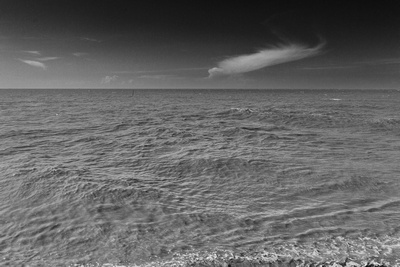
Seascape

Every time I view the sea, I feel a calming sense of security, as if visiting my ancestral home; I embark on a voyage of seeing.

– Hiroshi Sugimoto

In 1980 Sugimoto began working on a series of Seascapes from around the world, he uses different exposure times (sometimes up to three hours) and he composes them with the horizon bisecting the photograph.  Oh, he uses an old-fashioned large format camera to do this, serious stuff!

Sugimoto I’m not, but his reflection on how the view of the sea affects him made me thing of all the times I’ve visited our own Seawall, and even when the tide is high and the waves are rough, there’s a sense of sereneness that permeates me, calms me and makes me forget my worries.  His last phrase there also reminds me of how we often stand (or sit) and face the waters and stare out to sea, as if in a daydream, “on a voyage of seeing”.

I won’t try to mimic his work, but the simplicity of his work made me wonder if I could try a simple seascape, something without the occasional boat or human element, or the rocks along a shore.

This image was taken in the afternoon, and I processed it using Nik Silver Efex, with an orange filter for effect.

Click on the image for a better view in the Gallery, along with others in the Black and White series.

Cinchona View

One of the stops on the mini Jamaican Safari that Cecil Beharry took my cousin Alex and myself on was the Cinchona Gardens.  As captivating as the old Gardens itself was, the first thing, and the last thing, that we looked out upon was the view from the mountainside, down into the St Andrew parish.

Although I can try with every possible photographic tool at my disposal to convey to others the emotion that I felt standing there, I don’t think I can ever truly do it justice.

As we stepped out of the vehicle, we were greeted with a clean, cool mountain air that revived the senses and the spirit, after that long arduous drive, I’m sure that Cecil was the most grateful of us for that.

The view was breath-taking, the clouds and mists had claimed the tops of the mountains leaving just the valley for the viewer.  From the flowers dotting the edge of the road where the steep descent began, the valley spread out and rose and fell to the distant mountain peaks, from our vantage point, the mountain-sides that envelope and nestle the Cinchona Gardens framed the scene beautifully.

This is a view of an Island Paradise… from 5,200 feet up.

This is a Panoramic Photograph from thirteen images (each taken in portrait orientation) stitched together.  Click on the image to see it in the Gallery