2012 Deck – Week 38

Many moons ago, I sometimes took a few minutes to stare up at the stars and the moon, and let my mind wander, I haven’t done that in quite some time.  If you look at a child’s drawing, or an icon that is supposed to represent night, the moon is shaped in the crescent form, probably because the full moon would look like just a circle, and can be interpreted in many ways, but the crescent shape is instantly recognizable as the moon.

In Guyana it is not very common, but I’ve often seen drawings or paintings, and scenes in a movie or show where an old outhouse (the pit latrine) had a Crescent Moon carved on the door.  Many people see it as being decorative, the true significance have been forgotten by many and almost lost to the ages.  Apparently in ancient times the doors of the latrines were marked to identify the gender, the sun or star being for males (after the sun god Helios or similar deity) and the moon for the women (after the goddess of the moon, Celine or Selene, or similar deity).  So far the working theory as to why one with the sun or star symbol has been seen or recorded is that the women took better care of their out-houses 🙂

One night I got a message from Savita asking if I’d seen the moon that night, I hadn’t, and I told her so, she was excited that there was a star right next to the moon in the sky, and she hoped one of us could get a decent photo of it… I tried.

Not sure if you’ll see the star… but it’s there  🙂  Click on the image to see it better in the Gallery, along with a few other images in the Night album

2012 Deck – Week 37

I have a few rules or guidelines that I try to abide by in my photography, and I’m not referring to the Rule of thirds or Rules of composition, I’m referring to ones that will guide me as a photographer and help me to get those photos that I want.

Rule #2:  STOP and take the shot

Many times we regret not stopping, for one reason or another, to take the “shot” that we could see in our mind; we saw it, we thought of how to compose it, maybe even how to process it afterwards, but unless we actually stopped and took the shot, everything else is supposition and a wasted opportunity.

I was driving down the Railway Embankment heading home and saw the colours in the sky developing into what could be a lovely sunset, I saw the clouds low on the horizon and the sun dipping towards them and I knew I had to take a photo of it.

A photo of a sunset, is a photo of a sunset, unless you have something else in the photo that adds interest, then its just a photo of a sunset, and there’s a million of those.  As I was driving down, looking for something to use in the foreground, I remembered the Chimney at Chateau Margot, and quickly diverted towards the main Public Road.  As chance would have it, I ended up behind some slow moving traffic and could not get to the spot as quickly as I’d have liked, but I got there, didn’t try to change lenses, but grabbed what was there and just shot a few exposures to get it.

Although I could have gotten the sky as I saw it earlier, from the road with houses around and utility wires all over the frame, I spent a few precious minutes to get to a spot I felt better about, and I think I can live with that  🙂

Click on the image above for a better view in the Gallery.

2012 Deck – Week 36

Time never stands still.

It only seems like a few moons ago that my daughter was born, yet she’s now nine years old.

For a little while, on the Sunday before school re-opened, I let all else be lost, all worldly matters be forgotten, as I sat among the rocks on the seawall, with family, a snack or two, some drinks and the cool breeze brought by the incoming tide.  I just sat, camera in hand and as my daughter and her cousin played in the water, enjoyed the little slice of time that stood still…

I don’t often do photos of “people”, but I think this year I’ve uploaded more “portrait type shots for the Deck Project than before  🙂

A Photo’s Worth

Recently, Dwayne Hackett posted a question on Facebook, looking to garner from others what they thought, “What is a picture worth?”, and of course at least one person used the old adage of “a thousand words”.  I am sot certain of Dwayne was trying to get at philosophical or monetary answers  🙂

For more than a century we’ve heard that a picture is worth a thousand words, usually meaning that a complex idea can be expressed in a single image, but what is a photo actually worth?  My answer was “A photo’s worth is weighed differently by each viewer, it depends on how the photo affects them.”  For me this answer works for both the philosophical and monetary.

The most expensive Photograph on record (as of today) is the Rhein II by Andreas Gursky, which sold at auction last year for $4.3 Million, the cheapest may be that passport sized one you recently got for your American Visa Application 🙂  Which one is worth more?  To the Visa applicant, it is certainly the passport sized one, without which they can’t submit the forms, to an artist, the Rhein II certainly surpasses the “mug-shot” 🙂

While the simplicity and boldness of the Rhein II appeals to my artistic senses, a photo that sold for one-seventh of its value appealed to me much more, that would be Ansel Adams’ “Moonrise”, but that is because of how that photo affects me, and so I find more “worth” in that image.

Last year I dealt with this similarly in my post for the 23rd Week of the Deck Project, you can check it there for reference  🙂

I had taken this photo while on a walk with Nikhil and Sharon, hen I had downloaded the images, I had decided that this one was not going to make the cut, and left it aside, but after Dwayne’s question, something sparked an interest in the image.  I had used ISO500, I had shot into the sun, and I had done this dangling the camera downward simply because I was too lazy to get down in the rocks to properly compose the image, so I wasn’t enthusiastic about it  🙂

I didn’t think the resulting image was worth my time and effort to process, but I went back and while it is grainy from the high ISO and from the subsequent processing, I like it.  It may not have the same impact on a Christian as it would on a Hindu, it would not have the same effect on a North American as it would on someone from the Caribbean, each would decide it’s worth, it’s value as a photograph differently.  For many this may be worthless, for me, it was worth saving, worth the time and effort in processing, and if anyone reading this blog-post realizes the worth in their own photos, then this blog-post was worth writing.

2012 Deck – Week 35

In June of this year Imran Khan had done an article on the new insurgence of young (and not so young) Photographers in Guyana in the form of the Facebook Group Guyana Photographers, this was recently re-blogged on the GuyanaPhotographers.com site.  In it he mentioned that the Seawalls seem to be a favourite or default location for their “treks”, this is very true.

With most of the population of Guyana living on the Atlantic coast, this is inevitable; with the majority of (accessible) roads meandering along the coast, this is inevitable; with the majority of the coastland given over to farming (and now housing) leaving the only scenic areas being the seawalls stretching from east to west along the coast, this is inevitable.

I’m not saying that there aren’t more places that would make nice photographs, there are, they are just not as “easy” to get to.  You can read “easy” as being “not too expensive to get to”, “not too arduous to get to”, “not needing to plan a trip weeks in advance” and  ‘not requiring a four wheel drive vehicle with a winch and hi-lift” to get there.  🙂

So, for someone who has a full-time job but would still like to get a nice photograph, as Imran so accurately pointed out, the Seawall becomes the “default” location  🙂

With that said… here’s a pair of Jhandi Flags… on the sea shore, just in front of the Seawall

Click on the image to see it better in the Gallery, along with all the other entries for this year’s Deck Project.

Water

Sometimes using a “rule” works in your favour.  One of the most harped-upon rules of photography is the Rule of Thirds, I think every beginner in the field knows this one.  Divide the viewfinder in three parts, both vertically and horizontally, then use that to help compose the image, whether putting subjects into the portions or onto the dividing lines.

Nikhil always tells me that we should know the rules, so we’ll know when to break them with greater effect on the resulting image, or in this case use it as literally as possible  🙂

I tried my hand at another seascape, and remembered that sometime back I was told that more than two-thirds of the earth’s surface is covered by water, so I covered two-thirds of my image with the sea-water  🙂

Click on the image for a better view in the Gallery.

2012 Deck – Week 34

This was one of those weeks where I had not taken a photo at all until I was forced to take something on the last day or abandon the Deck Project.  To be on the safe side, I stopped on the seawall to take a few photos for another “Seascape”, this would have been around the Bel Air / Sophia area.

As things turned out, I took the family out to the seawall near Lusignan, as it was nearing sunset, I took some photos in general, then settled down amidst some rocks and waited for the sun to drop to just the right height.  This was one of the few times that I had “planned” a shot (or rather the general concept of what I was looking for).  I took several at different times in different orientations, but this one was the one that appealed to me the most.

As always, click on the image for a better view in the Gallery.

“Par” for the course

In October of 2009, I witnessed my second Parhelion, or Sundog, a natural phenomena, it wasn’t anything spectacular as those you see in the more northern or southern regions, but a complete halo around the sun, really large halo.

They are apparently caused by the effect of the sunlight passing through ice-crystals in the air (we’re in the tropics, ice-crystals??).  In the photo above, you can see the relative size compared with the portion of Central Garage’s building sticking out of the corner  🙂

A few nights ago, my friend Savita messaged me asking if I’d seen the moon that evening, on looking, I was amazed to see the same effect with the moon, called a Parselene.

Given my experience with lunar sky photography, I did not expect a great image out of it, so I’d say this one is just about par for the course  🙂

It may be difficult to see, depending on your monitor’s calibration  🙂  With the naked eye, I could actually see the rainbow of colours in the halo, off to the right of the image is the power-line to my house  🙂

As always, click on each image to see them better in the Gallery.

2012 Deck – Week 33

One of the first things I tell people asking me about getting better at their photography is to get to know their camera, regardless what camera it is, and I tell them that one of the ways to do this is to “read the manual”, you don’t have to understand all of it at one go, just read it  🙂

Each manual has some safety precautions that they list, one of them is “Don’t shoot directly at the sun!”.  My friend Nikhil repeatedly tells me that you have to know the rules and understand them, so that you’ll know when to break them 🙂

I hope this was one of those instances where it worked since I totally ignored that rule about the sun…  and I even liked the lens flare I got in the process.

Click on the image to see it in the Gallery, along with the previous images in the Deck Project for this year.

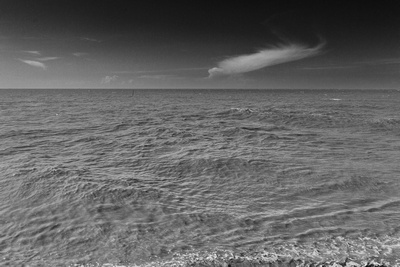
Seascape

Every time I view the sea, I feel a calming sense of security, as if visiting my ancestral home; I embark on a voyage of seeing.

– Hiroshi Sugimoto

In 1980 Sugimoto began working on a series of Seascapes from around the world, he uses different exposure times (sometimes up to three hours) and he composes them with the horizon bisecting the photograph.  Oh, he uses an old-fashioned large format camera to do this, serious stuff!

Sugimoto I’m not, but his reflection on how the view of the sea affects him made me thing of all the times I’ve visited our own Seawall, and even when the tide is high and the waves are rough, there’s a sense of sereneness that permeates me, calms me and makes me forget my worries.  His last phrase there also reminds me of how we often stand (or sit) and face the waters and stare out to sea, as if in a daydream, “on a voyage of seeing”.

I won’t try to mimic his work, but the simplicity of his work made me wonder if I could try a simple seascape, something without the occasional boat or human element, or the rocks along a shore.

This image was taken in the afternoon, and I processed it using Nik Silver Efex, with an orange filter for effect.

Click on the image for a better view in the Gallery, along with others in the Black and White series.