2015 Deck – Week 44

When I took this, the man who looked after the fields was rapidly approaching us… with tools in hand, so I didn’t even try multiple exposures; I knew that by shooting into the sun I’d blow the highlights, but it’s something I could live with, just to get this scene.

That tractor is probably twice my age, and it takes a lickin’ and keeps on tickin’.


Takes a lickin’ |  Mahaica, 2015  |  Canon EOS 60D, SIgma 10-20mm


Click on the image to see it in the Gallery.


2015 Deck – Week 40

My Jhandi addiction continues, I just find them visually appealing.  Of course, getting a shot of them that doesn’t look like ones I’ve already taken is getting more and more difficult.

This one was a toss up between this coloured portrait oriented version and a landscape oriented BW processed one, but the coloured one appeals to me on a different level, even though I tend towards the BW because I had originally intended the landscape ones as such because of the textures and contrast in the water / foam of the sea.

I hope you like it.


Canon 60D, Sigma 10-20mm  |  1/125s @ f/8.0, ISO100 (10mm)


Click on the image to see it in the Gallery

2015 Deck – Week 33

I climbed onto the seawall to see what I could photograph, and a voice coming from near my feet surprised me.  This fellow was packing up some items in a bag.   He thought I was a foreigner, but the minute I answered him he realised I was local.

According to him, he has lived along the seawall for most of his life, he doesn’t have a regular job, he does odd-jobs, but he says he finds everything he needs to survive right there on the seawalls.   Although I’m not sure about him finding “everything”, I saw no reason to doubt he finds most of what he needs 😀


Life on the wall 15-0143  |  Georgetown Seawall, Guyana

Canon EOS 60D, Sigma 10-20mm Lens


Click on the image to see it in the Gallery

2015 Deck – Week 30

One bad thing about Georgetown is that it floods…. as a photographer, I can also say that one good thing about Georgetown is that… it floods!  That sometimes makes for an interesting photo.

I only had my phone on my at this point, so it was a quick snap to get what I was seeing… and even so I had to crop for an interesting photo, which makes it a bit on the low resolution side.


Samsung Galaxy S5 Mini Duos  |  Instagram


Click on the image to see it in the Gallery.

2015 Deck – Week 28

I’m about to mention some things of which I am quite ignorant about, so anyone wishing to clarify, extrapolate, correct or otherwise educate me on it are welcome to do so.

I usually like to say something about the photo I am presenting, so here goes:

On the coast of Guyana, we see large shipping vessels (trawlers) heading out to sea for fishing, some smaller boats do so closer to shore (but often out of sight us of land), we see men (and women) cast-net fishing, we see some fishermen using rods and lines, and there are likely more methods than I know of, but one type was explained briefly to me because of a photo I took in which I was trying to identify the craft/vessel/device being used by the fisherman, this was the pin seine method.

Pin Seines are usually about 6 feet high and vary in width, the seine or fishing net usually carries a mesh size of three and a half inches or less; the seines are usually pinned to vertical stakes/poles, they are set up at high tide in the intertidal zone (between the tide lines/marks).  When the tide ebbs, fish are trapped in the nets and retrieved by fishermen.

One method of retrieval is by using what is locally called a catamarang, not to be confused with the more stylish catamaran.  The catamaran is a double hulled boat, while the only resemblance to the “double” part that I’ve seen on catamarangs has been the two long boards lashed/secured together forming the base of the vessel.  The catamarang basically consists of the wooden base which is about  14 to 18 inches wide by about 7 to 9 feet long (I haven’t measured one as yet), with a central wooden box the width of the base by about 2 feet long and about 12 to 18 inches deep (high).  It is operated by the fisherman kneeling or standing with one leg upon the base and pushing across the mud with the other leg, the central box is used to store the catch.

Seeing them skim across the top of the water/mud is usually impressive to me, probably because I’d be afraid to try it myself.

All that just to show you a photo of a fisherman returning to shore with his catamarang (and a few fish that are unseen) under a dappled sky.


Canon EOS 60D | Sigma 10-20mm  |  1/160s, f/9, ISO100


Click on the image to see it in the Gallery.
2015 Deck – Week 27

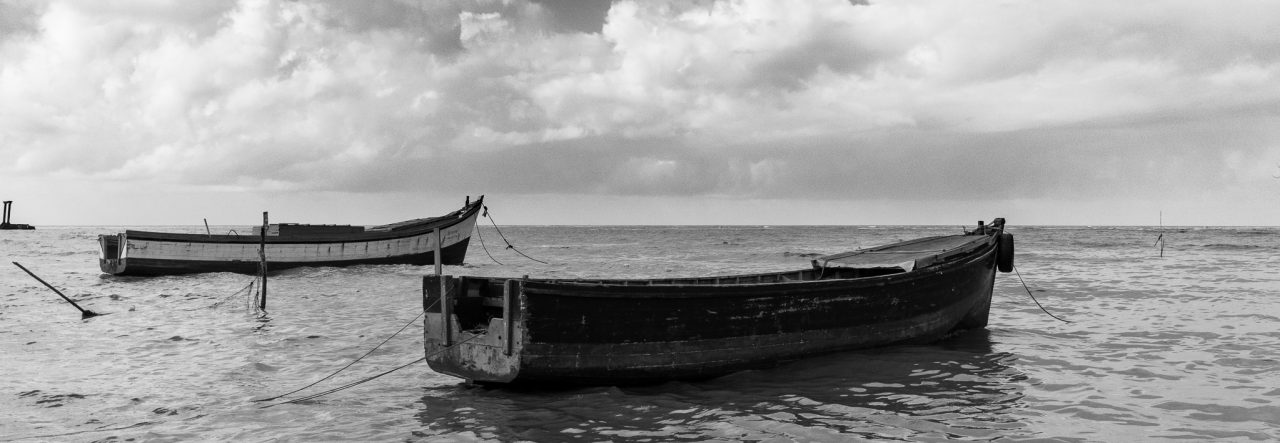
My fascination with the seawalls continues.

Almost every weekend, I stop somewhere along the walls… sometimes never taking a photo, just walk along the wall, or to the water’s edge for a few minutes.

Sometimes I take photos that never see the light of day, but sometimes there’s one that falls just into the type of image that I like taking, processing and sharing.


Canon EOS 60D, Sigma 10-20mm  |  10mm, 1/250s, f/11, ISO 100


Click on the image to see it in the Gallery along with other images from this year’s Deck Project

2015 Deck – Week 25

I don’t generally do portraits, I never am very happy with the outcome when I do try, but at the insistence of my friend Fidal, I went out to do a few informal family portraits for his family.  I had processed the usual ones and given over to him, of course… there are ALWAYS unprocessed images, aren’t there?

This is one that is more along the lines of what I’d normally shoot….  there’s a bit of “street photography” a bit of “landscape” in there, and I got some of the cloud details that I like too.


Canon EOS 6D  |  Canon EF24-105mm f/4L  |  1/250s, f/4, 28mm, ISO 320


Click on the image to see it in the Gallery