At Day’s End

I don’t want to be the one telling you a story in words, I want to be the one telling you a story in a photo, but who’s story is it?

Are you seeing and interpreting the scene in the same way I do?  Does it matter?

The photograph as it was taken tells one story, what that story is may be entirely up to the viewer, after I have processed it, there are some subtle and some not so subtle changes to the finished image (not edited, nothing has been taken out or added), in this manner, I hope to direct the line of thinking in a certain way, whether it works or not is another matter, but in this way I am interpreting the scene my way, and lending to it my feelings; how the viewer sees it is still up to the viewer.

Many people take scenes literally, others concoct long tales based on the elements in the frame,  others may just have an emotional reaction but not know precisely why;  if it affects you, then I am happy.


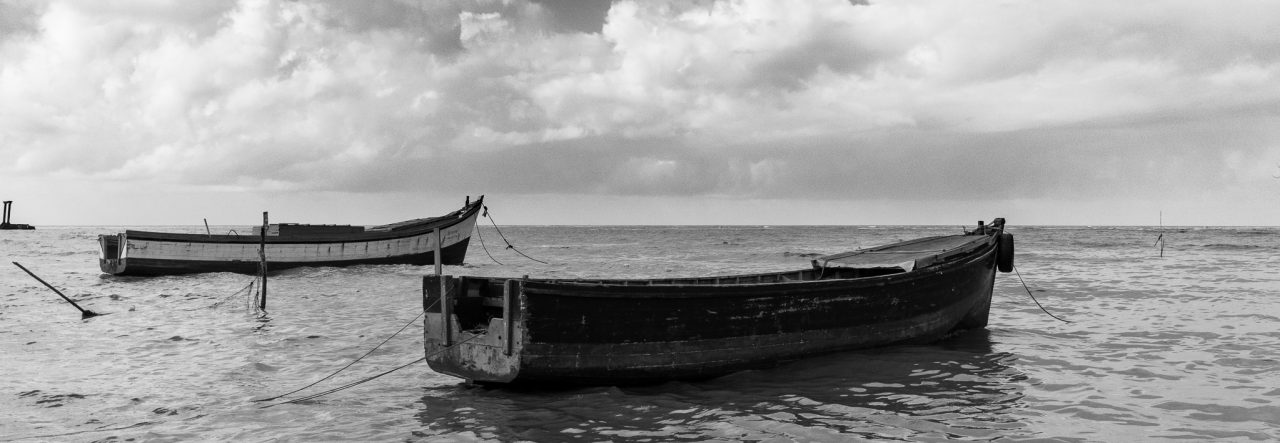
At Day’s End – 14-3289  |  Lusignan, East Coast Demerara  |  2014


Click on the image to see it in the Gallery along with other images in the Black and White Collection.


Discovery

– 1499 –
Imagine that somewhere on the horizon is a line of three Galleons…
okay, fine, Galleons are more impressive looking, but we’ll revert to the truth;
there’s a line of Caravels, three of them, heading from the north-west, somewhere where the clouds disappear into the distance.

If you grew up as I did, you were taught that many of “our” countries were discovered by that fellow Chris, but the leader of that flotilla on the horizon was not Chris, but Alonso.

If you can see the flotilla, imagine now that one of those caravels has separated and is heading our way, in a more south-easterly direction along the coast, the remaining two are heading further west and stopping at the mouth of the Essequibo;  Alonso is now the first European to be recorded as seeing and touching our shores… and in that south-easterly heading caravel is Amerigo, who is on his first voyage (second, if you believe a disputed letter), and it is after this explorer that the joint continents of “America” are named.

As for that fellow Chris, this voyage by Alonso, his pilot Juan and navigator Amerigo quite displeased his followers, which resulted in quite a fracas in Hispaniola 🙂

If you stand on our shores and stare toward the horizon, you will not now see those caravels, but in the wake of those voyagers, using the trade-winds and ocean currents, are many ships; and I wonder, what are those sailors thinking as they look towards land?  Are they thinking of those days of discovery?  Are they thinking of the journey home?  Do they see the stars as did those long-ago conquistadors did?

I was processing this image when thoughts of the actual “discoverers” came to mind, hence the long messy thought process above 🙂


“And both that morning equally lay

In leaves no step had trodden black.”

Robert Frost – The Road not taken

Canon EOS 60D, Sigma 10-20mm  |  Kingston, Georgetown, Guyana


Click on the image to see it in the Gallery


Between 15 and 50

There’s much that could be said, but little that I feel like sharing.

In the meantime, enjoy a photo that has my mind crossing space, time and emotions.   I’ve also included this into the extended Oniabo Collection.

.


Canon EOS 60D  |  Between 15 and 50  |  February 2016


Click on the image to see it in the Gallery

.


The Fourth

Apparently, I took this photograph on the Fourth of July, last year.   I remember taking the photo, but the date doesn’t ring a bell; I only know it was the 4th because the metadata says so.  Metadata is handy, you can tell a lot about an image from the metadata, from the type of camera used, to the focal length, ISO, speed and aperture settings, to a host of other miscellaneous  fields, these days, even the GPS coordinates.  The Canon 60D doesn’t have built-in GPS though, so that wasn’t included.

Across cultures we find that the importance or significance we place upon one thing may not be the same that those who live in another country place up a similar thing.  Take the Fourth for example;  Americans (as in those who live in the United States of America, and not just anyone who lives in the Americas) are very proud of their Independence Day, the 4th of July, it’s a big deal, so much so, that by just saying “the Fourth” anyone in that country knows what you’re referring to.  In Guyana, it used to be the case that our Independence Day passed largely unheralded, with more emphasis being place on Republic Day, or as it is more commonly known here, Mashramani.  That has changed over recent years, but the emphasis is still skewed that way.

I suppose photography is similar, as a parent taking quick photos of their children, the emphasis is centred on the child (most times literally centred in the frame); as a fashion photographer, the subject is the model and the articles being displayed by said model;  as a wedding photographer, the bride better be the main subject or somebody’s not getting paid; I get asked sometimes about my seawall photos, why do I shoot them?, what is it I see that makes me take so many?   I figure I have to be a lousy photographer to be asked what it is in the frame that I’m trying to show.

The subjects of my photos are not always front and centre (hardly ever actually, unless it’s people on Mash Day, or that kind of thing), the subject is often the entire scene; the lines, the textures, the tonal variations, the clash or harmony of nature and man; If a photo doesn’t make an impact on you, just move on; if it made you stop for a second, then it was good, if it made you feel something, anything, whether good or bad, then it was a great photo for me.


Meander – 15-9718  |  Canon EOS 60D, Sigma 10-20mm  |  Georgetown Seawall, Guyana


Click on the image to see it in the Collection, along with others in the Black and White Gallery

.

2015 Deck – Week 46

Oniabo

A different scent
in the air,
sounds of birds,
fishermen toil;
Clouds adrift
upon the horizon,
a distant sun
in heaven’s vault.
The moon upon
the oceans pull,
the fish upon
the tide at play;
Meandering shore,
of rocks and
mangroves,
shore of sand,
mud and life,
Oniabo I hear,
the sea, it calls,
Oniabo I fear,
the sea, it calls!


Oniabo is the name I have given to a currently ongoing Black and White Seascape collection of photographs.  Oniabo is an Arawak word meaning “water”; the selection that I used for a presentation at Moray House Trust can be seen here.

A video of that presentation can be seen alongside other presentations of The Photography Sessions at Moray House Trust at www.ThePhotographySessions.com


Oniabo 15-0380  |  Canon EOS 60D, Sigma 10-20mm


Click on the image to see it in the Gallery along with other images from this year’s Deck Project


2015 Deck – Week 33

I climbed onto the seawall to see what I could photograph, and a voice coming from near my feet surprised me.  This fellow was packing up some items in a bag.   He thought I was a foreigner, but the minute I answered him he realised I was local.

According to him, he has lived along the seawall for most of his life, he doesn’t have a regular job, he does odd-jobs, but he says he finds everything he needs to survive right there on the seawalls.   Although I’m not sure about him finding “everything”, I saw no reason to doubt he finds most of what he needs 😀


Life on the wall 15-0143  |  Georgetown Seawall, Guyana

Canon EOS 60D, Sigma 10-20mm Lens


Click on the image to see it in the Gallery